Law of Large Numbers in Sales: How to Use Averages for Cold Email Campaigns
Cold email feels random when you judge it from a small batch. One week, 100 emails produce six replies. The next week, 100 emails produce none. The law of averages and the law of large numbers help explain why that happens, and how to plan sales activity without overreacting to every short-term swing.
Short answer
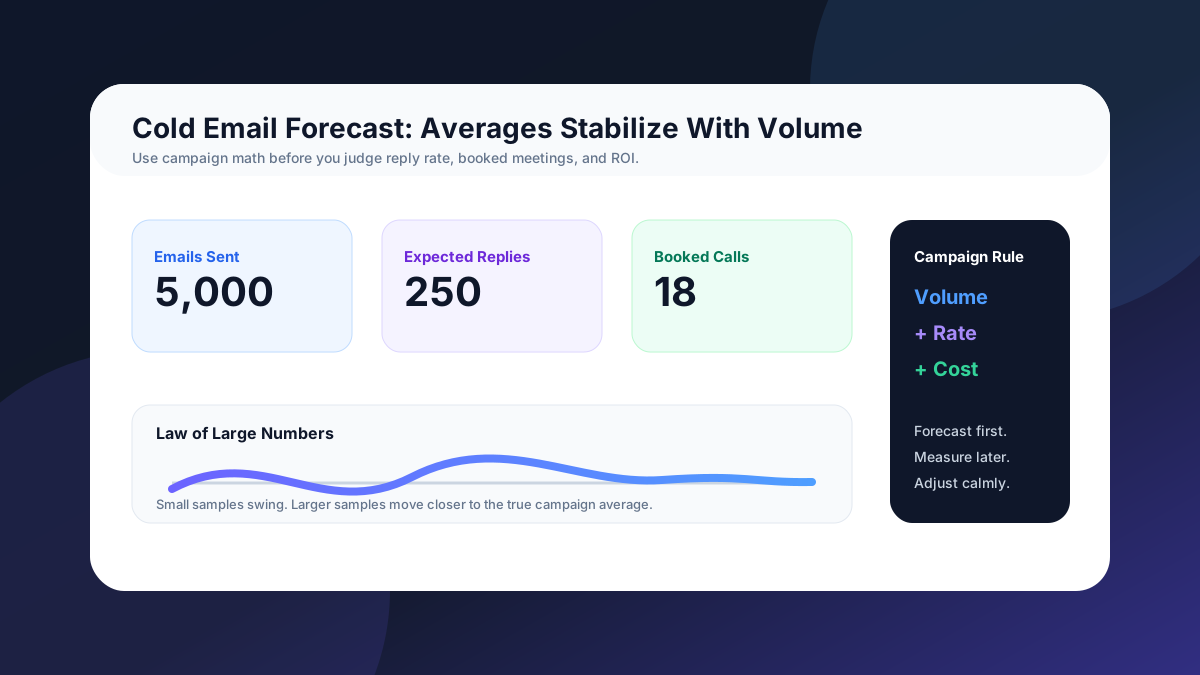
The law of large numbers means cold email results become more predictable as campaign volume increases. A 5% reply rate may not show up cleanly in the first 100 emails, but it is more likely to appear across 1,000, 5,000, or 10,000 delivered emails. Use averages to forecast, but measure the full funnel: delivered emails, replies, positive replies, meetings, clients, revenue, and cost.
Averages do not save weak targeting, poor deliverability, or a bad offer. They only become useful after the campaign inputs are clean enough to deserve scale.
What the law of averages means in sales
Sales teams often say, "If we make enough attempts, the numbers will average out." That phrase is useful, but it is usually imprecise. In cold email, the idea is simple: if your list, delivery, offer, and message quality stay reasonably consistent, your outcomes should move toward a repeatable average as you create more observations.
For example, if a campaign truly has a 5% reply rate from delivered emails, you might expect roughly 50 replies from 1,000 delivered emails. But that does not mean every block of 100 emails will produce exactly five replies. One block might produce one reply. Another might produce nine. The average becomes more useful when you stop judging tiny samples as if they are complete campaigns.
This is where the law of large numbers matters. It says that as the number of independent observations grows, the sample average tends to get closer to the expected average. In practical sales language: small batches are noisy, larger campaigns are easier to evaluate, and one bad day should not automatically rewrite your strategy.
Why small cold email samples are misleading
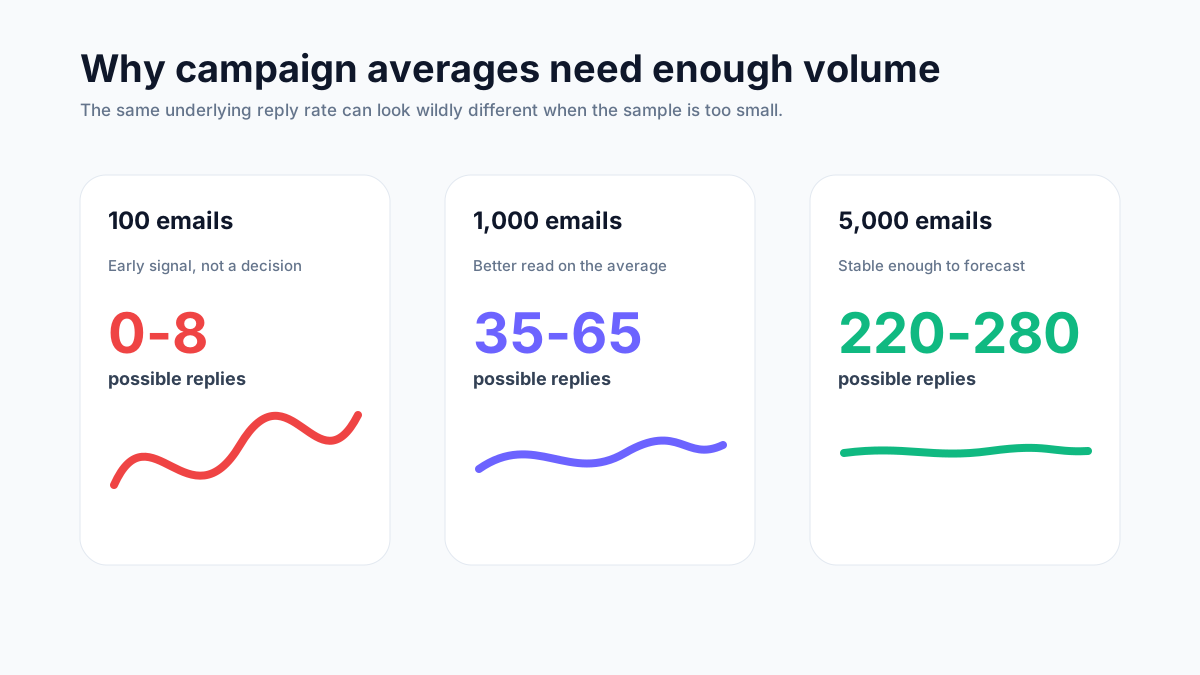
A cold email campaign with 100 delivered emails is rarely enough to judge reply rate, positive reply rate, or meeting rate. If the expected reply rate is 5%, the expected number of replies is only five. A difference of two or three replies changes the reported percentage dramatically. Three replies looks like 3%. Eight replies looks like 8%. Neither result proves much by itself.
That is why early campaign reporting can create bad decisions. A founder sends 150 emails, gets one reply, and assumes cold email does not work. An agency sends 200 emails, gets 18 replies, and assumes the campaign is a breakthrough. Both reactions may be premature. The sample is too small, and the variance is too high.
The better move is to separate early quality checks from performance conclusions. In the first few hundred emails, inspect deliverability, bounce rate, personalization quality, audience fit, and obvious copy problems. Do not declare the final reply-rate average yet. Once the campaign reaches a larger delivered sample, the reported average becomes more useful.
Cold email averages should be measured across the whole funnel
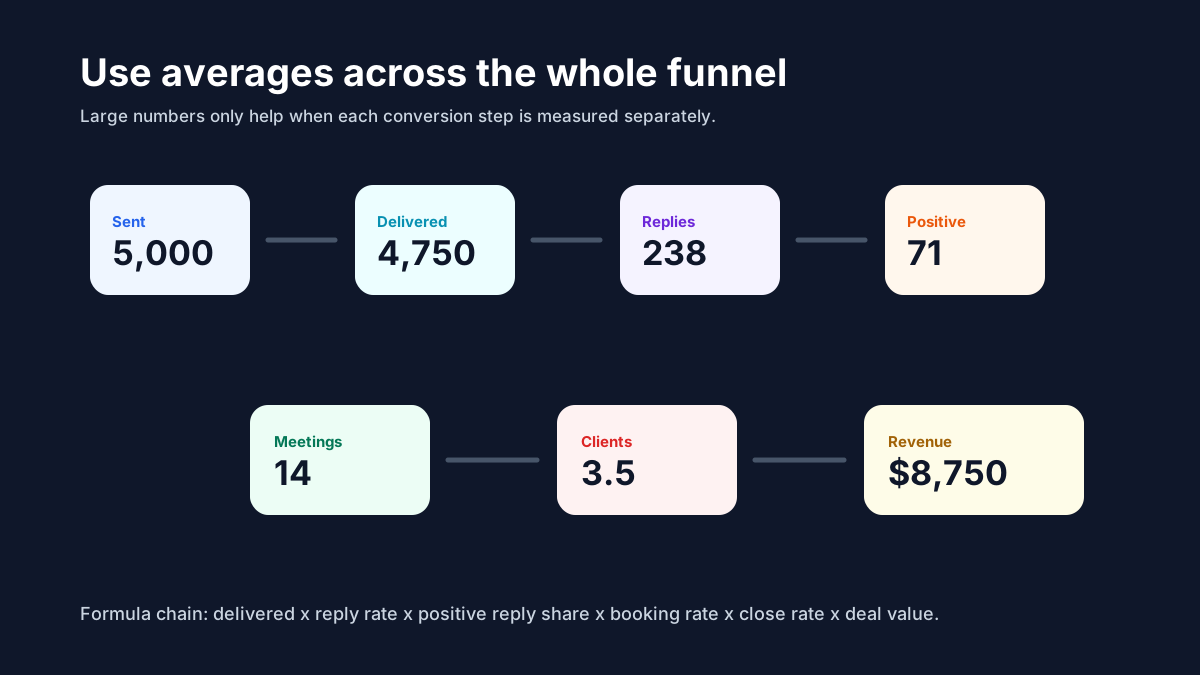
The biggest mistake is treating reply rate as the only average that matters. Cold email is a chain of averages. Sent emails become delivered emails. Delivered emails become replies. Replies become positive replies. Positive replies become meetings. Meetings become clients. Clients become revenue.
If you only measure total reply rate, you can scale the wrong campaign. A broad message might generate many polite rejections and unsubscribe requests. A more focused message might generate fewer total replies but more sales conversations. The first campaign looks better at the top of the funnel. The second campaign may produce better ROI.
For sales planning, track each average separately:
- Delivery rate: the share of sent emails that reach the mailbox.
- Reply rate: replies divided by delivered emails.
- Positive reply rate: sales-relevant replies divided by delivered emails.
- Meeting booking rate: booked meetings divided by positive replies.
- Close rate: new customers divided by meetings.
- Average deal value: expected revenue per closed customer.
When you use the law of averages this way, it becomes a forecasting tool instead of a motivational slogan.
Example: applying large-number thinking to a campaign
Imagine a campaign where you plan to send 5,000 cold emails. Your assumptions are reasonable but not guaranteed: 95% delivery, 5% reply rate from delivered emails, 30% of replies are positive, 25% of positive replies book a meeting, 25% of meetings close, and each client is worth $2,500.
The math works like this:
| Step | Formula | Forecast |
|---|---|---|
| Delivered emails | 5,000 x 95% | 4,750 |
| Replies | 4,750 x 5% | 238 |
| Positive replies | 238 x 30% | 71 |
| Meetings | 71 x 25% | 18 |
| Clients | 18 x 25% | 4.5 |
| Revenue | 4.5 x $2,500 | $11,250 |
This forecast is not a promise. It is a planning model. The campaign might close three clients or six clients. But the larger sample gives you enough volume to compare expected outcomes against campaign cost, team capacity, and revenue targets. That is the real value.
How much volume is enough?
There is no universal sample size that makes every cold email campaign predictable. A campaign targeting enterprise CFOs will behave differently from a campaign targeting local service businesses. Still, you can use a practical rule: the rarer the outcome, the more volume you need before the average stabilizes.
Reply rate may show a directional pattern after several hundred delivered emails. Positive reply rate usually needs more volume. Booked meetings need more than positive replies. Closed customers need the most patience because they sit at the bottom of the funnel and are affected by sales process, pricing, timing, and deal size.
For most campaigns, judge in layers:
- 100-300 delivered emails: check technical quality, bounces, obvious targeting misses, and whether the message is coherent.
- 500-1,000 delivered emails: look for a directional reply-rate and positive-reply signal.
- 2,000-5,000 delivered emails: evaluate campaign-level averages, meeting economics, and cost per opportunity.
- Multiple campaigns: compare segments, offers, industries, and sales motions.
The goal is not to send more for the sake of sending more. The goal is to avoid pretending that a tiny sample has more certainty than it really does.
Where people misuse the law of averages
The law of averages is often used as an excuse to keep pushing a bad campaign. That is dangerous. If your list is poorly targeted, your domains are not ready, your message is vague, or your offer has no clear buyer pain, larger volume will not magically create good economics. It will only reveal the weak average more clearly.
Before scaling, ask whether the inputs are consistent. Are you sending to the same type of buyer? Is the offer the same? Are inboxes healthy? Are bounces under control? Are follow-ups being sent on a consistent cadence? Are positive replies being handled quickly? If the inputs are unstable, the average is harder to interpret.
Another misuse is combining unrelated segments into one average. A 5% reply rate across a blended list may hide the fact that SaaS founders replied at 8%, local contractors replied at 2%, and agencies replied at 4%. Large numbers are most useful when the audience is coherent enough for the average to mean something.
How to use this in your sales plan
Start with the revenue target and work backward. If you need four new customers and your close rate from booked meetings is 25%, you need about 16 meetings. If 25% of positive replies book a meeting, you need about 64 positive replies. If 30% of replies are positive, you need around 213 total replies. If your reply rate is 5%, you need about 4,260 delivered emails.
That is the practical version of large-number sales planning. You are not guessing how many emails to send. You are using conversion averages to estimate the activity required to reach the outcome. Then you can ask better questions: Can our sending infrastructure support that volume? Do we have enough high-quality prospects? Is the expected revenue worth the cost? Can the sales team handle the replies?
You can model this manually, but it is faster to use the ColdMailCalculator or the ColdMail API. Enter your campaign assumptions, compare conservative and optimistic scenarios, and look at cost per meeting before you commit the budget.
A simple operating rule for cold email teams
Use a fixed review window so the team does not debate the campaign every morning. For example, agree that the first 250 delivered emails are a quality-control window, the first 1,000 delivered emails are an early signal window, and the first 3,000 to 5,000 delivered emails are the real campaign review window. That gives everyone a shared standard before emotions enter the conversation.
Inside each window, decide what you are allowed to change. During quality control, fix broken links, bounced lists, obvious personalization errors, and technical delivery problems. During the early signal window, improve subject lines, first lines, or audience filters if the replies are clearly off. During the campaign review window, compare actual averages against the forecast and decide whether to scale, pause, or test a new segment.
This operating rule protects the campaign from two common mistakes: quitting before the sample is meaningful, and scaling before the funnel quality is proven.
Use averages, but keep improving the system
The law of large numbers gives you patience. It does not give you permission to ignore feedback. As volume increases, watch which parts of the funnel underperform. Low delivery means list quality or infrastructure needs work. Low reply rate means targeting, subject line, or copy may need work. Low positive reply rate means the offer may be too broad. Low meeting booking rate means the reply handling and follow-up process need attention.
A good cold email team uses averages to stay calm and experiments to get better. They do not panic after 100 emails, and they do not blindly scale a campaign after a lucky week. They forecast, send enough volume to read the signal, compare the result to the model, and adjust the next campaign.
Final takeaway
Cold email is a probability game, but it is not pure luck. The law of averages and the law of large numbers help you understand why small samples swing and why larger campaigns are easier to forecast. If your inputs are clean, your audience is consistent, and your funnel metrics are tracked separately, you can use average-based planning to estimate replies, meetings, clients, revenue, and ROI before you send.
Do the math first. Then send with enough volume to learn something real.
Plan the campaign math before you send
Use the free calculator to model reply rate, booked calls, clients, revenue, profit, and ROI. If you are building campaign planning into your own product, use the ColdMail API.