Cold Email ROI Calculator for Agencies
Forecast meetings, clients, revenue, profit, and ROI before launching or scaling a cold email campaign.
Cold email agencies need more than reply-rate guesses. Before you sell a campaign, launch for a client, or increase sending volume, you need to know whether the numbers can actually work.
This Cold Email ROI Calculator for Agencies helps you estimate how many replies, positive replies, booked meetings, clients, revenue, profit, and ROI a campaign may produce based on your send volume, conversion rates, deal value, and campaign cost.
The goal is not to promise results. The goal is to pressure-test the campaign before time and budget are spent.
Best Answer: How Do You Calculate Cold Email ROI for an Agency?
Cold email ROI compares the estimated profit from a campaign against the total cost of running that campaign.
Formula:
ROI = Profit ÷ Campaign Cost × 100
Where:
Profit = Estimated Revenue − Campaign Cost
For example, if a campaign costs $2,500 and is forecasted to generate $9,720 in revenue:
$9,720 − $2,500 = $7,220 profit
Then:
$7,220 ÷ $2,500 × 100 = 289% ROI
That means the campaign is estimated to return about 2.89 times the campaign cost as profit.
This is only a forecast. Actual results depend on targeting, deliverability, offer quality, copy, follow-up, sales process, close rate, and deal value.
Why Agencies Need a Cold Email ROI Calculator
A cold email agency can make a campaign look strong by reporting surface-level metrics:
- Emails sent
- Open rate
- Reply rate
- Positive replies
- Booked meetings
Those numbers matter, but they do not tell the full story.
A campaign can have a decent reply rate and still be unprofitable if:
- The replies are not qualified
- The meetings do not show
- The offer is unclear
- The client cannot close deals
- The campaign cost is too high
- The average customer value is too low
That is why agencies should forecast the full funnel, not just the top of the funnel.
A better agency forecast connects:
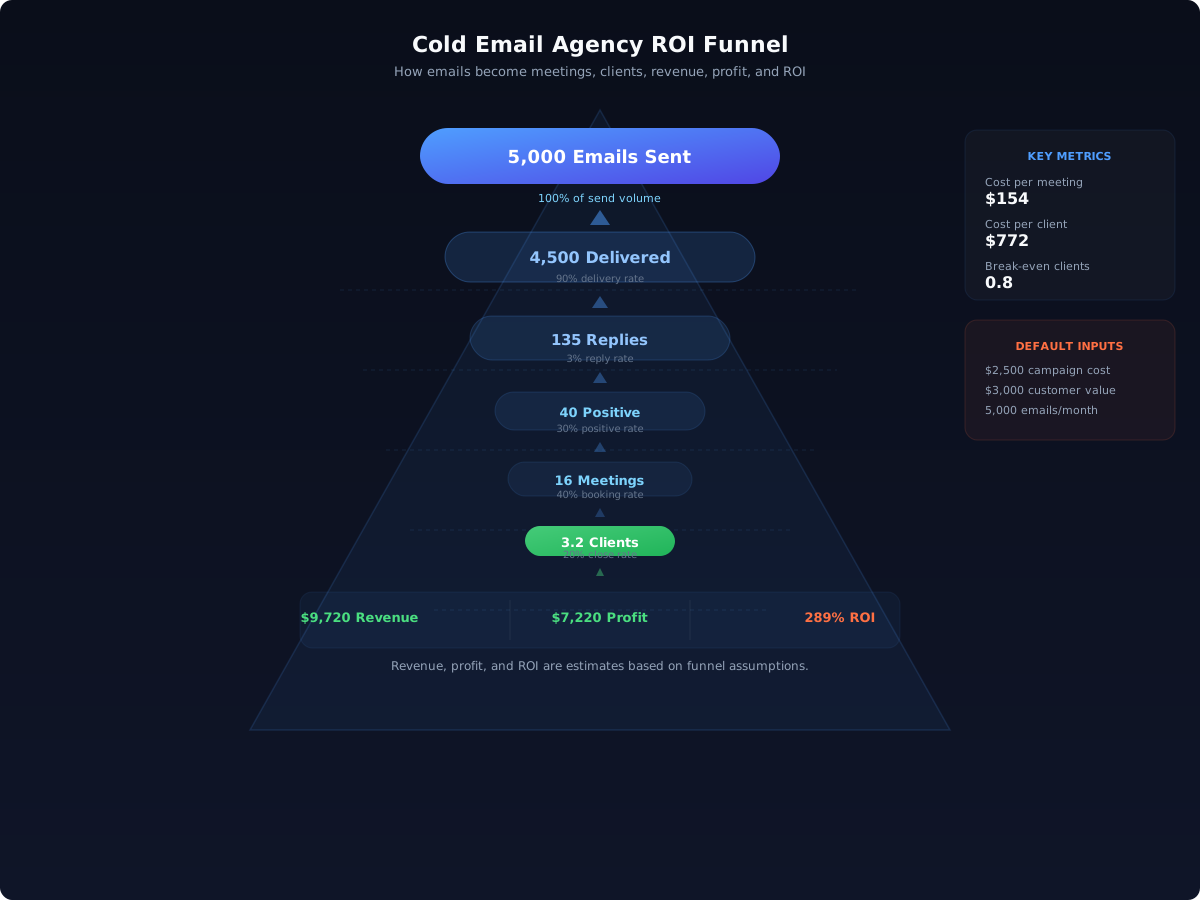
Emails sent → Delivered emails → Replies → Positive replies → Booked meetings → Clients → Revenue → Profit → ROI
This gives both the agency and the client a clearer picture of what needs to happen for the campaign to make sense.
How the Agency ROI Calculator Works
The calculator follows a simple cold email funnel.
You enter:
- Monthly emails sent
- Delivery rate
- Reply rate
- Positive reply rate
- Meeting booking rate
- Close rate
- Average customer value
- Campaign cost
Then the calculator estimates:
- Delivered emails
- Replies
- Positive replies
- Booked meetings
- New clients
- Revenue
- Profit
- ROI
- Break-even clients
- Cost per meeting
- Cost per client
Here is the basic flow:
1. Emails sent. This is the total number of cold emails planned for the campaign. Example: 5,000 emails sent.
2. Delivered emails. Not every email reaches the inbox. Formula: Delivered Emails = Emails Sent × Delivery Rate. Example: 5,000 × 90% = 4,500 delivered.
3. Replies. Reply rate estimates how many delivered emails generate a response. Formula: Replies = Delivered Emails × Reply Rate. Example: 4,500 × 3% = 135 replies.
4. Positive replies. Not every reply is useful. Formula: Positive Replies = Replies × Positive Reply Rate. Example: 135 × 30% = 40.5 positive replies.
5. Booked meetings. Formula: Booked Meetings = Positive Replies × Meeting Booking Rate. Example: 40.5 × 40% = 16.2 booked meetings.
6. New clients. Formula: New Clients = Booked Meetings × Close Rate. Example: 16.2 × 20% = 3.24 new clients.
7. Revenue. Formula: Revenue = New Clients × Average Customer Value. Example: 3.24 × $3,000 = $9,720 revenue.
8. Profit. Formula: Profit = Revenue − Campaign Cost. Example: $9,720 − $2,500 = $7,220 profit.
9. ROI. Formula: ROI = Profit ÷ Campaign Cost × 100. Example: $7,220 ÷ $2,500 × 100 = 289% ROI.
Campaign inputs
Results
Default Example: Agency Cold Email Campaign Forecast
Using the calculator default assumptions:
- Monthly emails sent: 5,000
- Delivery rate: 90%
- Reply rate: 3%
- Positive reply rate: 30%
- Meeting booking rate: 40%
- Close rate: 20%
- Average customer value: $3,000
- Campaign cost: $2,500
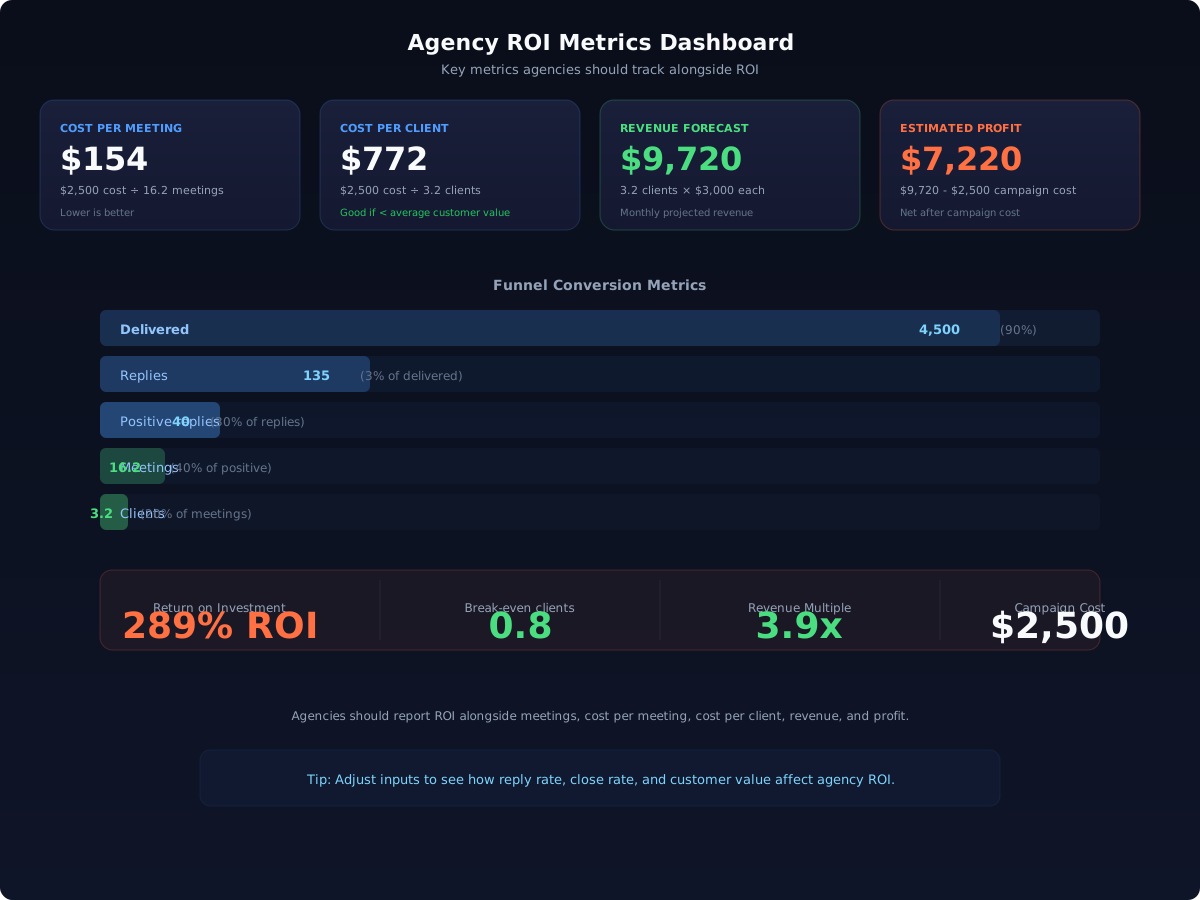
The forecast shows:
- Delivered emails: 4,500
- Replies: 135
- Positive replies: 40.5
- Booked meetings: 16.2
- New clients: 3.2
- Revenue forecast: $9,720
- Estimated profit: $7,220
- ROI: 289%
- Cost per meeting: $154
- Cost per client: $772
This example shows why reply rate alone is not enough. A 3% reply rate may sound normal, but the business result depends on what happens after the reply. If positive replies, booking rate, close rate, or deal value drop, ROI can change quickly.
What Campaign Cost Should Include
For agency ROI forecasting, campaign cost should include the full cost of running the campaign.
Do not include only the agency fee if the client also pays for tools, data, inboxes, or internal sales time.
A more complete campaign cost may include:
- Agency retainer or management fee
- Lead list or data cost
- Email verification cost
- Sending platform cost
- Domains and inboxes
- Deliverability tools
- Copywriting or strategy work
- Sales team follow-up time
- CRM or reporting tools
- Setup fees if you want first-month ROI
For example, if an agency charges $2,000 per month, but the client also spends $300 on data, $100 on inboxes, and $100 on verification, the real campaign cost is not $2,000. It is $2,500. That higher cost changes profit, ROI, cost per meeting, cost per client, and break-even point. A campaign may still be profitable, but the calculator should reflect the true economics.
Cost Per Meeting
Cost per meeting is one of the most useful agency metrics because it connects outreach spend to sales opportunities.
Formula: Cost Per Meeting = Campaign Cost ÷ Booked Meetings
Example: $2,500 ÷ 16.2 = $154 per booked meeting
This helps answer: How much are we paying to create one sales conversation? Can the client afford that meeting cost? Does the meeting quality justify the spend? Would scaling increase or reduce cost per meeting?
A lower cost per meeting is usually better, but only if meeting quality stays high. Cheap meetings with poor-fit prospects can still waste time and hurt ROI.
Cost Per Client
Cost per client shows how much the campaign costs to acquire one customer.
Formula: Cost Per Client = Campaign Cost ÷ New Clients
Example: $2,500 ÷ 3.24 = $772 per client
This is where campaign economics become easier to judge. If the average customer is worth $3,000 and the campaign costs $772 per client, there may be room for profit. If the average customer is worth $1,000 and the campaign costs $772 per client, the margin may be too thin unless there is repeat revenue or upsell potential.
Agencies should always compare cost per client against: average customer value, gross margin, client lifetime value, sales cycle length, and fulfillment capacity.
When Is a Cold Email Agency Campaign Profitable?
A cold email campaign is profitable when estimated revenue is greater than the total campaign cost. Simple formula: Revenue > Campaign Cost.
But agencies should go deeper. A campaign may look profitable on paper and still be risky if: the close rate is unrealistic, the average customer value is inflated, the sales cycle is long, the client has poor follow-up, meetings are low quality, or the campaign depends on one optimistic assumption.
For example: If the forecast needs a 40% close rate to work, the campaign may be risky. If it works at a 10–20% close rate, the campaign may be more realistic. If one new client pays for the entire campaign, the risk may be acceptable. If four or five clients are needed just to break even, the offer may need improvement. That is why scenario planning matters.
Conservative, Base, and Strong Campaign Scenarios
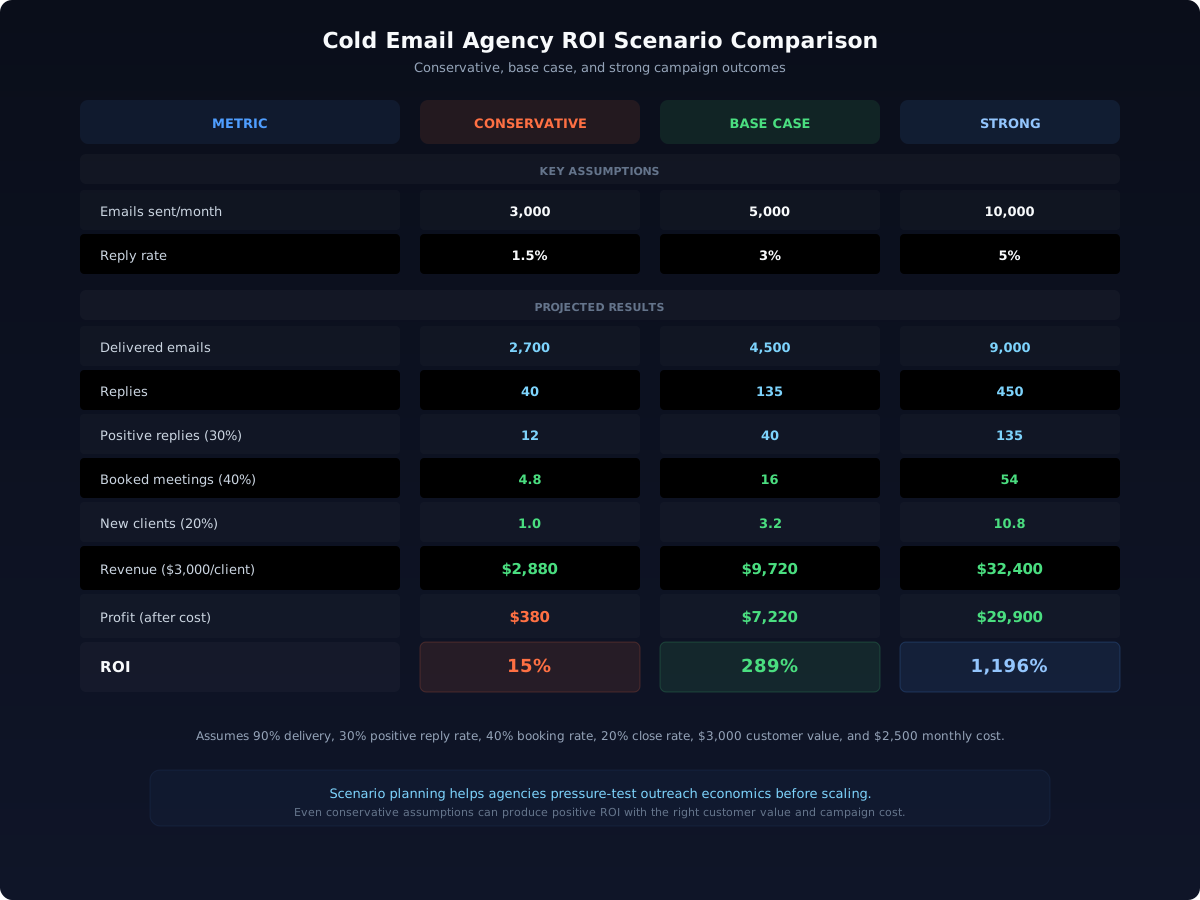
Agencies should avoid building proposals around only one optimistic forecast. A better approach is to model three scenarios:
Conservative scenario: Lower reply rate, lower positive reply rate, lower booking rate, lower close rate. Used to understand downside risk.
Base-case scenario: Realistic assumptions based on past performance. Used for planning and proposals. Should not depend on perfect execution.
Strong campaign scenario: Higher conversion rates, better offer-market fit, stronger sales follow-up. Used to understand upside potential.
Example:
- Conservative campaign: 8 meetings, 1 client, $3,000 revenue, 20% ROI
- Base case campaign: 16 meetings, 3 clients, $9,720 revenue, 289% ROI
- Strong campaign: 28 meetings, 5 clients, $15,000 revenue, 500% ROI
These numbers are not guarantees. They are planning scenarios. The point is to understand how sensitive ROI is to each part of the funnel.
Reply Rate Is Not the Same as ROI
Reply rate is useful, but it can be misleading. A campaign can have high reply rate, low positive reply rate, few booked meetings, poor close rate, and weak ROI. That often happens when the copy gets attention but attracts the wrong people.
For example, a campaign might generate many replies because the subject line is interesting or the message is broad. But if those replies are not from qualified buyers, the campaign may not create revenue.
Agencies should separate: all replies, positive replies, qualified replies, booked meetings, and closed customers. This makes reporting more honest and more useful. A 5% reply rate with poor-fit replies may be worse than a 2% reply rate with qualified buyers who book meetings.
What Is a Good ROI for a Cold Email Agency Campaign?
There is no universal good ROI because every business has different economics. A good ROI depends on: average deal size, gross margin, close rate, sales cycle, retention, customer lifetime value, campaign cost, internal sales cost, and opportunity cost.
For a low-ticket offer, the campaign may need a very low cost per client to be worth it. For a high-ticket B2B service, a single client may pay for the entire campaign.
Example: If one client is worth $10,000, a $2,500 campaign may only need one closed deal to work. If one client is worth $500, the same campaign needs many more customers to break even.
Agencies should not promise a universal ROI. Instead, they should model the campaign based on the client real numbers.
How Agencies Can Use This Calculator in Sales Calls
This calculator can help agencies sell more transparently. Instead of saying "We can get you more leads," say: "Let model the campaign. If we send 5,000 emails, get a 3% reply rate, convert 30% of replies into positive replies, book 40% of those into meetings, and close 20%, the campaign estimates about 3 clients and a 289% ROI before considering fulfillment capacity."
That is more specific, more credible, and easier to discuss.
You can use the calculator to: qualify prospects before selling them a campaign, show clients what assumptions need to be true, compare conservative and optimistic forecasts, explain why deal value matters, estimate cost per meeting and cost per client, show why follow-up and sales process affect ROI, and prevent unrealistic expectations.
The calculator can also reveal when a campaign does not make sense. That is a good thing. It is better to know before launching.
How Agencies Can Use This Calculator for Client Reporting
Agencies can also use ROI forecasting after a campaign starts. A simple monthly report might include: emails sent, delivered emails, replies, positive replies, booked meetings, closed clients, campaign cost, revenue generated, estimated profit, ROI, cost per meeting, and cost per client.
This helps shift the conversation from vanity metrics to business outcomes. Instead of only reporting "We sent 5,000 emails and got 135 replies," you can report: "The campaign created 16 booked meetings at an estimated cost of $154 per meeting. Based on 3.2 expected clients at $3,000 average customer value, the forecasted revenue is $9,720 against a $2,500 campaign cost." That is a better conversation.
Common Mistakes Agencies Make When Forecasting ROI
- Counting every reply as a lead. Not every reply is a lead. Use positive replies or qualified leads for better forecasting.
- Ignoring campaign costs. If you only count the agency fee and ignore data, inboxes, tools, and setup, ROI may look better than it really is.
- Using unrealistic close rates. A client may believe they close 50% of meetings, but their actual close rate may be much lower. Use realistic assumptions.
- Forgetting sales capacity. If a campaign books 30 meetings but the client can only handle 10, the forecast is not useful.
- Treating estimates as guarantees. ROI forecasts are planning tools, not guaranteed outcomes.
- Optimizing for reply rate only. A high reply rate does not matter if the replies are not qualified.
- Not testing scenarios. One forecast is not enough. Agencies should compare conservative, base, and strong cases.
How to Improve Cold Email ROI
To improve ROI, improve the quality of the funnel, not just the volume. You can improve ROI by: targeting better-fit prospects, cleaning and verifying lead lists, improving deliverability, writing clearer offers, personalizing where it matters, testing stronger calls to action, separating positive replies from all replies, improving follow-up sequences, reducing campaign waste, improving calendar booking flow, improving sales follow-up, improving close rate, and selling higher-value offers.
Sometimes the best way to improve ROI is not sending more emails. It is improving who you email, what you say, and what happens after someone replies.
When to Scale a Cold Email Campaign
Do not scale just because a campaign gets replies. Scale when the full funnel works.
Before increasing volume, check: Are replies from the right people? Are positive replies increasing? Are meetings actually booking? Are meetings showing up? Is the client closing deals? Is cost per meeting acceptable? Is cost per client profitable? Can the client handle more calls? Does deliverability remain healthy?
If the campaign is profitable at a small volume, scaling may make sense. If the campaign is unprofitable at a small volume, scaling usually makes the problem bigger.
Agency ROI Calculator FAQ
How do you calculate cold email ROI for agencies?
Calculate estimated revenue, subtract campaign cost to get profit, then divide profit by campaign cost and multiply by 100. Formula: ROI = (Revenue − Campaign Cost) ÷ Campaign Cost × 100.
What should campaign cost include?
Campaign cost should include the agency fee, lead data, verification, inboxes, domains, sending tools, deliverability tools, setup work, and any internal sales costs you want reflected in the model.
Is reply rate enough to judge a cold email campaign?
No. Reply rate is only one part of the funnel. Agencies should also track positive replies, booked meetings, close rate, cost per meeting, cost per client, revenue, profit, and ROI.
What is a good cost per meeting for cold email?
It depends on deal value, close rate, and gross margin. A $300 meeting may be acceptable for a high-ticket B2B offer but too expensive for a low-ticket product.
What is a good cold email ROI?
There is no universal number. A good ROI depends on campaign cost, deal size, margin, close rate, and sales cycle. The calculator helps compare expected profit against campaign cost.
Should agencies show ROI forecasts in proposals?
Yes, but forecasts should be framed as estimates, not guarantees. They are useful for explaining assumptions, risk, and break-even points.
Why does cost per client matter?
Cost per client shows how much the campaign costs to acquire one paying customer. It is one of the clearest ways to judge whether the campaign economics make sense.
Can this calculator guarantee campaign results?
No. ColdMailCalculator provides estimates for planning. Actual results depend on targeting, deliverability, offer quality, copy, follow-up, sales process, and market conditions.
Final Checklist Before Launching an Agency Cold Email Campaign
Before launching or scaling a campaign, confirm:
- The target audience is specific
- The offer is clear
- The lead list is clean
- Deliverability basics are in place
- Campaign cost includes all major expenses
- Reply rate assumptions are realistic
- Positive reply assumptions are realistic
- Meeting booking rate is realistic
- Close rate is based on real sales performance
- Average customer value is accurate
- Cost per meeting is acceptable
- Cost per client is profitable
- ROI works in conservative and base-case scenarios
- The client can handle the expected meeting volume
- Everyone understands the forecast is an estimate
Use This Forecast in Agency Proposals
Cold email agencies can use this calculator before sending a proposal, launching a campaign, or scaling volume for a client.
Instead of only saying "we can get more leads," show the campaign math:
- Expected replies
- Positive replies
- Booked meetings
- New clients
- Revenue forecast
- Campaign cost
- Estimated profit
- ROI
- Cost per meeting
- Cost per client
Example: 5,000 emails, 16 booked meetings, 3 clients, $9,720 forecasted revenue, and $154 cost per meeting.
Estimate Agency Cold Email ROI Before You Scale
Cold email can be profitable, but only when the funnel economics make sense. Use the calculator to forecast replies, positive replies, booked meetings, clients, revenue, profit, ROI, cost per meeting, and cost per client before increasing campaign volume.
A good agency campaign is not just about sending more emails. It is about sending the right emails, to the right people, with a clear offer, then turning qualified conversations into profitable customers.
Run the agency ROI calculator