Cold Emailing for a Job: How to Reach Hiring Managers and Get Replies
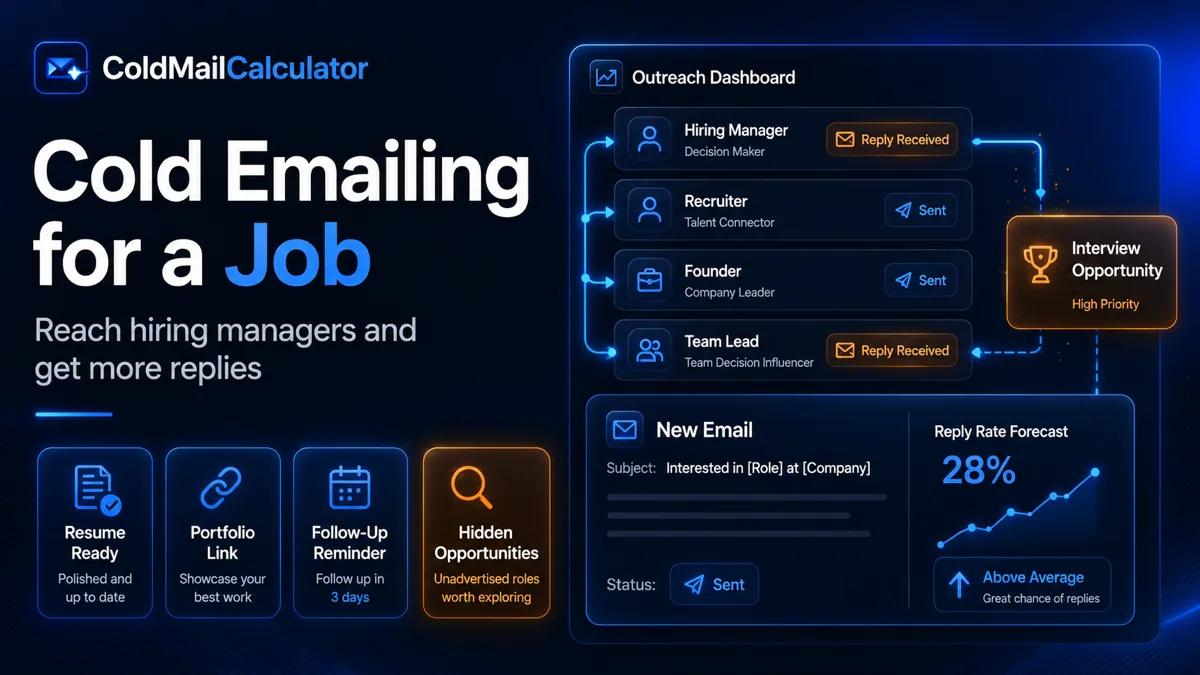
Cold emailing for a job means reaching out to a hiring manager, recruiter, founder, team lead, or employee you do not personally know to start a career conversation. Done right, it can help you find hidden opportunities. Done poorly, it gets ignored or makes you look careless.
Best Answer: Is It Okay to Cold Email for a Job?
Yes, it is okay to cold email for a job when your message is relevant, respectful, honest, and easy to answer. The best cold emails do not beg for a job. They introduce who you are, explain why you are interested in that company or team, show one or two reasons you may be useful, and make a small specific ask.
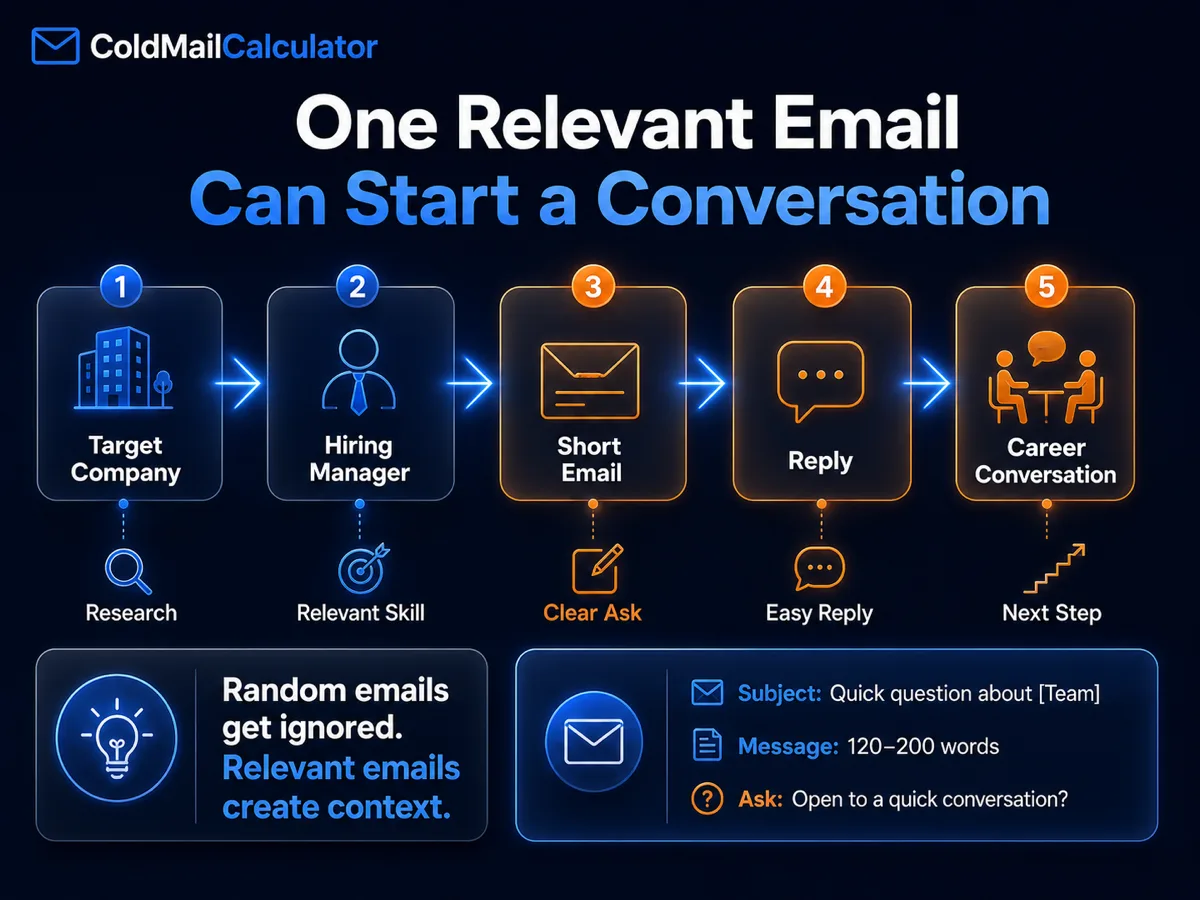
Keep the email short. For most job seekers, 120 to 200 words is enough. Your resume can do the deeper explaining. The email's job is to earn enough interest for a reply, referral, or short conversation.
What Is Cold Emailing for a Job?
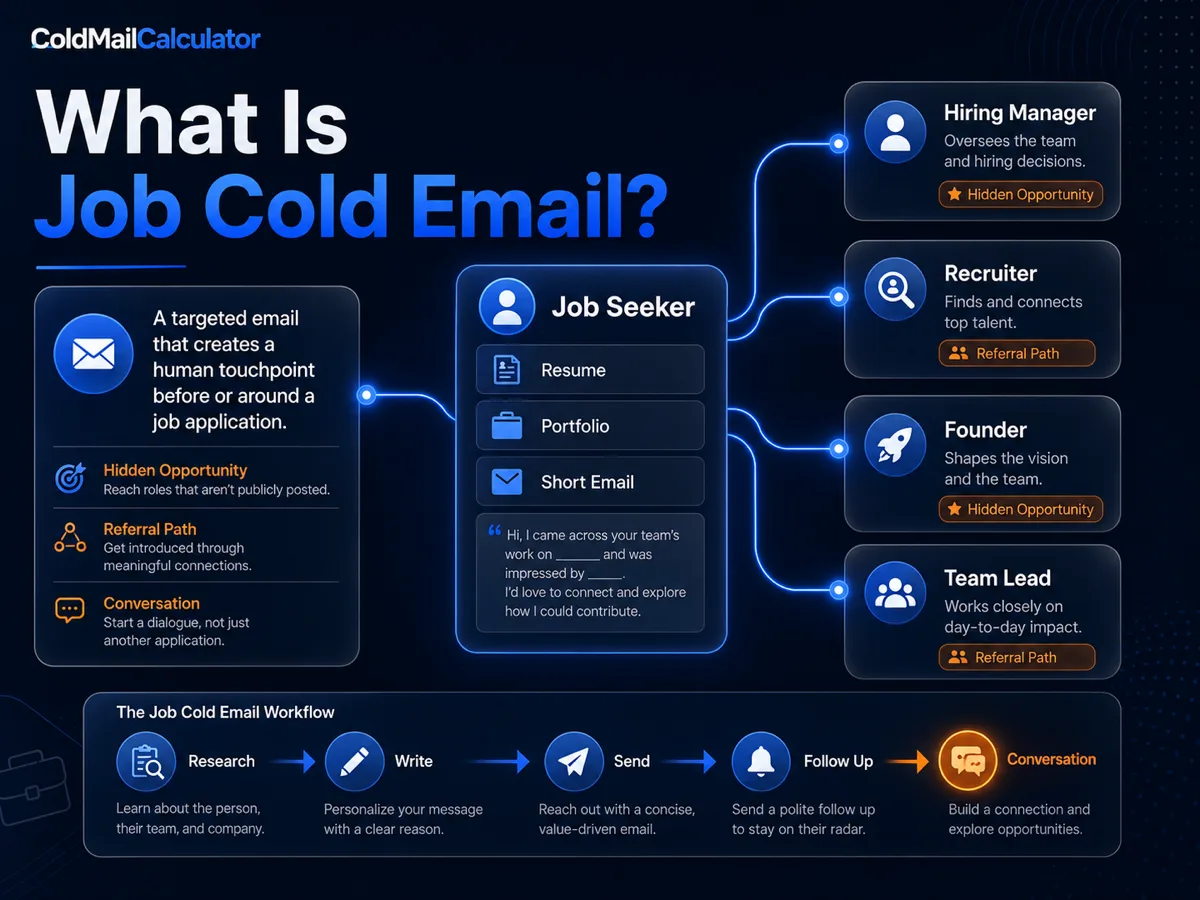
Cold emailing for a job is the process of contacting someone at a company before they have asked to hear from you. You might email a hiring manager about an open role, a recruiter about a team, a founder at a small company, or an employee who could point you in the right direction.
This is different from submitting a job application. A job application goes into the official hiring system. A cold email creates a human touchpoint around that process. It can help you learn whether a role is real, understand what the team values, get a referral, or make your application easier to notice.
Cold emailing is especially useful when you are applying to smaller companies, startups, agencies, creative teams, internships, entry-level roles, apprenticeships, or jobs where your portfolio and initiative matter.
Does Cold Emailing for Jobs Work?
Yes, but not because sending random emails magically creates interviews. It works when your email makes the recipient's job easier. Hiring managers are busy. Recruiters are busy. Most employees are not waiting for strangers to ask for favors.
A good job cold email gives them a quick reason to care. It shows that you understand the company, that you have relevant skills, and that your ask is small enough to answer.
Use the 30/30/50 idea as a simple writing check: spend part of the email on them, part on you, and most of the message on why the connection is useful. That does not mean writing exact percentages. It means avoiding the common mistake of making the email only about what you want.
Who Should You Email?
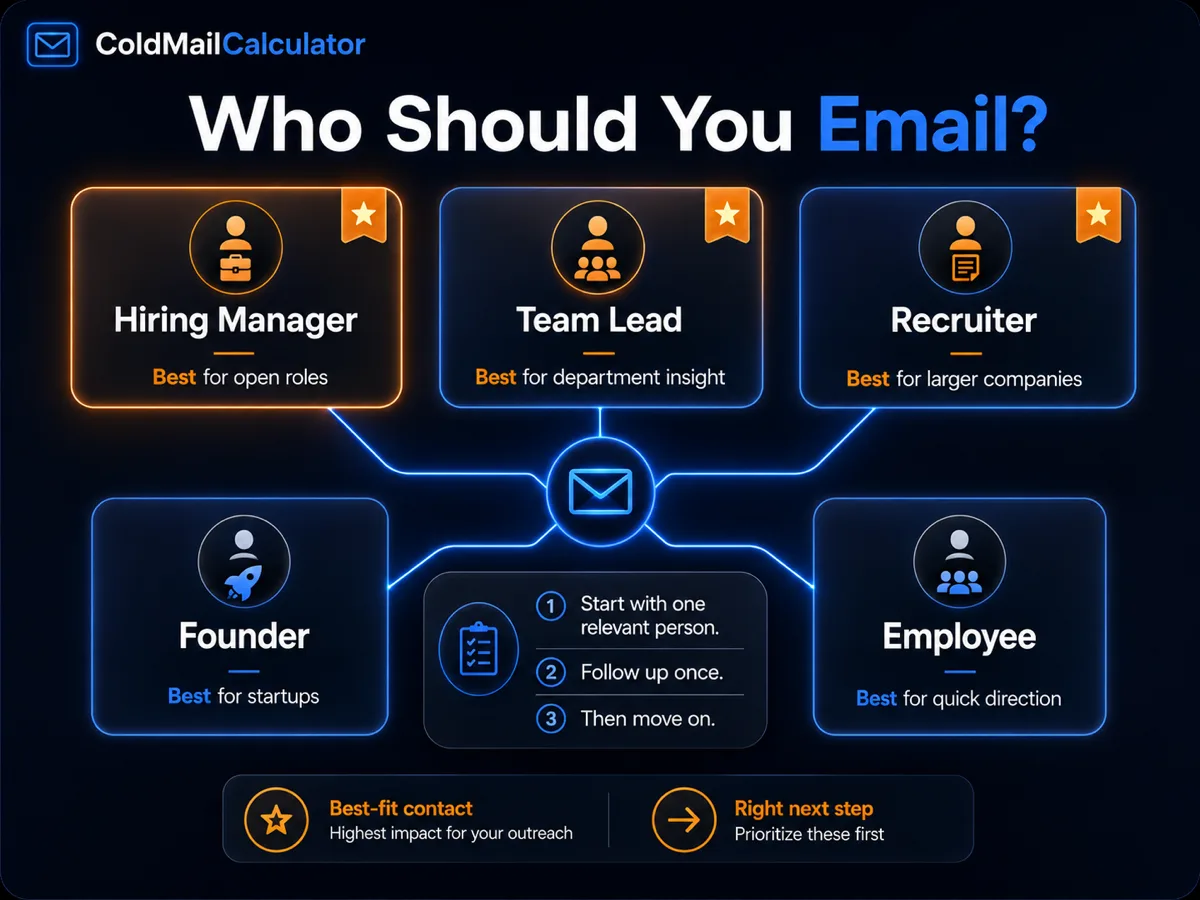
The right person depends on the role. If you are applying to a marketing job, the marketing manager may be more useful than a generic careers inbox. If you are applying to a design job, the creative director, design lead, or founder may be better. For larger companies, a recruiter can be the right first contact.
Good targets include:
- The hiring manager listed or implied by the job post.
- A team lead in the department you want to join.
- A recruiter who works on that function.
- A founder or operator at a small company.
- An employee who has a similar background and may be open to a quick question.
Do not email everyone at the company. Start with one relevant person. If they do not respond, send one polite follow-up. If there is still no response, move on or try a different appropriate contact later.
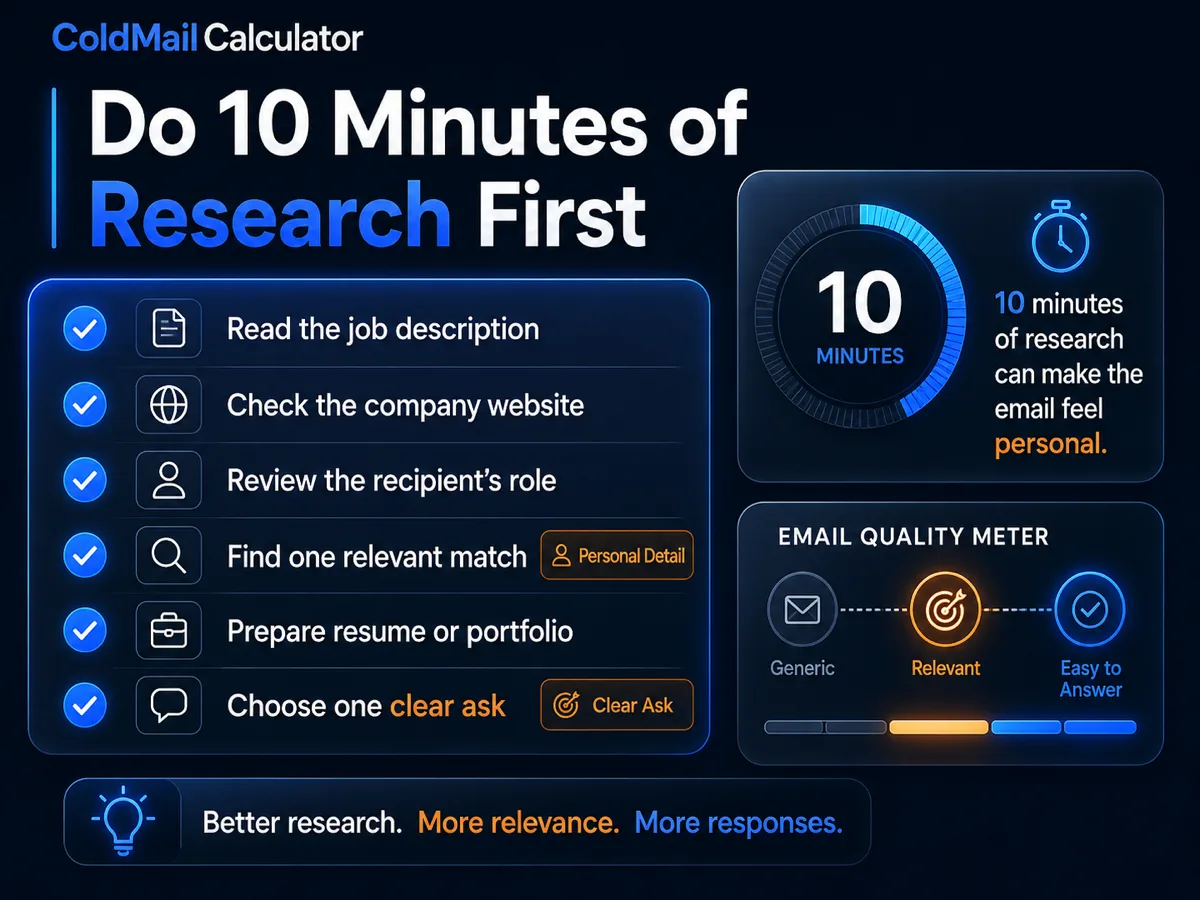
Before You Email: Do 10 Minutes of Research
The fastest way to improve a job cold email is to make it obvious that it was written for that company. You do not need a deep investigative report. You need enough context to sound relevant.
- Read the job description carefully.
- Look at the company's homepage, product, or recent updates.
- Check the recipient's role and team.
- Find one reason your background matches the problem they hire for.
- Prepare a resume, portfolio, LinkedIn profile, or work sample link.
- Decide your one clear ask before writing.
This matters because recruiters and hiring managers skim quickly. Many career advisors point out that resumes only get a few seconds of initial attention, so your email and resume need to be clear immediately. Do not hide the important details in a long paragraph.
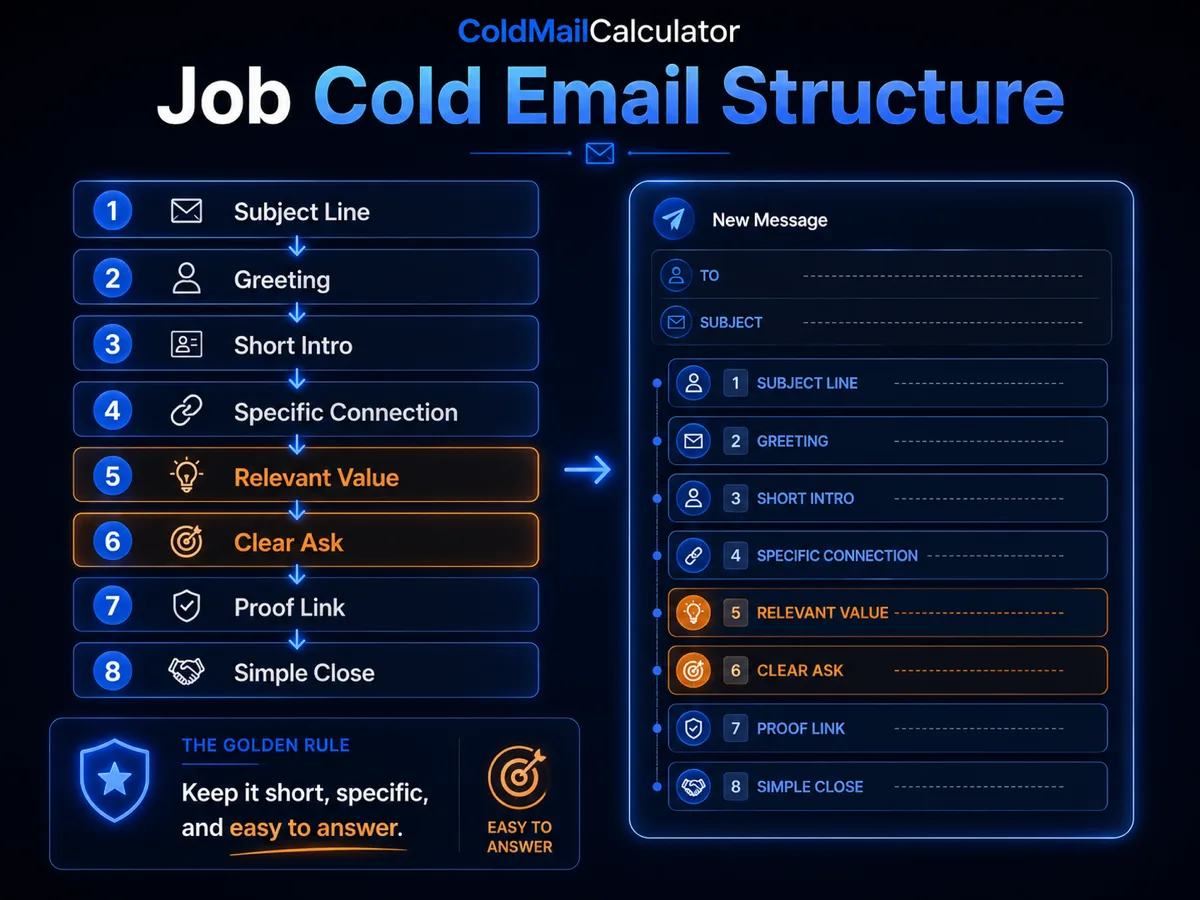
Best Cold Email Structure for Job Seekers
Use a simple structure. The email should feel easy to read on a phone.
- Subject line: Clear, specific, and professional.
- Greeting: Use the person's name if you have it.
- One sentence intro: Say who you are and what role or area you are interested in.
- Specific connection: Mention the company, role, product, team, or project.
- Your value: Share one or two relevant skills, results, projects, or experiences.
- Clear ask: Ask for a short conversation, the right person to contact, or whether they are open to reviewing your application.
- Easy proof: Link your resume, portfolio, or LinkedIn if helpful.
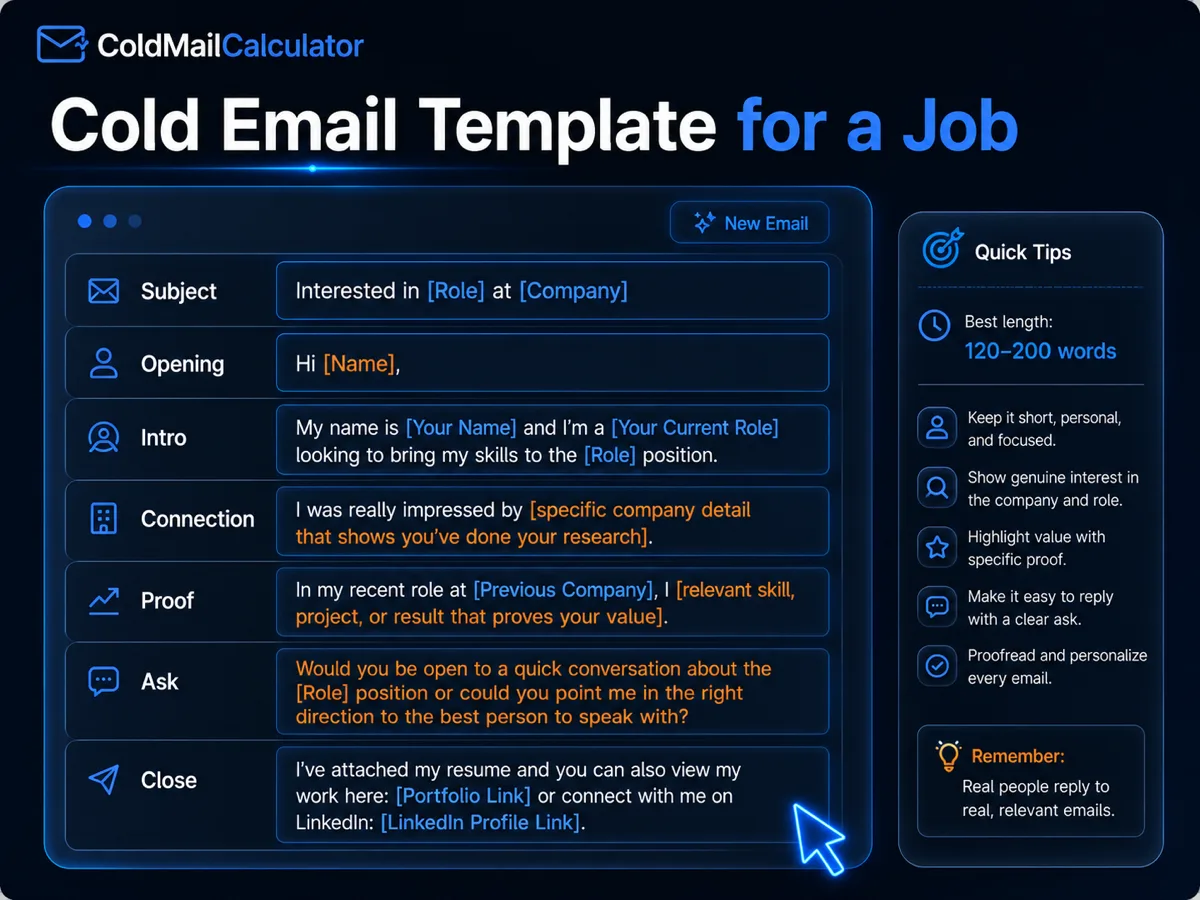
Cold Email Template for a Job
Use this template when there is a specific role or team you care about.
Subject: Interested in [Role] at [Company]

Hi [Name],

My name is [Your Name], and I'm a [your role/background] interested in the [role/team] at [Company]. I saw your work on [specific company detail, product, campaign, post, or job requirement], and it stood out because [brief reason].

My background includes [relevant skill/project/result]. For example, [one short proof point that connects to the role].

I wanted to ask whether you would be open to a quick conversation or whether there is someone better I should contact about this role. I've included my [resume/portfolio/LinkedIn] here for context: [link].

Thank you for your time,
[Your Name]
Short Cold Email Template
If you are emailing someone senior or very busy, use a shorter version.
Subject: Quick question about [Team/Role]

Hi [Name],

I'm [Your Name], a [background] interested in [Company]'s [team/role]. I noticed [specific detail], and it connects closely with my experience in [relevant skill or project].

Would you be open to pointing me toward the right person to contact about opportunities on this team?

My resume/portfolio is here for context: [link].

Best,
[Your Name]
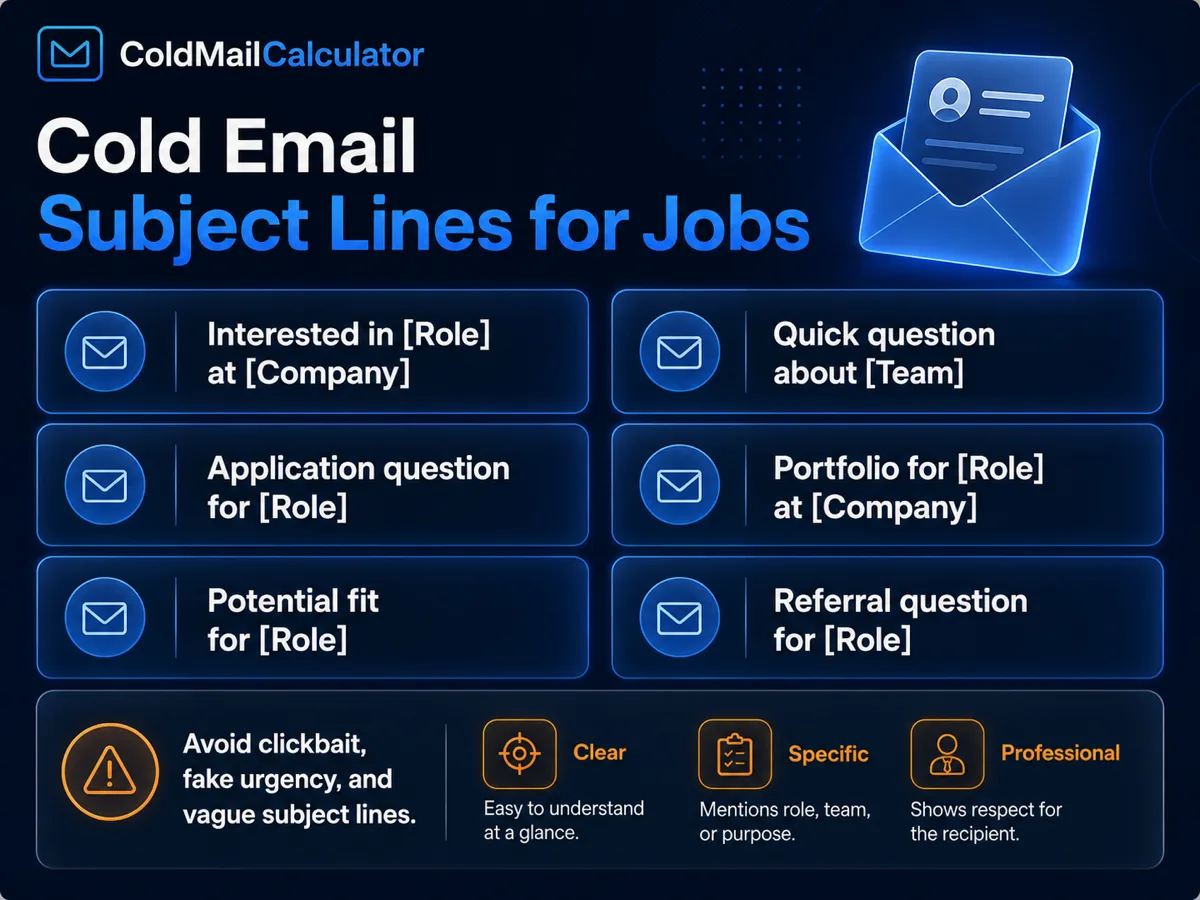
Cold Email Subject Lines for Jobs
A good subject line should look like a normal professional email. Avoid clickbait, fake urgency, and vague lines like "Question" or "Please help."
- Interested in [Role] at [Company]
- Quick question about [Team]
- [Your Role] interested in [Company]
- Application question for [Role]
- Interested in contributing to [Project/Product]
- Referral question for [Role]
- [School/Company] background, interested in [Team]
- Portfolio for [Role] at [Company]
- Question about joining [Company]
- Potential fit for [Role]
If you want more subject-line patterns, see our guide to cold email subject lines.
What to Attach or Link
For job cold emails, links are usually cleaner than attachments unless the job post specifically asks for a resume file. Attachments can feel heavy, and some companies are careful with files from unknown senders.
- Resume: Link to a PDF or attach it only if appropriate.
- Portfolio: Essential for design, writing, marketing, development, and creative roles.
- LinkedIn: Useful when it is current and matches your resume.
- Work sample: Helpful when it directly relates to the role.
Do not send five links. Choose the one or two that best prove fit.
How to Follow Up
Wait 5 to 7 business days before following up. If the role is closing soon, you can follow up a little sooner, but stay polite. The follow-up should be shorter than the original email.
Subject: Following up on [Role/Team]

Hi [Name],

I wanted to politely follow up on my note about [role/team]. I know things get busy, so no worries if now is not the right time.

I'm still very interested in [Company] because [specific reason], and I would appreciate any guidance on the best person to contact.

Thank you again,
[Your Name]
Send one follow-up. If there is no response after that, move on. A non-response is not always rejection. It often just means the person is busy, traveling, or not the right contact.
Is Cold Emailing for Jobs Legal?
In the United States, cold email can be legal when it follows rules such as the CAN-SPAM Act. The main ideas are simple: do not use deceptive headers or subject lines, identify yourself accurately, include valid contact information when required, and provide a way to opt out of future commercial messages.
A one-to-one job inquiry is different from a mass marketing campaign, but the safest habit is still to be honest, relevant, and respectful. If you are emailing in Canada, the UK, or Europe, rules can be stricter, especially for commercial or bulk outreach. When in doubt, send fewer, better, more relevant emails.
Common Mistakes to Avoid
Most job cold emails fail because they ask for too much too soon or look like they could have been sent to anyone.
- Sending a generic message with no company-specific detail.
- Writing a long life story instead of a short email.
- Asking "Can you get me a job?" instead of making a clear, smaller ask.
- Using a casual or misleading subject line.
- Attaching too many files.
- Sounding entitled or desperate.
- Emailing the wrong person repeatedly.
- Not proofreading.
- Forgetting to include a resume, portfolio, or proof link when useful.
- Not following up once.
Good vs Bad Cold Email Example
Bad Example
Hi, I need a job and saw your company is hiring. I am hardworking and passionate. Please look at my resume and let me know if there is anything available.
Why it fails: It is generic, does not mention a role, gives no proof, and makes the recipient do all the work.
Good Example
Hi Jordan, I'm Maya, a junior growth marketer interested in the lifecycle marketing role at BrightCart. I noticed your team is hiring for someone to improve onboarding emails, and my last project increased trial activation by 18% through a 5-email onboarding sequence. Would you be open to a quick conversation, or is there someone better I should contact? My portfolio is here: [link].
Why it works: It is specific, brief, relevant, and easy to answer.
How Many People Should You Cold Email?
Start with 10 to 20 highly relevant contacts, not 200 random people. Track the company, contact, role, date sent, follow-up date, and reply. If nobody replies, improve the email before sending the next batch.
If you are sending a campaign-sized batch, use our cold email calculator to estimate how many emails you may need based on your expected reply rate. The calculator is built for outbound math, but the same principle applies: better targeting usually beats more volume.
Final Checklist Before Sending
- The email names the right person or team.
- The company-specific detail is real.
- The role or career goal is clear.
- The email is under 200 words.
- The ask is small and specific.
- Your resume, portfolio, or LinkedIn link works.
- The subject line is professional.
- You proofread before sending.
FAQ
Is it okay to cold email for a job?
Yes. It is okay when the email is honest, relevant, respectful, and sent to someone who reasonably relates to the role or company.
What is the 30/30/50 rule for cold emails?
It is a simple guideline: include personalization, explain your value, and focus heavily on why the message is useful to the recipient. Do not treat it as exact math.
How long should a job cold email be?
Usually 120 to 200 words. Keep it short enough to skim on a phone.
Should I attach my resume?
If the recipient expects it, yes. Otherwise, a clean resume or portfolio link can feel lighter and safer than an attachment.
What if they do not reply?
Wait 5 to 7 business days and send one polite follow-up. If there is still no reply, move on.
Is cold emailing illegal?
Cold emailing can be legal, but laws vary by country and message type. In the United States, follow CAN-SPAM basics such as honest subject lines, accurate sender information, and opt-out rules for commercial messages.
Planning More Outreach?
If you are sending job cold emails in batches, use our cold email calculator to estimate how many emails you may need to send based on your expected reply rate.
Use the Cold Email Calculator