Cold Email ROI Formula: How to Forecast Revenue Before You Send
The cold email ROI formula is revenue minus campaign cost, divided by campaign cost. To forecast revenue before you send, multiply delivered emails by reply rate, positive reply rate, booking rate, close rate, and average deal value.
Short answer
Use this formula to calculate cold email ROI:
Cold email ROI formula
Use this formula to forecast cold email revenue before sending:
Revenue forecast formula
Track both profit ROI and revenue multiple. Profit ROI measures net return after campaign cost. Revenue multiple measures total revenue divided by campaign cost.
Cold email ROI formula
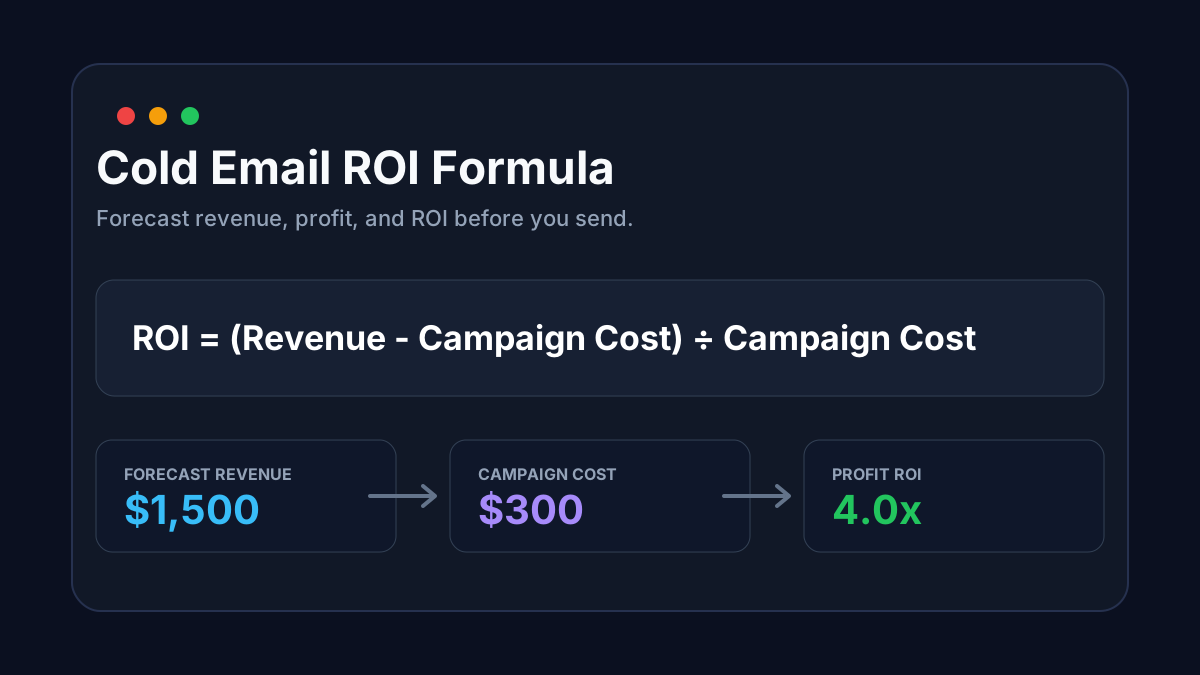
Cold email ROI measures how much profit a campaign creates compared with what it costs to run. The clean formula is:
Profit ROI
If a campaign generates $1,500 in revenue and costs $300 to run, the profit is $1,200. Divide $1,200 by $300 and the profit ROI is 4.0x, or 400%.
Some teams also report revenue multiple:
Revenue multiple
Using the same numbers, the revenue multiple is $1,500 divided by $300, or 5.0x. Neither version is wrong. Just label them clearly so finance, founders, clients, and sales teams are looking at the same metric.
How to forecast cold email revenue
ROI is the last step. First you need to forecast revenue from the outreach funnel. Cold email revenue is created by a chain of conversion rates:
- Emails sent: how many prospects enter the campaign.
- Delivery rate: the percentage that reach the inbox.
- Reply rate: the percentage of delivered emails that get any reply.
- Positive reply rate: the percentage of replies that show real interest.
- Booking rate: the percentage of positive replies that turn into booked calls.
- Close rate: the percentage of booked calls that become customers.
- Average deal value: the revenue from each closed customer.
Full funnel revenue formula
This is why small rate changes matter. A campaign does not need one giant improvement to change the economics. A slightly better list, a slightly stronger reply rate, and a tighter follow-up process can compound into a much larger revenue forecast.
Example cold email ROI calculation
Here is a simple forecast using the same example values pre-filled in ColdMailCalculator:
| Input | Example value | Result |
|---|---|---|
| Emails sent | 500 | 500 prospects |
| Delivery rate | 85% | 425 delivered emails |
| Reply rate | 3% | 12.75 replies |
| Positive reply rate | 35% | 4.46 positive replies |
| Booking rate | 40% | 1.79 booked calls |
| Close rate | 25% | 0.45 expected clients |
| Average deal value | $1,500 | $669 expected revenue |
| Campaign cost | $300 | $369 expected profit |
That creates a profit ROI of about 1.23x and a revenue multiple of about 2.23x. The exact number may look fractional because forecasting uses expected value. In real life you cannot close 0.45 clients, but over many campaigns the average matters.
Why expected value is better than wishful rounding
Outbound math often looks awkward at small volumes because each stage creates decimals. That does not mean the forecast is broken. It means the sample size is small.
If you round 0.45 expected clients up to 1 client, the forecast says $1,500 in revenue and 4.0x profit ROI. If you round it down to 0 clients, the forecast says negative ROI. The honest planning number is the expected value: $669 in revenue from that exact set of assumptions.
For client reporting, scenario planning, and internal planning, use expected value first. Then create conservative, realistic, and upside cases so everyone understands the range.
Cold email ROI inputs that matter most
Every input affects ROI, but some create more leverage than others.
Delivery rate
Delivery rate sets the size of the real audience. If 15% of emails bounce, fail, or land where prospects never see them, every later conversion rate has less room to work. This is why list quality and inbox setup should be part of ROI planning, not just deliverability cleanup.
Positive reply rate
Total replies can be misleading. Out-of-office messages, unsubscribe requests, referrals, and negative replies do not create the same value as interested replies. Positive reply rate tells you whether the message and offer are creating real pipeline.
Booking rate
A campaign can generate interested replies and still lose money if those replies do not turn into meetings. Booking rate depends on follow-up speed, CTA clarity, qualification, and how easy it is for a prospect to schedule.
Close rate and deal value
Close rate and average deal value determine how much revenue each booked call can create. A low-volume campaign can still produce strong ROI if the offer has a high deal value and a reliable close rate.
Cost per booked call and cost per client
ROI is useful, but it is not the only number to watch. Two practical cost metrics make campaign planning easier:
Cost per booked call
Cost per client
If a campaign costs $300 and books 1.79 expected calls, the cost per booked call is about $168. If it creates 0.45 expected clients, the expected cost per client is about $671. Compare those numbers with your average deal value and customer margin before deciding whether the campaign is worth scaling.
Break-even point
The break-even point tells you how many clients you need before the campaign pays for itself:
Break-even formula
With a $300 campaign cost and a $1,500 average deal value, you need 0.2 clients to break even on revenue. That means one closed client covers several similar campaign tests. If your average deal value is only $150, the same campaign needs 2 clients to break even.
Benchmarks are starting points, not guarantees
Cold email ROI depends on the market, list quality, offer, timing, follow-up process, sender reputation, and sales conversion. Benchmarks are useful for building a first forecast, but your own campaign data should replace generic assumptions as soon as you have enough volume.
Use the cold email ROI benchmarks guide to sanity-check your starting assumptions, then use your own delivery, reply, booking, and close rates for planning.
When to use the calculator instead of a spreadsheet
A spreadsheet is fine for one-off math. A calculator is better when you want fast scenario testing without rebuilding formulas each time. Use ColdMailCalculator when you want to quickly answer questions like:
- How many emails do we need to send to book 10 calls?
- What happens if reply rate drops from 5% to 3%?
- How much can we spend on data and tools before ROI breaks?
- What cost per client should we expect from this campaign?
For dashboards, CRMs, and agency reporting workflows, the ColdMail API can run the same forecasting logic programmatically.
Forecast cold email ROI before you send
Use ColdMailCalculator to model delivered emails, replies, positive replies, booked calls, clients, revenue, profit, ROI, cost per call, and break-even point.
Use the ColdMailCalculator