Planning guide
How Many Cold Emails Does It Take to Book One Meeting?
For founders and SDRs sizing a campaign before committing budget — a stage-by-stage breakdown of the emails-to-meeting math, so you can set a realistic volume target instead of guessing.
Last updated July 9, 2026 · ColdMailCalculator, operated by Wade Digital
The short answer
At a 5% reply rate, a 40% positive reply rate, and a 50% meeting booking rate, it takes roughly 100 emails to book one meeting. The math: 100 emails × 5% reply rate = 5 replies. 5 replies × 40% positive reply rate = 2 positive replies. 2 positive replies × 50% booking rate = 1 booked meeting.
That 100-email figure is a working assumption, not a law of physics. Move any one of those three rates and the number swings hard — which is exactly why teams that plan around a single flat ratio ('we book 1 meeting per 100 sends') get surprised when a new list or new offer performs nothing like the old one.
Why the number moves so much
Reply rate, positive reply rate, and booking rate all compound. A conservative campaign (2% reply, 25% positive, 35% booking) needs about 570 emails per meeting. An upside campaign (8% reply, 55% positive, 65% booking) needs about 35 emails per meeting. Same funnel shape, 16x difference in required volume.
This is why the calculator models three scenarios side by side instead of one number — the gap between conservative and upside is normally the difference between a campaign that loses money and one that pays back in a month.
Work the math backward from your meeting goal
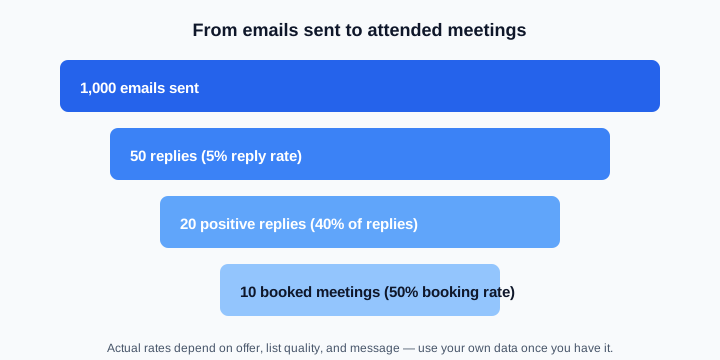
If you need 10 booked meetings this month, reverse the funnel: 10 meetings ÷ 50% booking rate = 20 positive replies. 20 positive replies ÷ 40% positive reply rate = 50 replies. 50 replies ÷ 5% reply rate = 1,000 emails needed.
Run that backward calculation with your own historical rates once you have them — industry ranges are a starting point for a first campaign, not a substitute for your own data after send four or five.
What actually changes the ratio
List quality and targeting specificity move reply rate more than anything else. A narrow, verified, relevant list at 5-8% reply rate will consistently beat a broad, purchased list at 1-2%, even with identical copy.
Offer relevance and message specificity move positive reply rate — replies that say 'not interested' count as replies but not positive replies, so a vague pitch can inflate reply rate while starving the stages that actually matter.
Mailbox reputation and deliverability set a ceiling on all of it: emails that land in spam never get the chance to generate any reply. Run a domain and mailbox authentication check before you scale volume based on a meetings-per-email assumption.
Where mailbox limits fit into the plan
A single warmed mailbox can typically sustain roughly 30-50 sends per day before deliverability risk rises. If your backward-calculated volume is 1,000 emails and you want to send it in two weeks, that's about 70-100 emails per business day — meaning you likely need 2-3 mailboxes running in parallel, not one mailbox pushed past a safe daily cap.
Before you commit to a volume target
- Confirm your reply-rate assumption against your own past campaigns, or use a conservative published range if this is a first send.
- Separate 'reply rate' from 'positive reply rate' — do not treat every reply as interest.
- Reverse-calculate required volume from your actual meeting goal, not the other way around.
- Check mailbox count against daily send caps for your planned volume and timeline.
- Model a conservative, working, and upside scenario before setting a budget.
Common mistakes
- Treating industry-average reply rates as guaranteed outcomes for a brand-new list and offer.
- Assuming every reply is a positive reply, which overstates expected meetings.
- Ignoring show-up rate — a booked meeting is not the same as an attended meeting.
- Scaling send volume before fixing a weak subject line or generic opener.
- Pushing one mailbox past a safe daily volume instead of adding mailboxes.
Frequently asked questions
Is there one correct emails-per-meeting ratio?
No. It depends on list quality, offer relevance, copy, and mailbox reputation. Use a range and refine it with your own data.
Should I count every reply toward my meeting math?
No — separate total replies from positive replies. Out-of-office and 'not interested' replies count as replies but do not lead to meetings.
How do I get a more accurate number for my situation?
Run a small test batch, record your actual reply, positive reply, and booking rates, then plug those into the calculator instead of a generic benchmark.
Related pages
Related guides
Put this into your own numbers
This article is educational planning content, not guaranteed results, legal advice, or compliance advice. Use the calculator to model your own assumptions.
Estimates are based on user-provided assumptions and are not guaranteed. See the disclaimer for details.