Planning guide
How to Calculate Cold Email Reply Rate
Reply rate is the metric that actually signals interest. Here is the exact formula, a worked example, and the difference between total and positive reply rate.
Last updated July 9, 2026 · ColdMailCalculator, operated by Wade Digital
The short answer
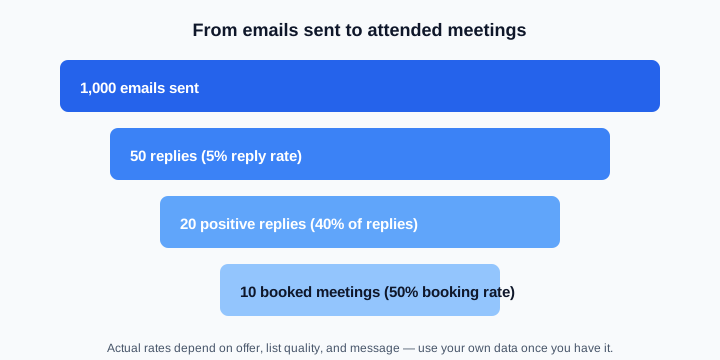
Reply rate = (replies ÷ delivered emails) × 100. If 1,000 emails are delivered and 50 come back with a reply, your reply rate is 5%. Positive reply rate uses the same formula but counts only replies that show genuine interest — 'not interested' and out-of-office replies are excluded.
Always divide by delivered, not sent. Bounces and spam-folder placements were never going to reply, and counting them inflates your denominator, making a weak campaign look better than it is.
Worked example
You send 1,200 emails. 60 bounce or go missing, so 1,140 are delivered. You get 57 replies. Reply rate = 57 ÷ 1,140 × 100 = 5.0%. Of those 57, 23 are genuine interest ('yes, tell me more'), 20 are soft nos, and 14 are out-of-office. Positive reply rate = 23 ÷ 1,140 × 100 = 2.0%.
That 2.0% positive reply rate is the number that feeds meetings. A campaign reporting only '5% reply rate' hides that most replies were not real interest — which is why you should always track the two separately.
Total reply rate vs positive reply rate
Total reply rate counts every response, including replies that move you no closer to a meeting. Positive reply rate counts only the replies that indicate a real next step. Because only positive replies convert, positive reply rate is the pipeline signal; total reply rate is a noisier engagement signal.
A campaign with a 5% total reply rate but only 0.5% positive replies is weaker than one with a 3% total reply rate and 2% positive replies. The second will book more meetings from fewer sends.
Reverse the math from your meeting goal
If you need 10 booked meetings and your rates are 40% positive-to-meeting and 2% positive reply, you need 25 positive replies (10 ÷ 40%), which needs 1,250 delivered emails (25 ÷ 2%). Add a realistic bounce rate and you know your send target.
Run this backward calculation with your own historical rates once you have them. Published ranges are a starting point for a first campaign, not a substitute for your verified data after four or five sends.
What actually moves reply rate
List quality and targeting move reply rate more than anything else — a narrow, verified, relevant list beats a broad, purchased one even with identical copy. Offer relevance and message specificity move positive reply rate, because vague pitches inflate total replies while starving the stage that matters.
Deliverability sets the ceiling: emails in spam never get the chance to generate a reply. Check domain authentication and inbox placement before you scale volume based on a reply assumption.
Before you report reply rate
- Calculate from delivered emails, not total sent.
- Track positive reply rate separately from total reply rate.
- Show absolute reply counts next to the percentage.
- Use your own historical rates once available, not just benchmarks.
- Check deliverability before blaming copy for a low rate.
Common mistakes
- Counting bounces in the denominator, which flatters a weak campaign.
- Reporting total reply rate as if every reply were interest.
- Treating one wave's rate as proof without checking sample size.
- Ignoring deliverability when reply rate drops suddenly.
Frequently asked questions
What is the reply rate formula?
Reply rate = (replies ÷ delivered emails) × 100. Use delivered, not sent, so bounces and spam placement do not distort the number.
What is the average cold email response rate?
A healthy total reply rate is roughly 3–8%, with positive reply rate around 1–3%. Rates vary by audience, offer, and list quality, so treat ranges as educational starting points.
Reply rate vs positive reply rate — what is the difference?
Total reply rate counts every response including 'not interested' and out-of-office. Positive reply rate counts only genuine interest, and it is the rate that feeds booked meetings.
Related pages
Related guides
Put this into your own numbers
This article is educational planning content, not guaranteed results, legal advice, or compliance advice. Use the calculator to model your own assumptions.
Estimates are based on user-provided assumptions and are not guaranteed. See the disclaimer for details.