Planning guide
Outreach Assumptions That Break Your Campaign
The optimistic assumptions that quietly turn a cold email campaign unprofitable — and how to catch them before you commit budget.
Last updated July 9, 2026 · ColdMailCalculator, operated by Wade Digital
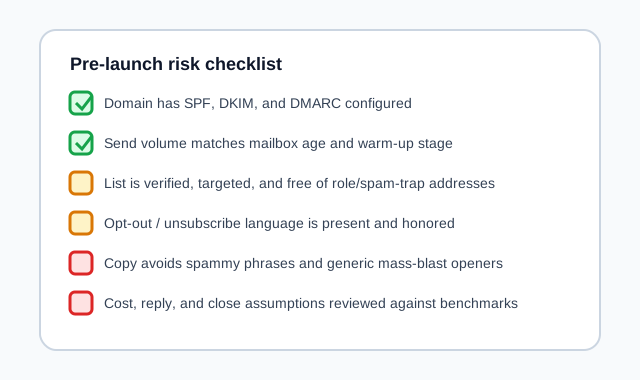
Stacking optimistic rates at every stage
The most common way a forecast goes wrong is assuming a high rate at every single funnel stage simultaneously — high reply rate, high positive reply share, high booking rate, high show-up rate, high close rate. Even if each individual assumption is plausible on its own, the combined probability of all five holding true at once is usually much lower than it feels.
Fix: run at least one stage at a conservative rate even in your 'working' scenario, and treat a campaign that only works if every stage hits its best case as high risk.
Treating pipeline as revenue
A booked meeting is not a closed client, and a verbal 'yes' is not collected revenue. Forecasts that count pipeline value as if it were realized revenue consistently overstate a campaign's actual return — model closed revenue and pipeline value as two separate numbers.
Ignoring show-up rate
Booked meetings that don't happen produce zero revenue. A campaign that books 30 meetings at a 60% show-up rate is functionally an 18-meeting campaign for revenue purposes — leaving show-up rate out of the model overstates expected clients by whatever percentage fails to attend.
Missing cost categories
Labor, tools, and agency fees are the three most commonly omitted cost categories. A campaign that looks highly profitable when only list and mailbox costs are counted can look very different once a fair hourly rate for the time spent is added in.
Using generic benchmarks past their useful life
Industry benchmarks are a reasonable starting point for a first campaign. After a few hundred sends, your own data is almost always more accurate than a generic range — continuing to plan around a generic benchmark once you have real data is a common and avoidable mistake.
Assumption audit checklist
- Check whether every funnel stage in your model assumes a best-case rate simultaneously.
- Confirm revenue is calculated from closed clients, not booked meetings or pipeline.
- Confirm show-up rate is included, not assumed to be 100%.
- Confirm labor, tools, and agency fees are in the total cost figure.
- Replace generic benchmarks with your own data as soon as you have enough sends.
Common mistakes
- Modeling every stage at its optimistic rate at the same time.
- Counting pipeline value as realized revenue.
- Assuming 100% show-up rate on booked meetings.
- Leaving labor cost out of total campaign cost.
Frequently asked questions
What's the single highest-impact fix?
Running at least one funnel stage at a conservative rate in your main planning scenario — it's the fastest way to catch an over-optimistic forecast before it costs real budget.
Related pages
Related guides
Put this into your own numbers
This article is educational planning content, not guaranteed results, legal advice, or compliance advice. Use the calculator to model your own assumptions.
Estimates are based on user-provided assumptions and are not guaranteed. See the disclaimer for details.