Planning guide
How to Know if a Cold Email Campaign Is Worth It
A decision framework for deciding whether a planned cold email campaign is worth running, before you spend money finding out the hard way.
Last updated July 9, 2026 · ColdMailCalculator, operated by Wade Digital
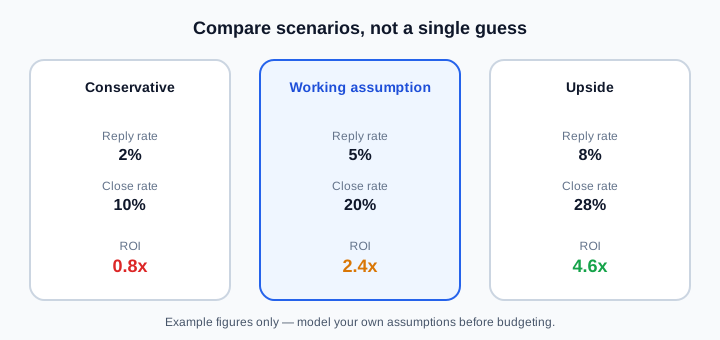
Start with a conservative scenario, not an average one
Model the campaign using the conservative end of your assumption ranges first. If the conservative scenario is still profitable (or close to break-even), the campaign has real margin for error. If the conservative scenario already loses money, the campaign is depending entirely on things going better than expected.
Check three numbers, not one
ROI multiple tells you overall profitability. Cost per meeting tells you whether the funnel's middle stages are efficient. Break-even email volume tells you the minimum scale needed before the campaign turns profitable at all — useful for judging whether you can even reach that volume with your current mailbox and list capacity.
When a campaign is usually worth testing
A small, capped-budget test is usually worth running when: the offer has a clear, specific audience; the conservative scenario is roughly break-even or better; and you can commit to fixing the weakest funnel stage rather than abandoning the channel after one send.
Go / no-go checklist
- Run the conservative scenario first — does it hold up?
- Check ROI multiple, cost per meeting, and break-even volume together.
- Confirm mailbox/domain capacity can reach the required break-even volume.
- Set a small test budget and a specific stage to fix before scaling further.
Frequently asked questions
What ROI multiple makes a campaign 'worth it'?
There's no universal cutoff, but many teams treat a conservative-scenario ROI near or above break-even as worth a small test, and treat a conservative scenario deep in the red as a signal to fix assumptions before spending.
Related pages
Related guides
Put this into your own numbers
This article is educational planning content, not guaranteed results, legal advice, or compliance advice. Use the calculator to model your own assumptions.
Estimates are based on user-provided assumptions and are not guaranteed. See the disclaimer for details.