Planning guide
Scenario Planning for Cold Outreach
Why comparing conservative, working, and upside scenarios beats planning around a single forecast number — and how to build the three scenarios properly.
Last updated July 9, 2026 · ColdMailCalculator, operated by Wade Digital
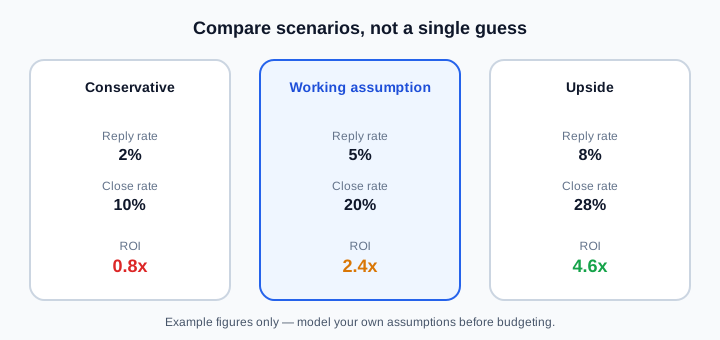
Why one number isn't enough
A single forecast hides how sensitive the outcome is to its assumptions. Two campaigns can share the same 'expected' ROI while one has a conservative scenario that's still profitable and the other has a conservative scenario that loses money badly — very different risk profiles behind an identical headline number.
Building the three scenarios
Conservative: use the low end of your reply, positive reply, booking, and close rate ranges. Working: use your best honest estimate, ideally grounded in real data. Upside: use the high end of a plausible range, clearly labeled as an outcome to hope for, not to plan a budget around.
Using the spread to decide, not just to inform
If the conservative scenario is still roughly break-even, the campaign has real margin for error and is a reasonable test. If the conservative scenario loses significant money, the campaign's viability depends entirely on hitting working or upside numbers — treat that as a higher-risk bet and size the initial test accordingly.
Scenario planning checklist
- Build conservative, working, and upside versions of every campaign forecast.
- Label which scenario is being shown any time you share a number internally or with a client.
- Size your initial budget to what the conservative scenario can tolerate.
Frequently asked questions
How different should the scenarios be?
Wide enough to reflect real uncertainty — commonly a 3-5x spread in required email volume between conservative and upside for the same meeting goal.
Related pages
Related guides
Put this into your own numbers
This article is educational planning content, not guaranteed results, legal advice, or compliance advice. Use the calculator to model your own assumptions.
Estimates are based on user-provided assumptions and are not guaranteed. See the disclaimer for details.