Planning guide
How to Calculate Cold Email ROI
A step-by-step walkthrough of the cold email ROI formula, using the same inputs and math the calculator runs, so you can check the number by hand before you trust it.
Last updated July 9, 2026 · ColdMailCalculator, operated by Wade Digital
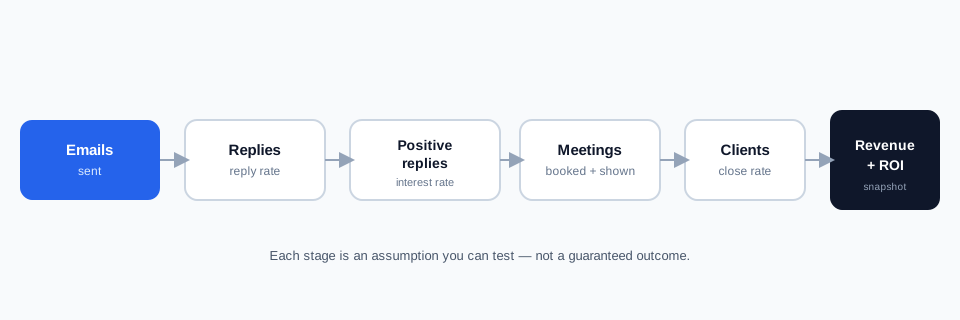
The cold email ROI formula
ROI multiple = Net Profit ÷ Total Campaign Cost, where Net Profit = Revenue − Total Cost. Revenue comes from the funnel: emails sent → replies → positive replies → booked meetings → attended meetings → clients → revenue (clients × average deal value, multiplied by recurring months if the deal repeats).
Total cost should include every real expense: domain cost, mailbox cost, lead list or data cost, tool/software cost, labor cost (your time or a hired SDR), agency fees if outsourced, and any other campaign cost. Leaving out labor or tools is the single most common way ROI gets overstated.
A worked example
Say you send 2,000 emails at a 4% reply rate (80 replies), 35% positive reply rate (28 positive replies), 45% meeting booking rate (13 meetings), 75% show-up rate (10 attended meetings), and 20% close rate (2 clients) at a $4,000 average deal value.
Revenue = 2 clients × $4,000 = $8,000. If total cost (domain + mailbox + list + tools + labor) is $1,400, Net Profit = $8,000 − $1,400 = $6,600. ROI multiple = $6,600 ÷ $1,400 = 4.7x. That means for every $1 spent, the campaign is modeled to return $4.70 in net profit — a strong working scenario, worth validating with a live test before scaling budget.
Why revenue alone is not ROI
Revenue tells you what came in. ROI tells you what came in relative to what it cost to get it. A campaign that generates $20,000 in revenue but cost $18,000 to run has a much weaker ROI multiple than one that generates $8,000 for $1,400 — even though the first number looks bigger on a slide.
This is why cost per meeting and CAC (customer acquisition cost) matter alongside ROI: they show you where the money is actually going stage by stage, not just the final total.
Annualizing recurring revenue
If a closed client represents a recurring contract (a monthly retainer, subscription, or service fee), multiply average deal value by the number of months you expect to retain the client before calculating revenue. A $500/month client retained for 12 months is $6,000 in modeled annual value, not $500 — but only recognize that value if your retention assumption is realistic for your business.
ROI calculation checklist
- List every cost category: domain, mailbox, list/data, tools, labor, agency fees.
- Use net profit (revenue minus total cost), not revenue alone, as the ROI numerator.
- Apply a realistic recurring-months multiplier only if retention is genuinely expected.
- Run conservative, working, and upside scenarios instead of one point estimate.
- Recheck ROI after a real campaign using actual reply, meeting, and close data.
Common mistakes
- Calculating ROI from revenue instead of net profit.
- Forgetting labor cost because no invoice was issued for it.
- Over-crediting recurring revenue without a realistic retention assumption.
- Using one optimistic scenario instead of a conservative-to-upside range.
Frequently asked questions
What is a good ROI multiple for cold email?
There is no universal number, but many teams treat anything above 2-3x net profit-to-cost as a reasonable working assumption worth testing further, and anything below 1x as a signal to fix the funnel before spending more.
Does ROI include labor cost?
It should. Excluding your own time or a hired SDR's time is the most common way cold email ROI gets overstated.
Can I calculate this without the calculator?
Yes — the formula above (Net Profit ÷ Total Cost) is exactly what the tool runs. The calculator just saves you from re-deriving the funnel math by hand every time an assumption changes.
Related pages
Related guides
Put this into your own numbers
This article is educational planning content, not guaranteed results, legal advice, or compliance advice. Use the calculator to model your own assumptions.
Estimates are based on user-provided assumptions and are not guaranteed. See the disclaimer for details.