Planning guide
Average Cold Email Response Rate: Benchmarks
Benchmarks help you spot a problem, but they vary by audience, offer, and list. Here is what 'average' looks like and how to read it without误导 yourself.
Last updated July 9, 2026 · ColdMailCalculator, operated by Wade Digital
The short answer
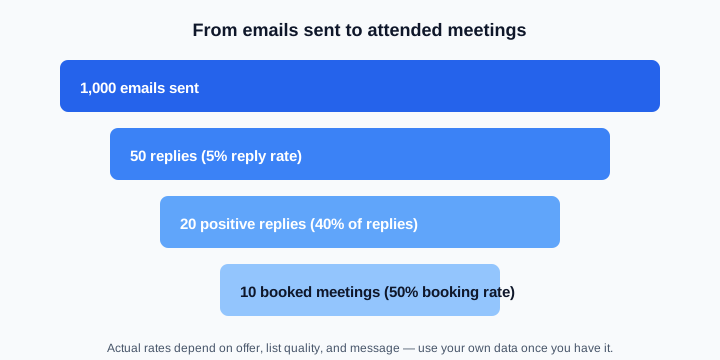
A typical cold email response (reply) rate is about 3–8%, with positive reply rate around 1–3%. 'Average' is a moving target: a tightly targeted, well-personalized campaign can exceed 8%, while a broad or purchased list can sit below 1%.
Use benchmarks as a diagnostic, not a target. The useful question is not 'are we average?' but 'which stage is leaking compared with our own past performance?'
Why benchmarks vary so much
Audience fit dominates. A verified list of practitioners who clearly match your offer replies far more than a generic list scraped from a directory. Offer relevance, sender name, and timing also shift the number by multiples.
Outreach method matters too. A single touch with no follow-up underperforms a respectful sequence, because 60–70% of replies typically come from follow-up emails rather than the first send.
Rough ranges by context
Across common B2B segments, total reply rates often land around 3–8% and positive replies around 1–3%. SaaS and marketing audiences tend toward the higher end; regulated industries such as healthcare tend lower. These are educational ranges, not guarantees, and your own verified data should replace them after a few sends.
Open rate is a different metric entirely and is distorted by auto-preload; do not confuse a 50% open rate with a 50% response rate.
What a 'good' rate really means
Good is relative to cost and goal. A 4% reply rate that yields profitable clients beats an 8% reply rate that yields only tyre-kickers. Judge the rate against positive reply rate, meeting rate, and cost per meeting — not against an industry average in isolation.
If your rate is below 3%, the usual suspects are targeting, offer clarity, or deliverability. Fix those before changing send volume, because more sends at a low rate just costs more.
How to use benchmarks without fooling yourself
Baseline your own campaigns, then compare each new wave to your own history first and to external ranges second. Report positive reply rate alongside total, and always pair the rate with the absolute count so a small sample is not mistaken for strong performance.
Using response-rate benchmarks
- Treat 3–8% reply / 1–3% positive as educational ranges, not guarantees.
- Compare new waves to your own history before external averages.
- Always report positive reply rate next to total reply rate.
- Pair every rate with the absolute reply count.
- Judge the rate against cost per meeting and client quality, not in isolation.
Common mistakes
- Taking an external average as a target instead of a diagnostic.
- Mixing open rate and reply rate as if they were the same metric.
- Celebrating total replies that are mostly 'not interested'.
- Comparing a tiny sample to an industry average.
Frequently asked questions
What is the average cold email response rate?
Roughly 3–8% total reply rate, with 1–3% positive reply rate. It varies widely by audience, offer, and list quality, so treat it as a diagnostic range, not a fixed target.
What is a good response rate for cold email?
Good depends on economics: a 4% reply rate that yields profitable clients beats an 8% rate that yields poor-fit replies. Judge it with positive reply rate, meeting rate, and cost per meeting.
Why do cold email benchmarks vary?
Audience fit, offer relevance, list quality, follow-up sequence, and deliverability all shift the rate by multiples. Regulated or broad audiences sit lower; tight, verified audiences sit higher.
Related pages
Related guides
Put this into your own numbers
This article is educational planning content, not guaranteed results, legal advice, or compliance advice. Use the calculator to model your own assumptions.
Estimates are based on user-provided assumptions and are not guaranteed. See the disclaimer for details.