Cold Email Infrastructure Costs: Domains, Inboxes, Tools, and Setup
Cold email infrastructure costs are the full set of expenses needed to send, track, and manage campaigns responsibly. If you only count the sending platform and ignore domains, inboxes, lead data, verification, setup time, and management, your cold email ROI can look much better than it really is. Infrastructure also affects campaign assumptions like delivery rate, bounce rate, and cold email reply rate benchmarks.
Short answer
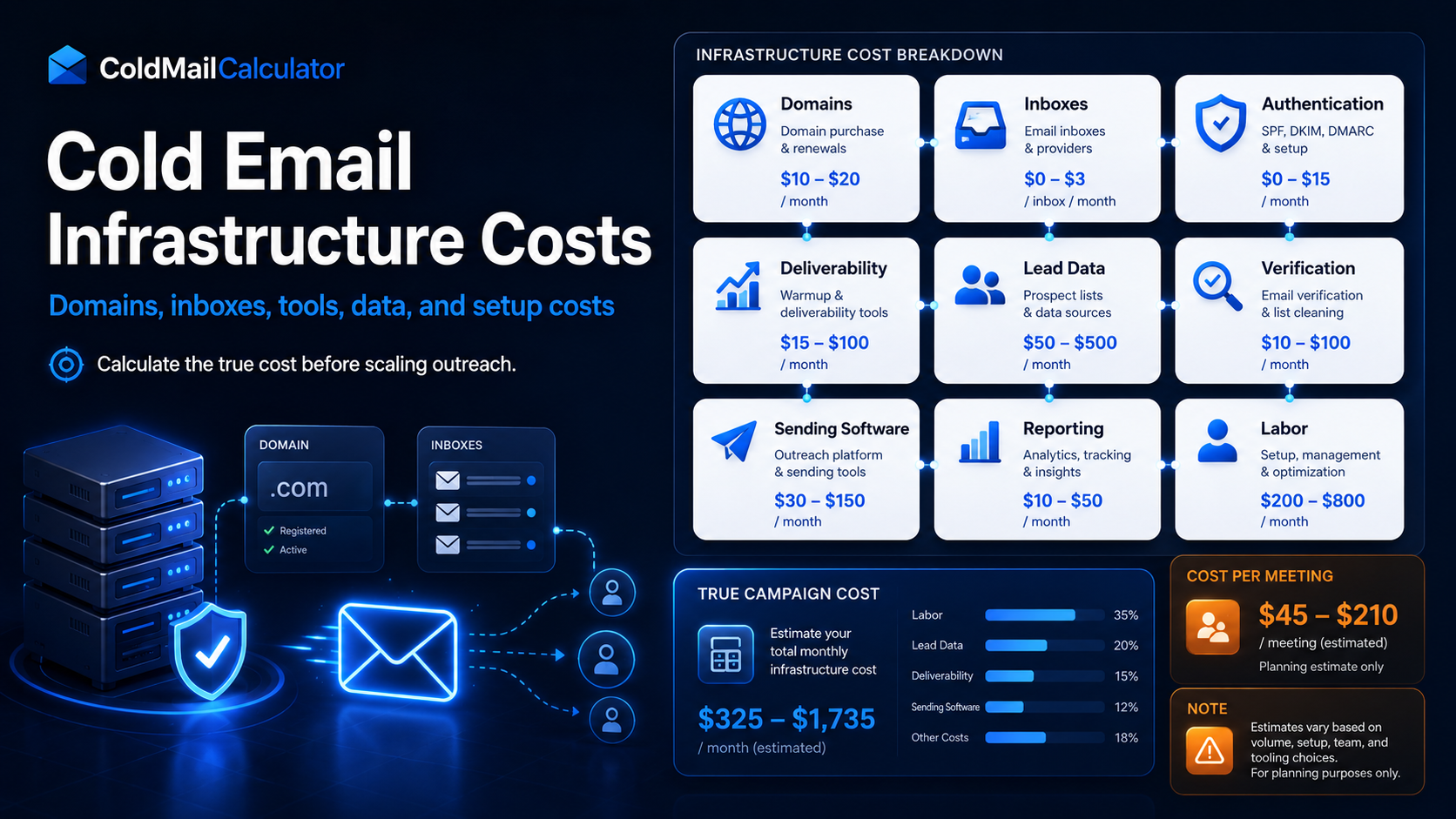
Cold email infrastructure costs usually include:
- Domains
- Inboxes/mailboxes
- Email authentication setup
- Warmup/deliverability tools
- Lead data
- Email verification
- Sending software
- Copywriting or campaign management
- Reporting/analytics
- Agency or contractor fees if outsourced
What Is Cold Email Infrastructure?
Cold email infrastructure is the system that lets a campaign send safely, track performance, and protect the main business domain. It is not just the email sequence tool. It includes the technical setup, data sources, sender accounts, monitoring, reporting, and human work behind the campaign.
At minimum, infrastructure usually includes sending domains, mailboxes, authentication, warmup or deliverability monitoring, sending software, lead data, verification, tracking/reporting, and human strategy and management. Agencies and internal teams may package these differently, but the costs still exist.
This matters because cold email setup cost is not only a software subscription. A campaign can have a low tool bill and still be expensive once you account for data, inboxes, list cleanup, copywriting, reply handling, and reporting time.
Cold Email Infrastructure Cost Breakdown
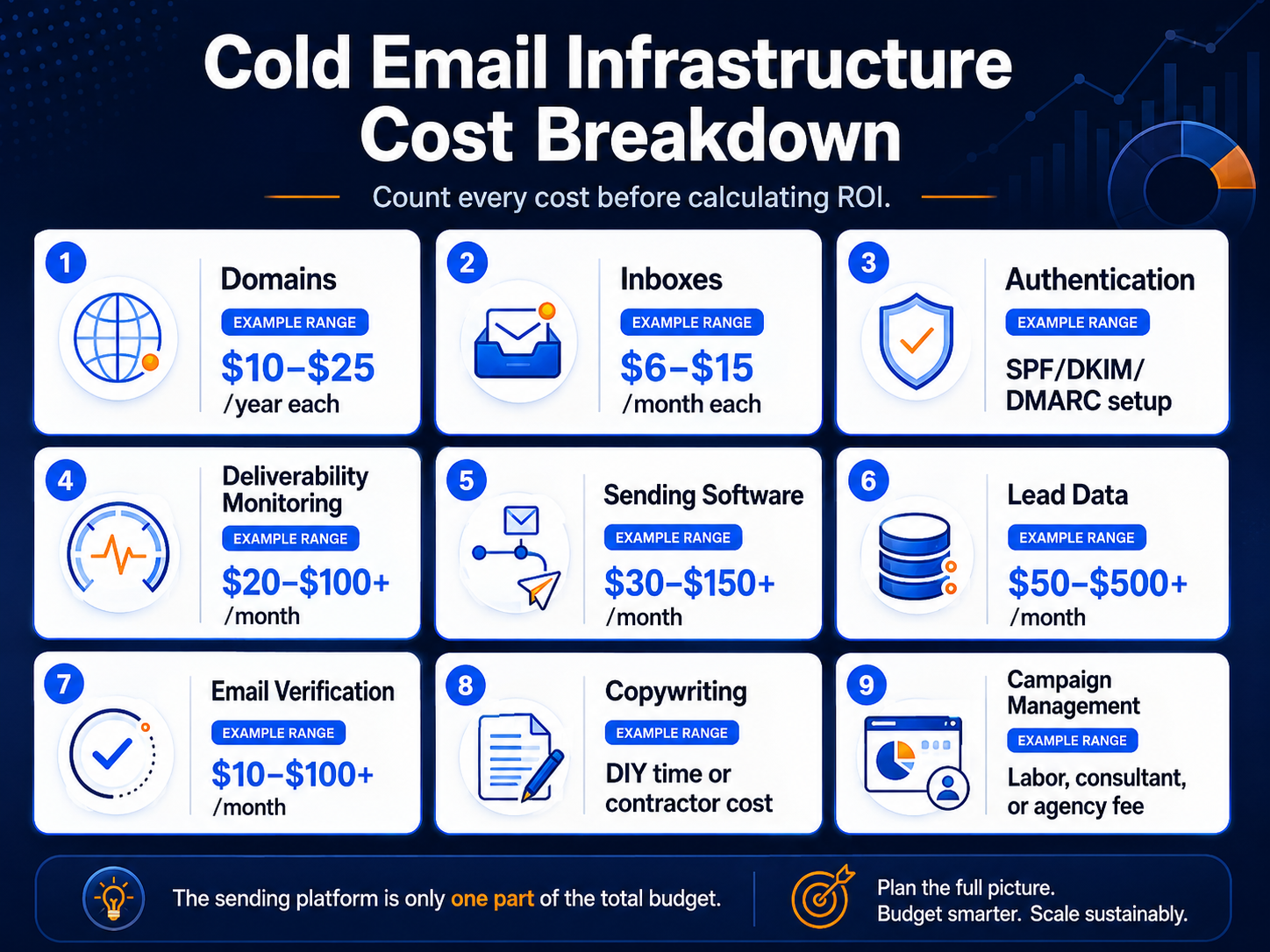
The ranges below are planning examples, not universal prices. Actual costs depend on volume, providers, geography, data needs, agency scope, and whether you handle setup yourself or outsource it.
| Cost item | What it covers | Planning range | Notes |
|---|---|---|---|
| Domains | Separate sending domains used for outbound campaigns | $10-$25/year each | More volume often means more domains; avoid treating domain cost as the whole setup. |
| Inboxes/mailboxes | Email accounts used to send campaign messages | $6-$15/month each | Cold email inbox cost scales with volume and risk tolerance. |
| SPF/DKIM/DMARC setup | Basic sender authentication records | DIY time or setup help | Authentication supports trust, but it does not guarantee inbox placement. |
| Warmup/deliverability monitoring | Inbox health monitoring and reputation signals | $20-$100+/month | Useful for monitoring, not a guarantee of deliverability. |
| Sending platform | Sequencing, campaign management, tracking, and replies | $30-$150+/month | Cold email software cost is only one part of the full budget. |
| Lead data | Prospect lists, enrichment, contact data, and company data | $50-$500+/month | Bad data can quietly increase cost per lead and cost per meeting. |
| Email verification | Checking addresses before sending | $10-$100+/month | Can reduce avoidable bounces, but cannot make a bad list good. |
| Copywriting | Messaging, subject lines, follow-ups, and test variants | DIY time or contractor cost | Weak copy can make otherwise good infrastructure underperform. |
| Campaign management | Launches, monitoring, replies, testing, and optimization | DIY time, consultant, or agency fee | Often the largest hidden cost. |
| Reporting | Tracking sends, replies, meetings, CPL, CPM, and ROI | DIY time or included in tools/agency | Reporting should connect outreach activity to pipeline economics. |
Why Infrastructure Costs Matter for ROI
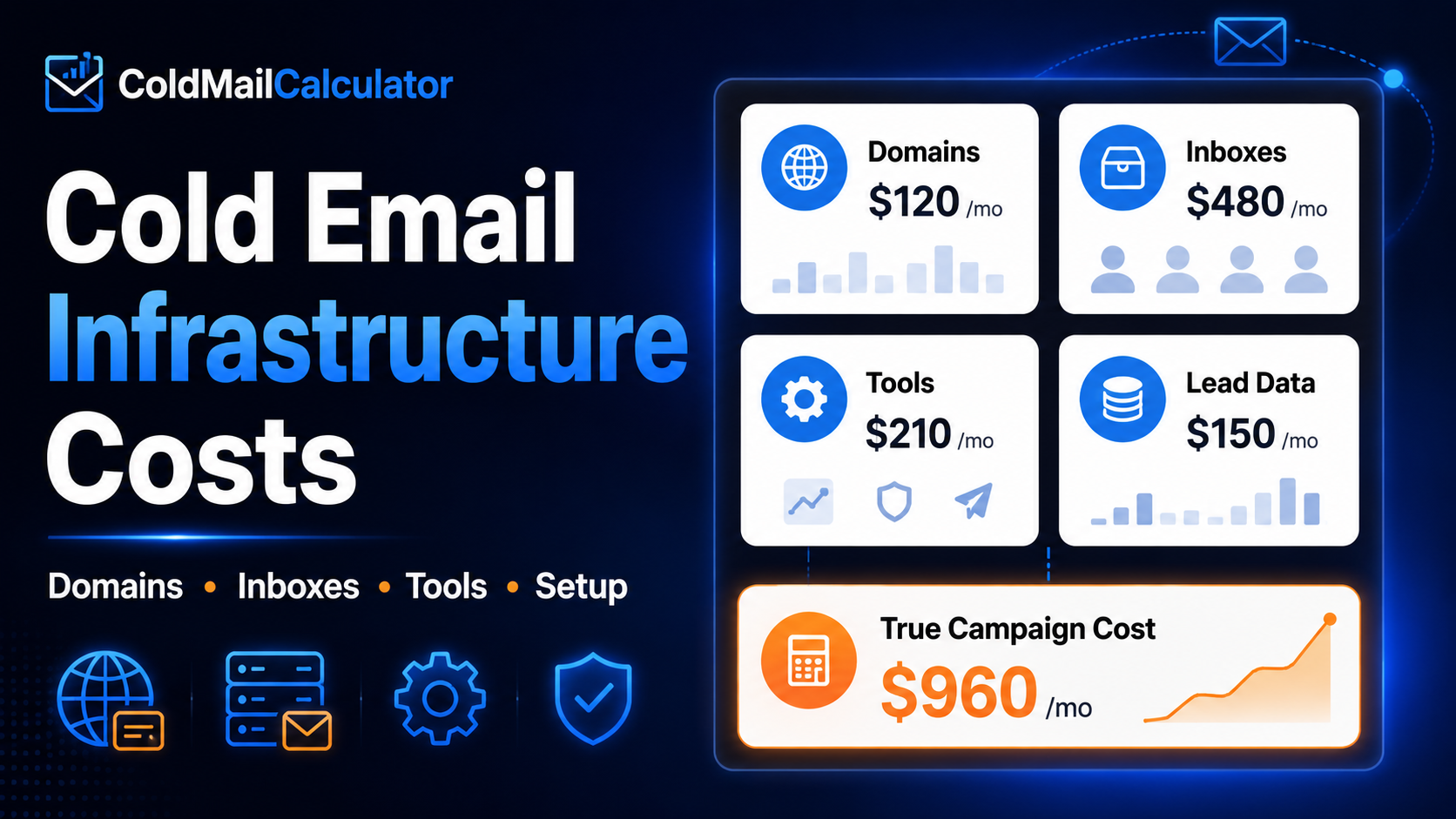
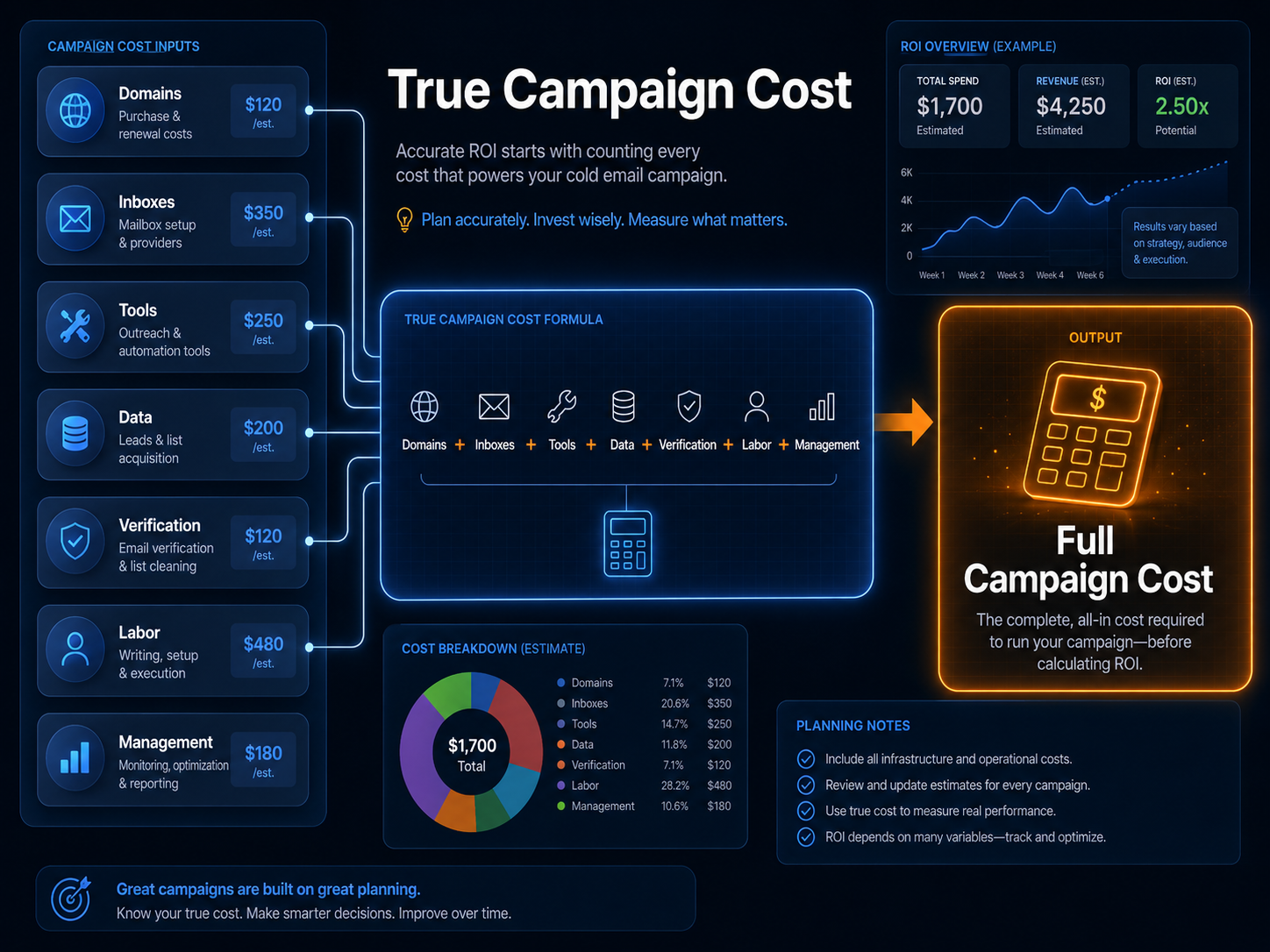
A campaign can look profitable if only the sending tool is counted. That same campaign can become unprofitable once list costs, inboxes, verification, warmup, domains, tools, and labor are included.
True campaign cost formula
Use the full cost when forecasting revenue, profit, cost per lead, and cost per booked meeting.
Before judging a campaign, include every cost required to run it. Then model the economics with the Cold Email ROI Calculator for Agencies.
Calculate true cold email ROI
Include domains, inboxes, tools, data, verification, labor, and management before judging campaign performance.
Use the Agency ROI CalculatorBuilding a cold email tool or agency dashboard?
Use the ColdMail API to forecast replies, meetings, clients, revenue, and ROI from campaign assumptions.
Explore the ColdMail API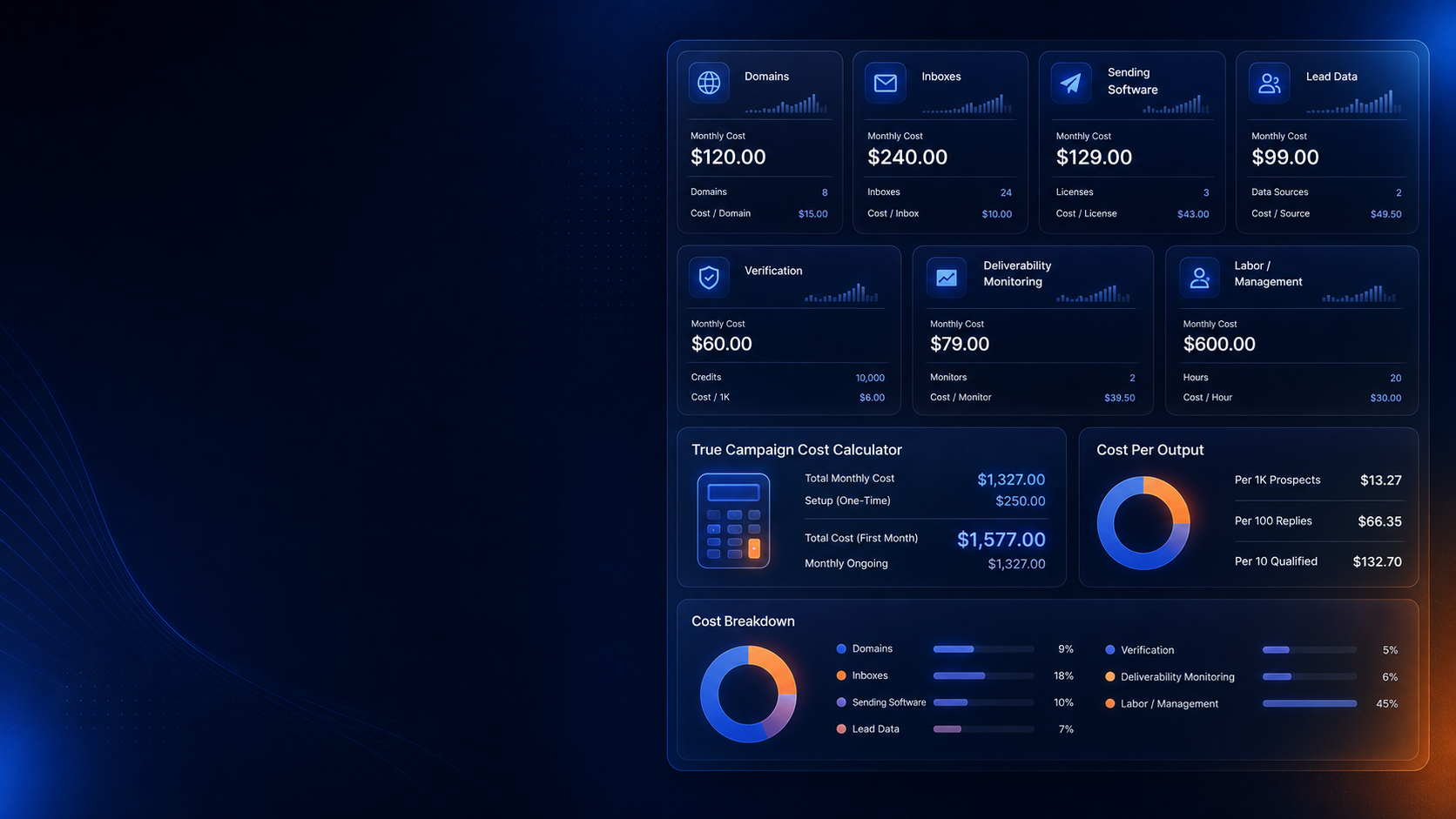
Domains and Inboxes: The Foundation of Cold Email
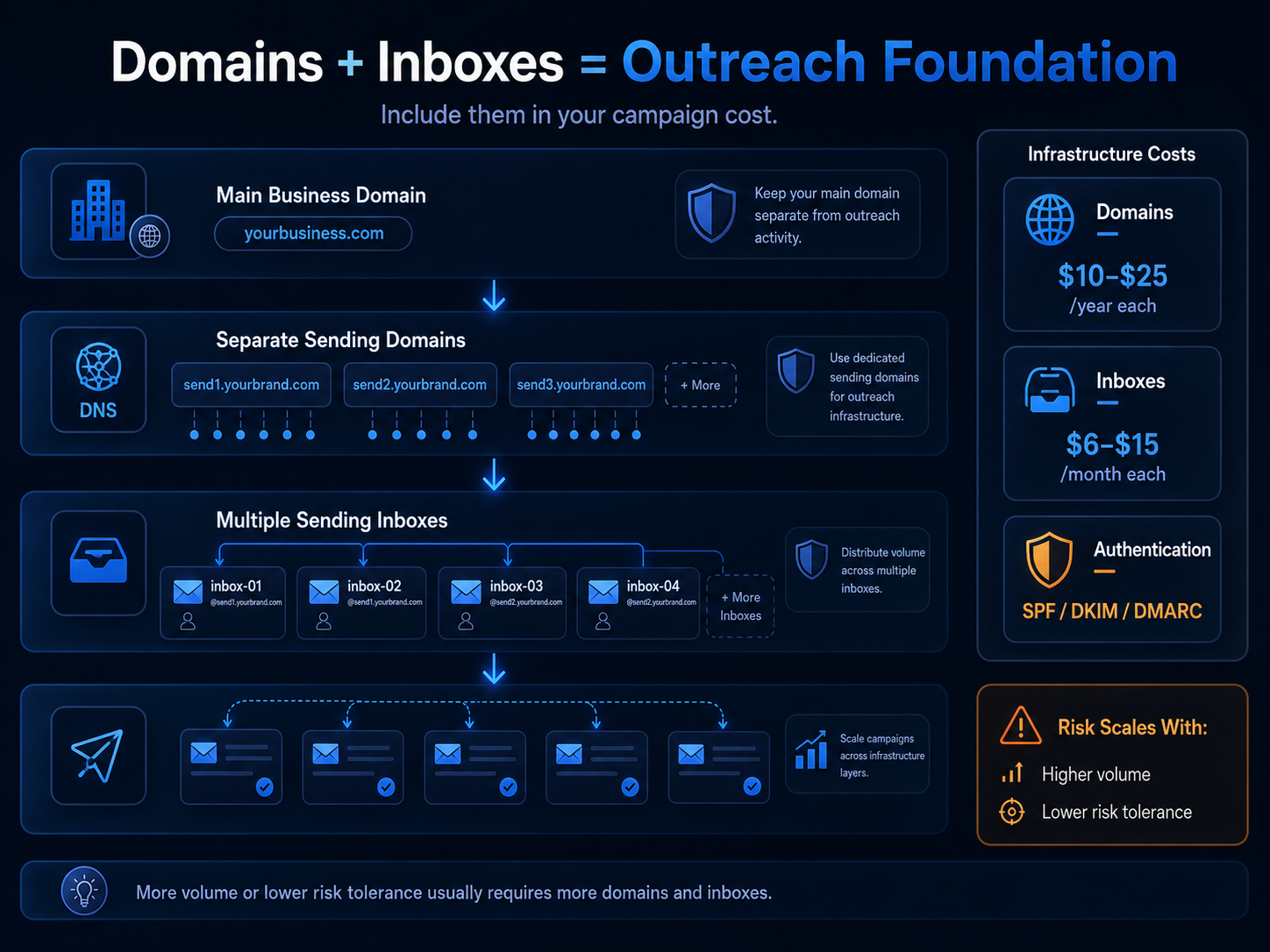
When avoidable, many teams do not send cold email from the main business domain. They use separate sending domains and inboxes to reduce risk to the core brand domain. That does not remove deliverability risk, but it can make the outbound system easier to manage.
Domain age, reputation, authentication, sending behavior, list quality, and sending volume all matter. More volume usually means more inboxes and domains, which means more recurring cost. There is no exact number of inboxes that guarantees safe sending or inbox placement.
This is why cold email domain cost and cold email inbox cost should be included in campaign math even if they look small individually. At scale, they become part of the real cost per lead and cost per meeting.
Software, Warmup, and Deliverability Tools
Sending tools help with sequences, tracking, inbox rotation, reply management, and campaign reporting. Warmup and deliverability tools may help monitor inbox health, but they do not guarantee inbox placement. Authentication, list quality, message quality, sending volume, and recipient engagement still matter.
For ROI planning, include cold email software cost, warmup or deliverability monitoring, and any reporting tools required to understand results. If the agency includes these in its fee, count the agency fee. If they are billed separately, add them to the campaign cost.
Also separate one-time setup work from recurring monthly costs. Domain configuration, inbox creation, authentication, tracking setup, and initial campaign loading may happen once at the beginning. Sending software, inboxes, data, verification, monitoring, and management usually continue every month. Mixing those together can make the first month look unusually expensive or make later months look artificially cheap. For cleaner forecasting, calculate both the first-month cost and the steady-state monthly cost.
If you are comparing providers, ask each vendor which costs are included, which are pass-through, and which are your responsibility. A lower tool subscription can still be more expensive overall if it requires more manual list work, more cleanup, or more reporting time.
Lead Data and Email Verification Costs
Lead data can be one of the biggest hidden costs in cold email. A campaign with cheap software but poor data can produce low reply quality, avoidable bounces, weak personalization, and misleading ROI.
Verification can reduce avoidable bounces, but it does not make every lead qualified. A verified address can still belong to the wrong buyer, wrong company, wrong market, or wrong timing. This is why qualified lead cost matters more than raw list size.
Use the Cold Email Cost Per Lead Calculator to connect data cost, reply rate, and qualified lead volume to campaign efficiency.
Labor Costs: The Cost Most People Forget
Labor is often the largest hidden cost. Cold email requires ICP research, list building, copywriting, personalization, campaign setup, reply handling, reporting, and optimization. Even if you do not pay an agency, that time still has a cost.
If an agency does this work, it appears as an agency fee. If a founder, SDR, marketer, or assistant does it internally, it appears as time cost. Either way, it should be part of ROI math.
Ignoring labor makes DIY campaigns look artificially cheap. Including labor helps you compare DIY work against a contractor or the cold email agency cost of a managed campaign.
Example Cold Email Infrastructure Budgets
Starter DIY
Low volume, a few inboxes, a basic sending tool, and a smaller data budget. Watch for undercounted labor because setup, list building, and reply handling still take time.
Growth Campaign
More inboxes/domains, better data, verification, more testing, and stronger reporting. Watch for cost creep across tools, data, and management time.
Agency-Managed Campaign
Agency fee may include infrastructure or bill it separately. Watch for ownership clarity, reporting depth, and whether the fee improves cost per meeting.
Infrastructure Cost vs Cost Per Meeting
The key question is not just how much infrastructure costs. The better question is: "How many qualified meetings does this infrastructure help create?"
Cost per meeting formula
Total campaign cost should include infrastructure, data, verification, tools, labor, management, and agency fees.
Turn the full campaign cost into a meeting-level number with the Cold Email Cost Per Meeting Calculator. That number makes vendor quotes, DIY experiments, and agency retainers easier to compare. To estimate the email volume behind those meeting costs, read the guide on how many cold emails to book a meeting.
See your cost per booked meeting
Turn your full campaign cost into a simple cost per qualified meeting.
Calculate Cost Per MeetingFinal Takeaway
Before judging whether cold email is expensive, include the full infrastructure cost. Then calculate cost per lead, cost per meeting, and ROI.
Use the Cold Email ROI Calculator for Agencies to estimate the full campaign economics before scaling a campaign or comparing agency quotes.
FAQ
What is cold email infrastructure?
Cold email infrastructure is the system behind outreach: domains, inboxes, authentication, deliverability monitoring, sending software, lead data, verification, reporting, and campaign management.
How much does cold email infrastructure cost?
For planning, domains may be $10-$25 per year each, inboxes $6-$15 per month each, sending tools $30-$150+ per month, data $50-$500+ per month, verification $10-$100+ per month, and agency management $1,500-$7,500+ per month. These are examples, not guarantees.
Do I need separate domains for cold email?
Many teams use separate sending domains when avoidable to reduce risk to the main business domain. The right setup depends on volume, risk tolerance, and technical needs.
How many inboxes do I need for cold email?
It depends on volume, sending behavior, reputation, and campaign risk. More volume usually means more inboxes, but no inbox count guarantees deliverability.
Should I include lead data in campaign cost?
Yes. Lead data and enrichment directly affect reply quality, bounce risk, cost per lead, and cost per meeting.
Are warmup tools required?
Warmup and deliverability tools may help monitor inbox health, but they do not guarantee inbox placement. Authentication, list quality, sending behavior, and message quality still matter.
What is the biggest hidden cost in cold email?
Labor is often the biggest hidden cost because strategy, list building, personalization, copywriting, reply handling, reporting, and optimization take time.
How do I calculate the true cost of a cold email campaign?
Add domains, inboxes, tools, data, verification, labor, and management. Then compare the full cost against qualified leads, booked meetings, customers, revenue, and ROI.