How Many Cold Emails Does It Take to Book a Meeting?
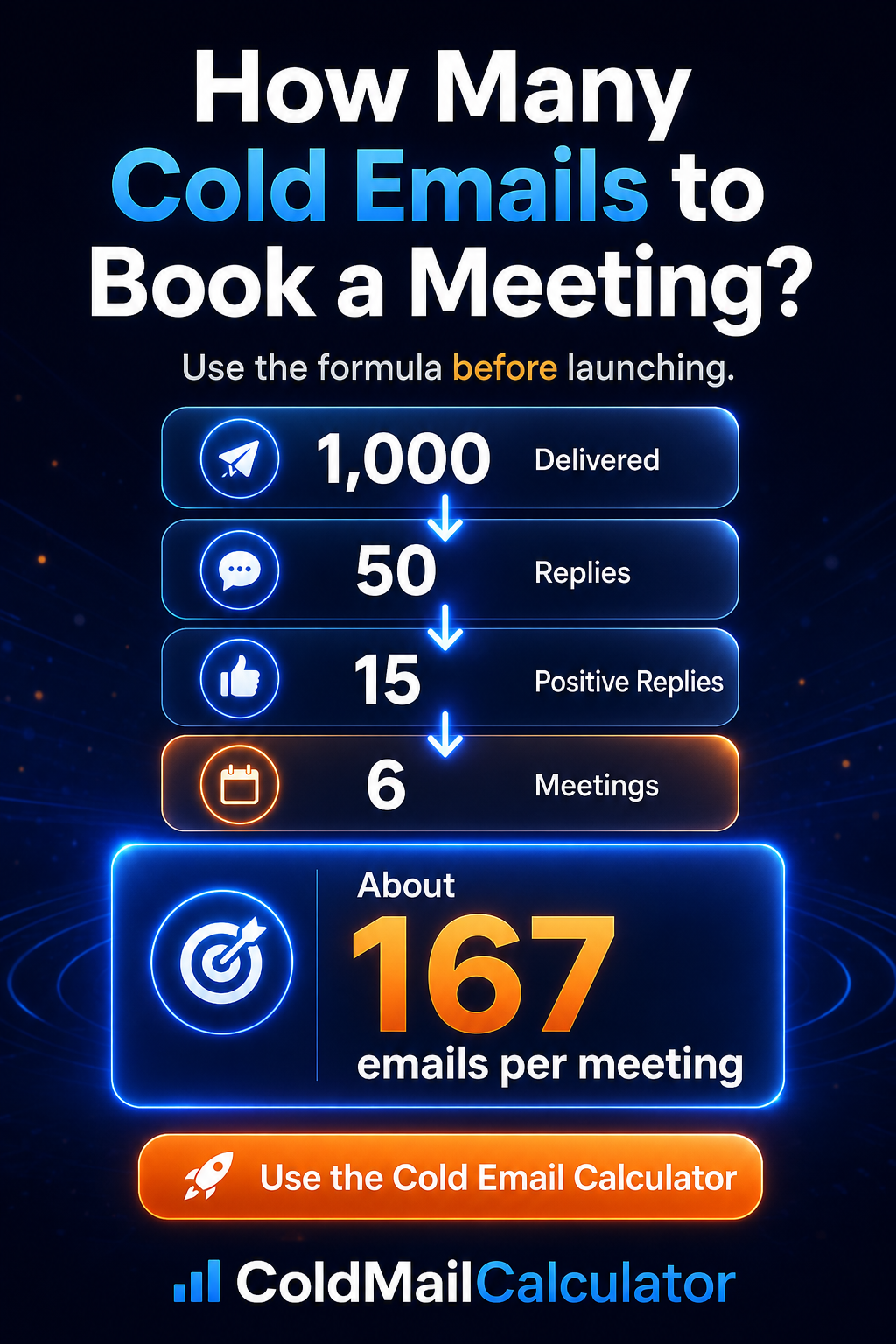
For planning purposes, most cold email campaigns need roughly 100 to 250 delivered emails per booked meeting, depending on delivery rate, reply rate, positive reply rate, and meeting booking rate. The exact number varies by market, offer, targeting, list quality, and follow-up process. Use the formula below to estimate your own volume before launching a campaign.
Short answer
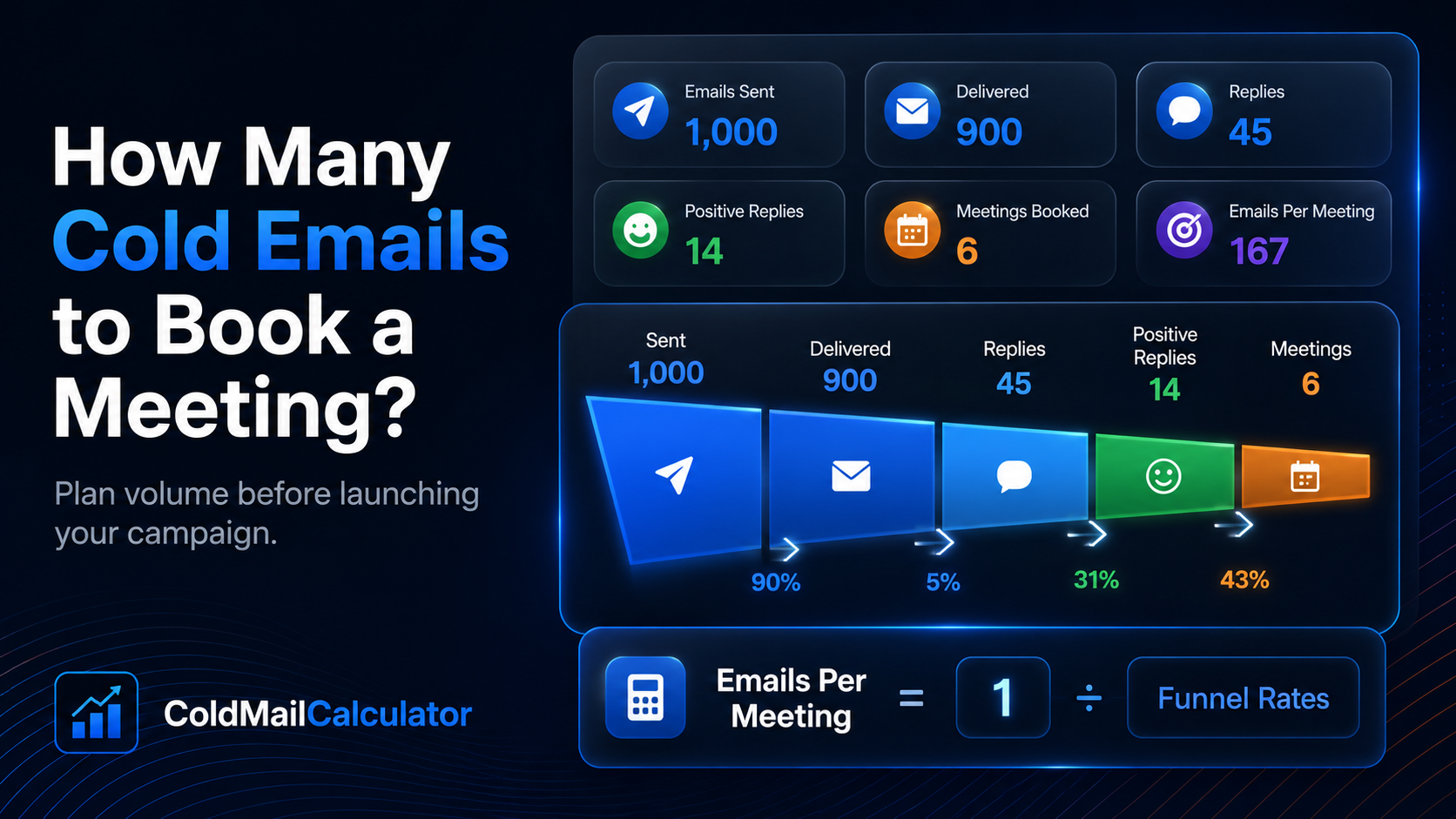
The number of cold emails needed to book one meeting depends on four main factors:
- Delivery rate — how many sent emails reach an inbox
- Reply rate — how many delivered emails get any reply
- Positive reply rate — how many replies express genuine interest
- Meeting booking rate — how many positive replies turn into a booked calendar event
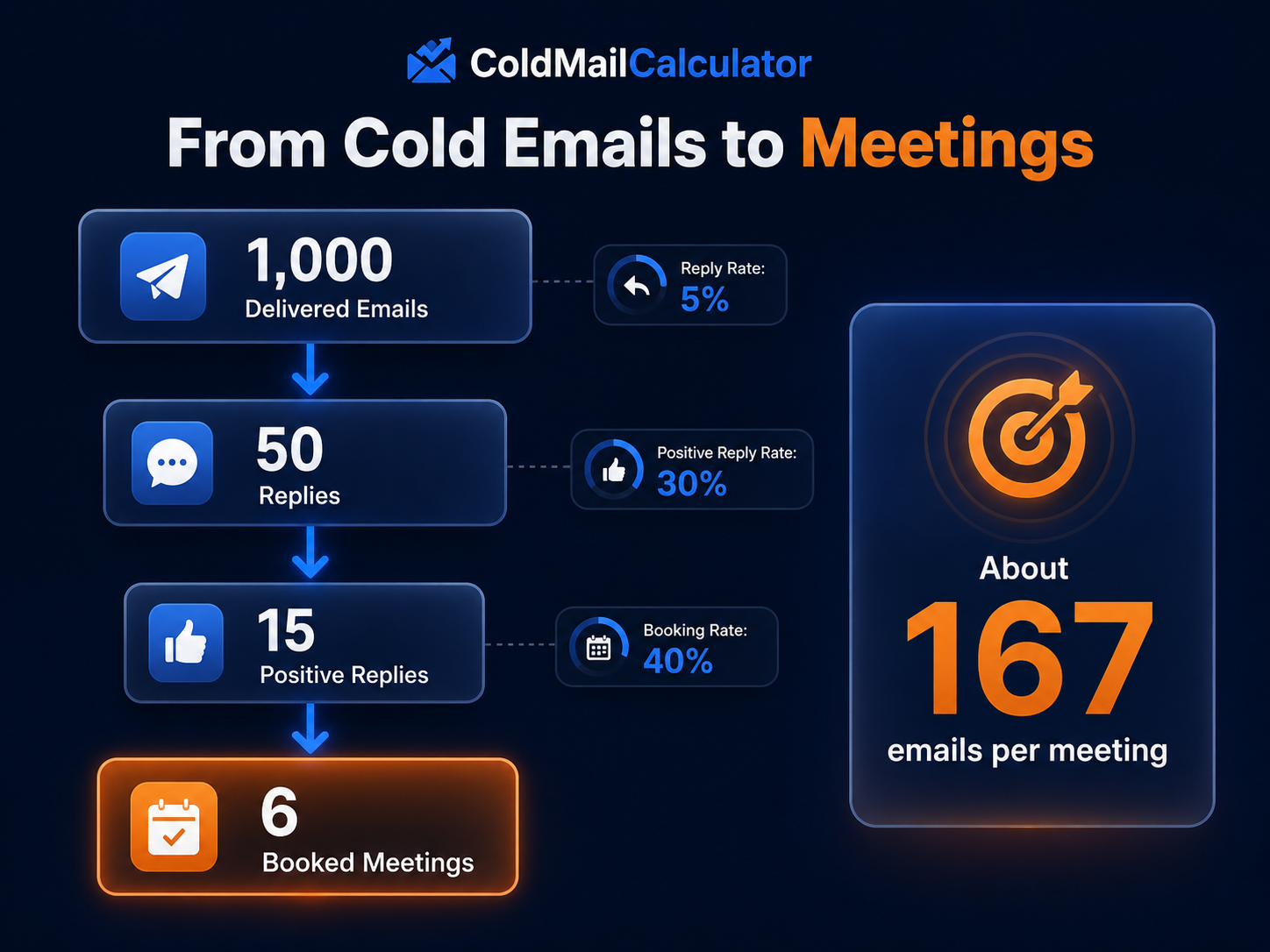
Example: If 1,000 emails are delivered, 5% reply, 30% of replies are positive, and 40% of positive replies book a meeting:
- Replies: 50
- Positive replies: 15
- Meetings: 6
- Emails per meeting: about 167 delivered emails
These are estimates, not guarantees. Actual results depend on targeting, offer, market, deliverability, timing, and sales follow-up.
The Simple Formula for Emails Per Meeting
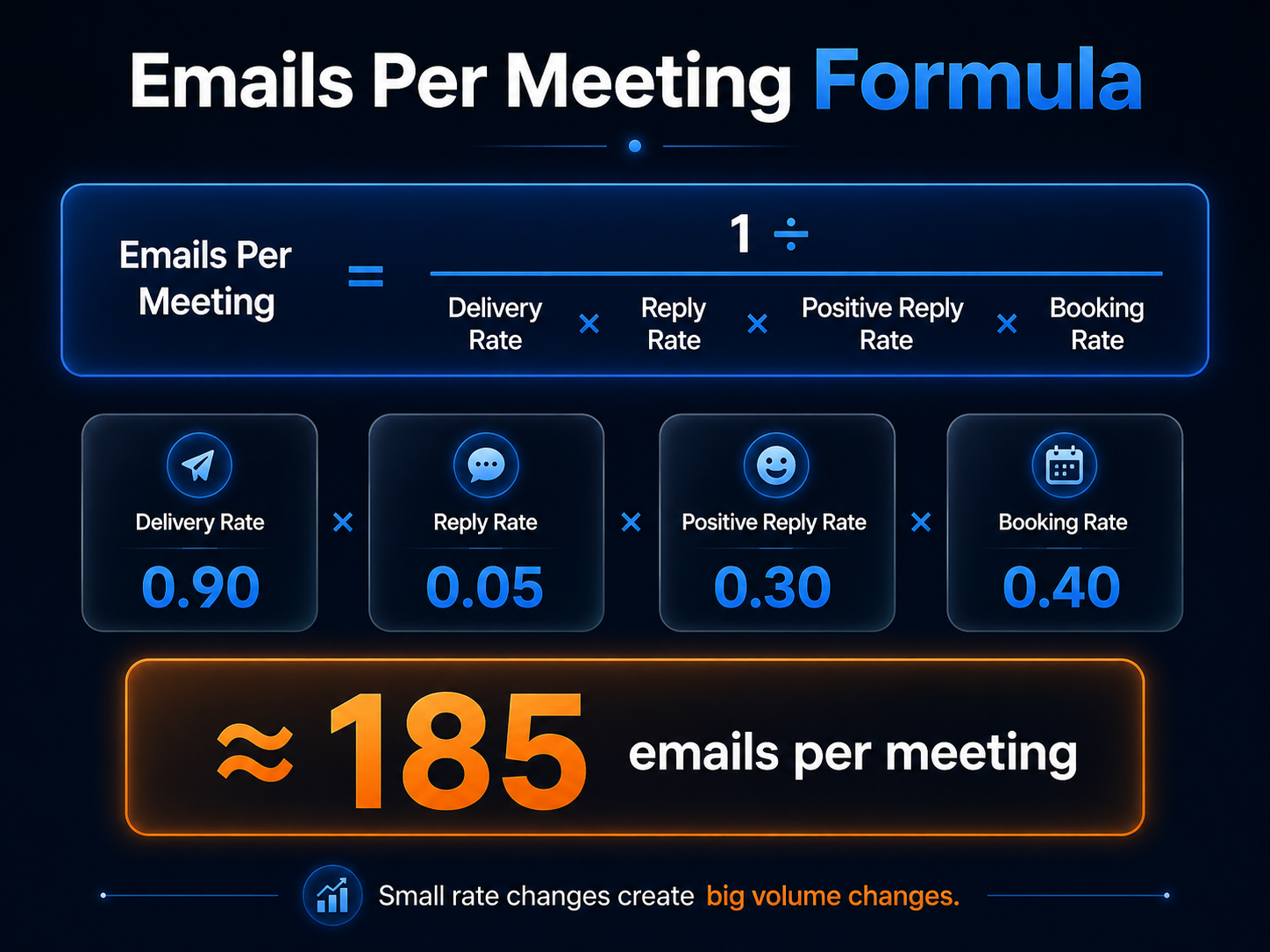
You can estimate cold email volume needed per meeting with a straightforward formula. Multiply the four key rates together, then divide one by the result.
Emails per meeting formula
Enter each rate as a decimal, not a whole percentage. For example:
- 90% delivery rate = 0.90
- 5% reply rate = 0.05
- 30% positive reply rate = 0.30
- 40% meeting booking rate = 0.40
Example calculation
That means if you send 185 cold emails with these rates, you can roughly expect one booked meeting. If your rates are lower, the number goes up. If your rates are higher, the number goes down.
What Counts as a Booked Meeting?
Before calculating volume, define what counts as a booked meeting. Not every email reply or phone chat is a real booked meeting. For planning purposes, a booked meeting should usually mean:
- A qualified prospect in the right role and company fit
- A real calendar booking with a confirmed time slot
- Clear interest in the problem or offer being discussed
- The prospect has the authority or influence to move forward
Agencies should define meeting qualification rules before using pay-per-meeting pricing or publishing case studies. Without clear criteria, volume estimates become unreliable and cost per meeting math becomes misleading.
Cold Email Benchmarks That Affect Meeting Volume
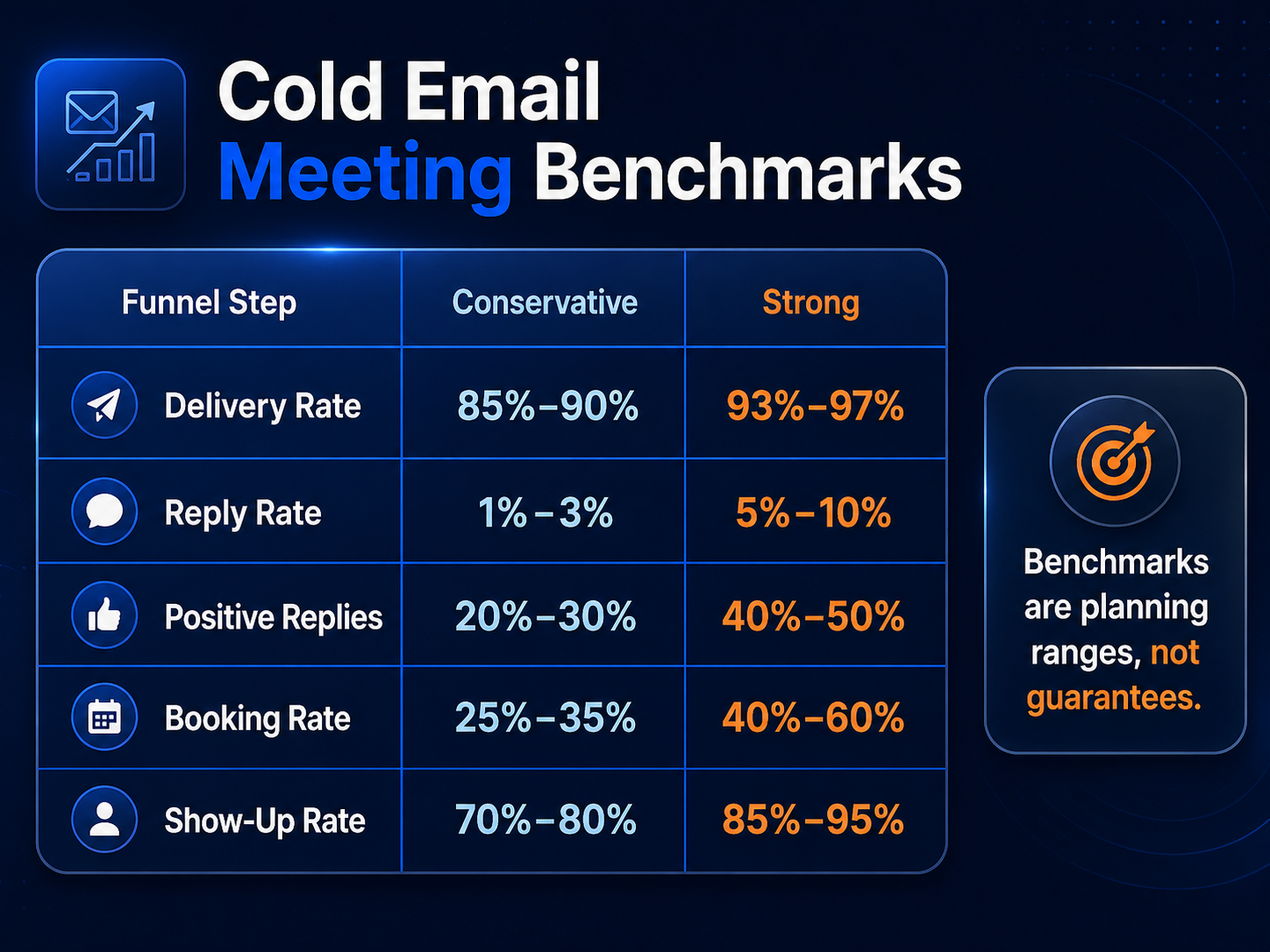
The table below shows conservative and strong planning assumptions for each stage of the cold email funnel. Use these as starting points, then update them with your own campaign data.
| Funnel step | Conservative planning assumption | Strong planning assumption | Why it matters |
|---|---|---|---|
| Delivery rate | 85-90% | 93-97% | Low delivery means fewer prospects see your email, inflating the volume needed per meeting |
| Reply rate | 1-3% | 5-10% | More replies give you more conversations to qualify and convert into meetings |
| Positive reply rate | 20-30% of replies | 40-50% of replies | Only positive replies can become meetings; total reply rate alone is misleading |
| Meeting booking rate | 25-35% of positive replies | 40-60% of positive replies | Converting positive replies into calendar bookings is where pipeline becomes real |
| Show-up rate | 70-80% | 85-95% | Booked meetings that no one attends waste cost and slow down pipeline building |
| Close rate | 10-20% of meetings | 25-40% of meetings | Meetings only matter if they turn into customers and revenue |
For a deeper look at reply rate assumptions, read the cold email reply rate benchmarks guide.
Example: How Many Cold Emails to Book 10 Meetings?
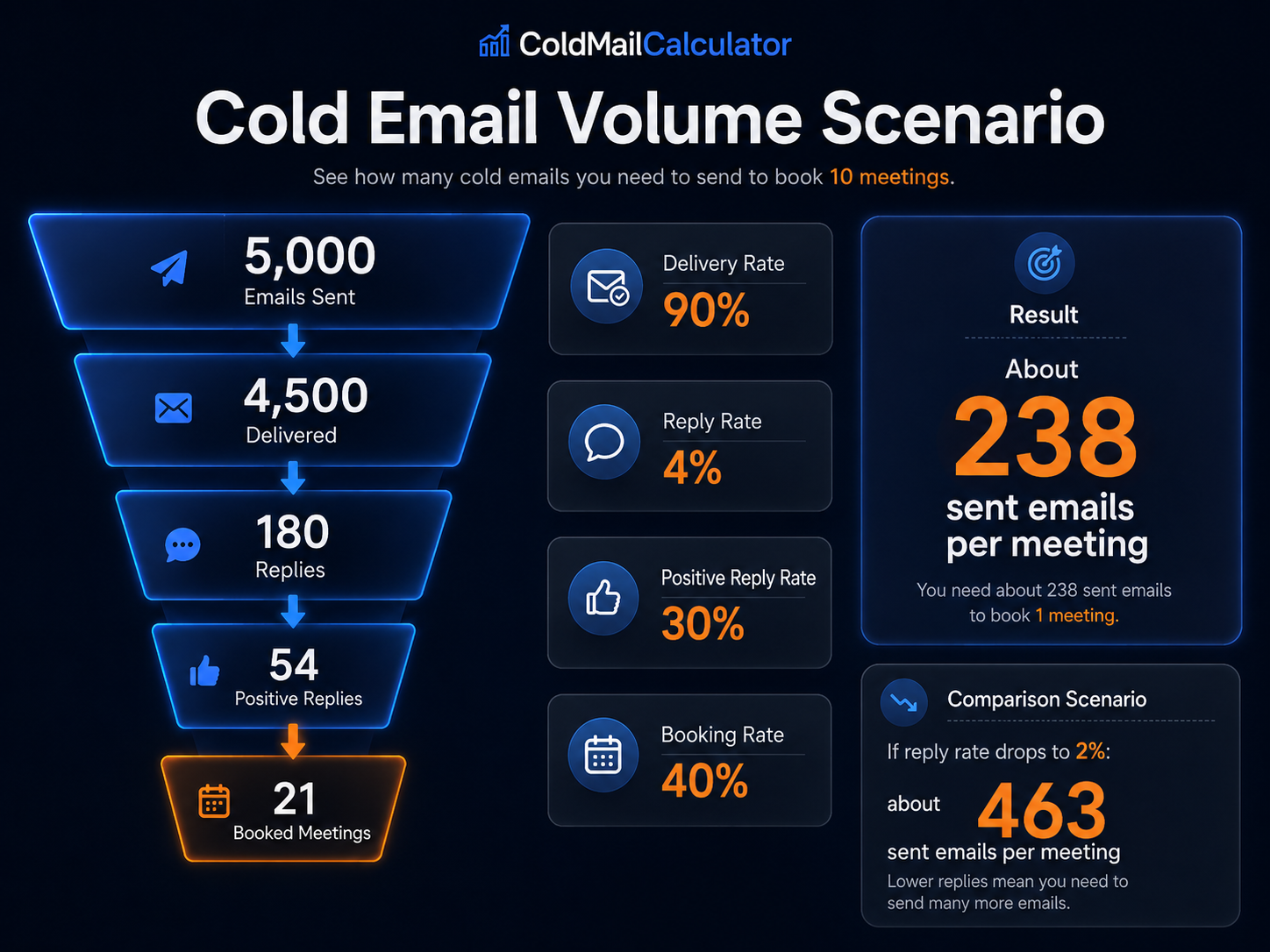
Let’s run a real scenario. You send 5,000 cold emails with the following planning assumptions:
- 90% delivery rate
- 4% reply rate
- 30% positive reply rate
- 40% meeting booking rate
Scenario breakdown
- 5,000 sent × 0.90 delivery = 4,500 delivered
- 4,500 delivered × 0.04 reply = 180 replies
- 180 replies × 0.30 positive = 54 positive replies
- 54 positive replies × 0.40 booking = 21.6 booked meetings
In this scenario, 5,000 sent emails produce roughly 21 booked meetings. That is about 238 sent emails per meeting. If the reply rate drops to 2%, the same 5,000 emails produce about 10.8 meetings, or about 463 sent emails per meeting.
This is why small changes in early funnel rates produce large changes in meeting volume. Improving delivery from 90% to 95% or reply rate from 3% to 5% can reduce the emails needed per meeting noticeably.
Why Reply Rate Alone Does Not Predict Meetings
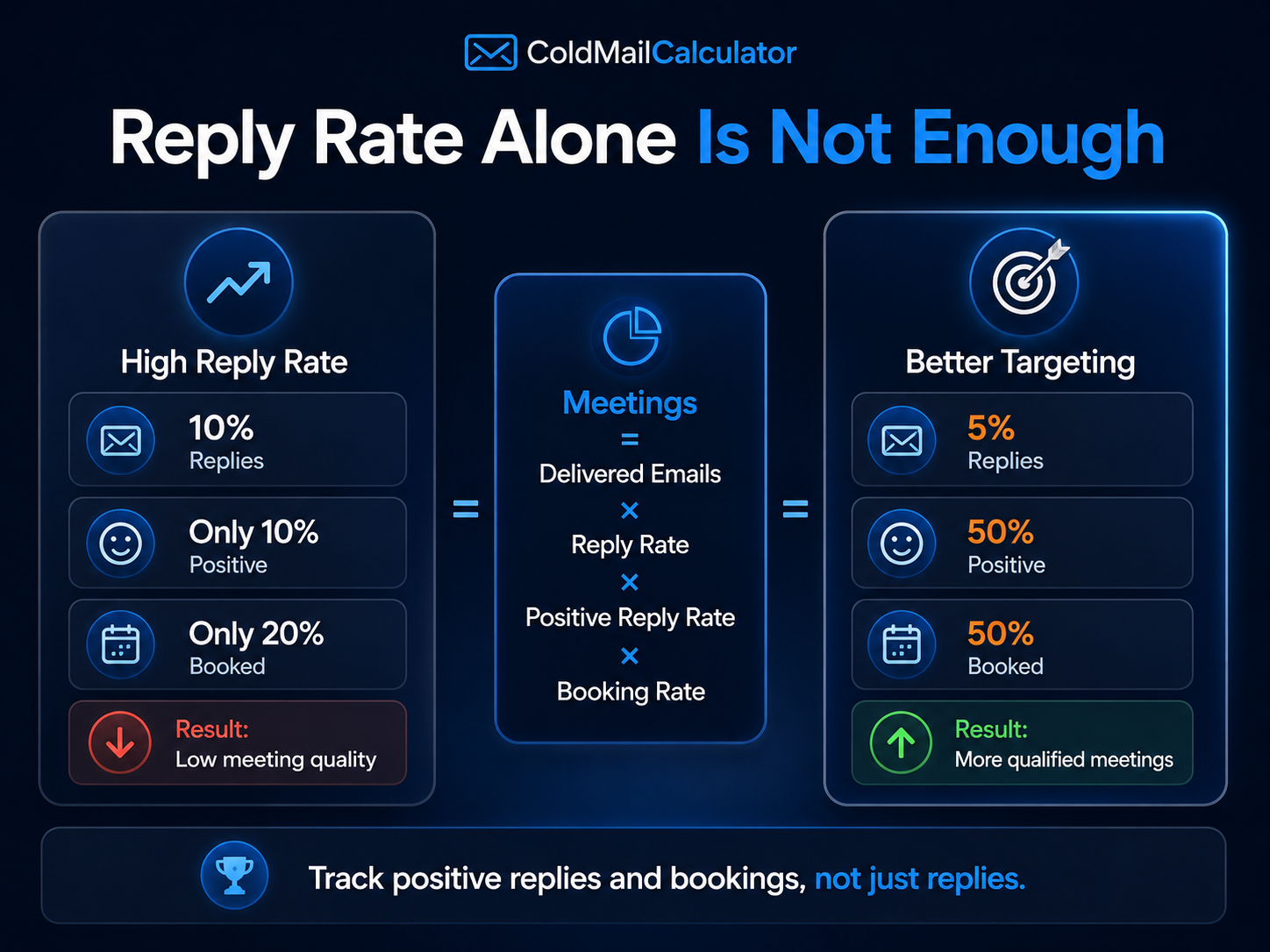
A high reply rate with poor-fit prospects can create very few qualified meetings. A lower reply rate with strong targeting can create more valuable meetings because positive reply quality is higher. The full formula to understand is:
Meetings formula
If you only track reply rate, you miss two critical steps: whether replies are positive and whether those positive replies turn into bookings. A campaign with a 10% reply rate but only 10% positive replies and 20% booking rate creates fewer meetings than a campaign with a 5% reply rate, 50% positive replies, and 50% booking rate.
Use the Cold Email Cost Per Meeting Calculator to connect these funnel rates to real meeting economics.
How Cost Changes the Answer
The question is not just “how many emails?” It is also “how much does each meeting cost?” Volume only matters if the cost per meeting fits your business model. A campaign that needs 500 emails per meeting can still be profitable if each meeting has a high enough close rate and customer value.
Cost per meeting formula
Example: $2,500 campaign cost with 10 qualified meetings equals $250 per meeting.
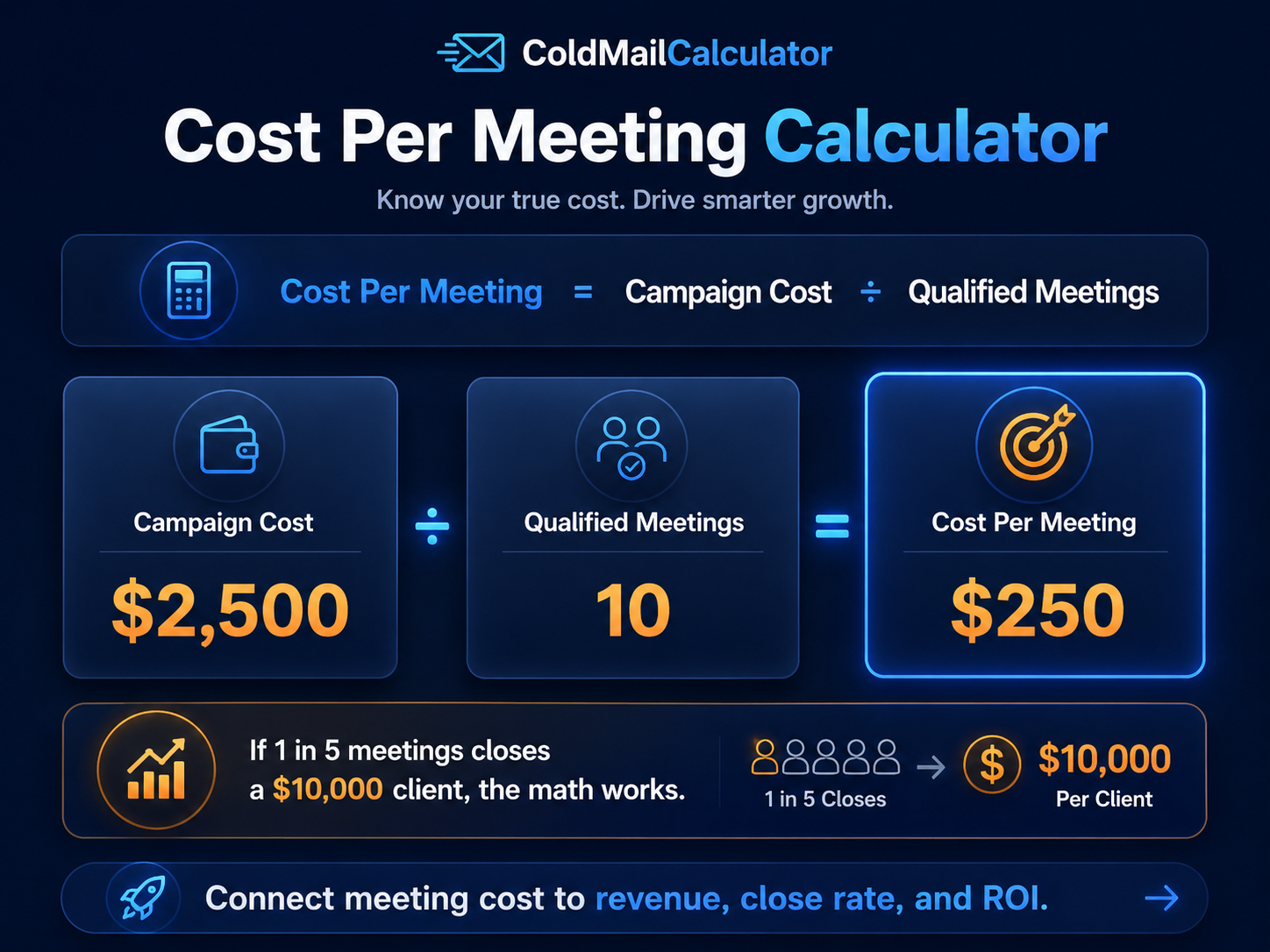
Whether $250 per meeting is reasonable depends on your average customer value and close rate. If one in five meetings becomes a $10,000 client, that $250 meeting cost is easy to justify. If one in twenty meetings becomes a $1,000 client, the same meeting cost may be too high.
Test your own assumptions with the Cold Email Cost Per Meeting Calculator before scaling volume.
Calculate your cost per booked meeting
Estimate how many meetings your campaign may create and what each qualified meeting could cost.
Use the Cost Per Meeting CalculatorHow Many Cold Emails Should You Send Per Day?
Daily volume is a common question, but there is no safe universal number that applies to every sender. The right daily volume depends on domain age, inbox setup, sender reputation, list quality, and risk tolerance. What works for an established sending infrastructure may damage a new domain.
For planning purposes, keep these principles in mind:
- Ramp slowly. Start with low volume and increase gradually as deliverability stabilizes.
- Monitor bounces and replies. A rising bounce rate or sudden drop in replies may signal a deliverability problem.
- Avoid sending from the main domain when possible. Use separate sending domains to protect your primary business domain.
- Quality beats raw volume. Sending more emails to a poor list rarely creates more meetings. It usually creates more bounces, more spam complaints, and higher cost.
For a detailed breakdown of the setup costs behind sending infrastructure, read the guide to cold email infrastructure costs.
How Agencies Should Use This in Campaign Planning
Agencies should avoid promising exact meeting counts to clients. A more honest and useful approach is to show multiple scenarios: a conservative case, a base case, and a strong case. This helps clients understand the range of possible outcomes and makes reporting more transparent after launch.
| Scenario | Reply rate | Positive reply rate | Booking rate | Planning use |
|---|---|---|---|---|
| Conservative | 1-3% | 20-25% | 25-30% | New market, unproven offer, or early testing |
| Base case | 3-6% | 30-40% | 35-45% | Clear ICP, decent data, relevant offer, normal campaign risk |
| Strong campaign | 6-10% | 40-50%+ | 45-60% | Narrow list, high relevance, proven offer, strong personalization |
Using low/base/high scenarios keeps client expectations realistic and helps the agency explain variance after launch. If actual results land below the conservative case, the team investigates targeting, data, deliverability, or offer-market fit. If results meet the base case, the campaign is on track. If results hit the strong case, the team can discuss scaling.
Forecast full campaign economics with the Cold Email ROI Calculator for Agencies before onboarding new clients or setting retainer expectations.
Forecast full campaign ROI
Model emails, replies, meetings, clients, revenue, cost, and ROI before launching a campaign.
Use the Agency ROI CalculatorBuilding a cold email tool or agency dashboard?
Use the ColdMail API to forecast replies, meetings, clients, revenue, and ROI from campaign assumptions.
Explore the ColdMail APIHow to Improve Meeting Booking Rate
Improving the number of meetings from a cold email campaign is usually a process of small, cumulative improvements. No single change guarantees more bookings, but these tactics help move the rate in the right direction:
- Target a narrower ICP. A tighter ideal customer profile means higher relevance and more willing conversations.
- Use a clearer offer. If the prospect cannot quickly understand what you do and why it matters, they will not book a meeting.
- Personalize the opener. The first line should connect to something specific about the prospect or their company.
- Make the CTA low-friction. Ask for a short call or a simple reply instead of a multi-step booking process.
- Ask a simple question. Questions that show research and curiosity often get more positive replies than direct pitches.
- Follow up. Most replies and bookings happen after the first email. A structured follow-up sequence matters.
- Improve reply handling. Reply quickly and professionally. Slow responses lose momentum and trust.
- Qualify prospects before booking. Not every reply should become a meeting. Pre-qualifying saves time and improves show-up rate.
- Test one variable at a time. Change the offer, CTA, personalization approach, or follow-up cadence, then measure the effect on booking rate.
Final Takeaway
A good cold email campaign is not measured only by how many emails you send. It is measured by how many qualified meetings and customers those emails create.
Use the Cold Email Cost Per Meeting Calculator to estimate your meeting economics before launching. Then use the Cold Email ROI Calculator for Agencies to connect meetings, close rate, customer value, and total campaign cost into a full ROI model.
FAQ
How many cold emails does it take to book one meeting?
For planning purposes, a common estimate is between 100 and 250 cold emails delivered per booked meeting. This depends on delivery rate, reply rate, positive reply rate, and meeting booking rate. Use the formula: Emails Per Meeting = 1 / (Delivery Rate × Reply Rate × Positive Reply Rate × Meeting Booking Rate).
How many cold emails should I send to book 10 meetings?
If you estimate 185 cold emails sent per booked meeting, you would need roughly 1,850 sent emails to book 10 meetings. A more conservative estimate would be around 2,500 sent emails. The exact number depends on your delivery rate, reply rate, positive reply rate, and booking rate.
What is a good cold email meeting booking rate?
For planning purposes, many teams model a meeting booking rate around 30-50% of positive replies. That means if someone replies positively, there is a 30-50% chance they will actually book a meeting. The rate depends on offer clarity, CTA friction, timing, qualification criteria, and follow-up speed.
Does reply rate equal booked meeting rate?
No. Reply rate and booked meeting rate are different. Reply rate measures how many delivered emails get any reply. Booked meeting rate measures how many positive replies turn into actual calendar bookings. A campaign can have a high reply rate but a low booked meeting rate if replies are unqualified or the CTA is unclear.
How many cold emails should I send per day?
There is no safe universal number. Daily send volume depends on domain age, inbox setup, sender reputation, list quality, and risk tolerance. Most teams start low, ramp slowly, and monitor bounces, spam complaints, and reply quality closely before increasing volume.
What is a good cost per meeting from cold email?
A good cost per meeting depends on customer value and close rate. For high-ticket B2B offers, $200-$500 per meeting may be workable. For lower-value offers, the cost per meeting needs to be proportionally lower. Calculate your own cost per meeting with the Cold Email Cost Per Meeting Calculator.
How do I calculate emails needed per meeting?
Use the formula: Emails Per Meeting = 1 / (Delivery Rate × Reply Rate × Positive Reply Rate × Meeting Booking Rate). Enter each rate as a decimal. For example, with 0.90 delivery, 0.05 reply, 0.30 positive reply, and 0.40 booking rate, you need about 185 sent emails per booked meeting.
Can a cold email campaign guarantee meetings?
No. Cold email cannot honestly guarantee meetings because results depend on targeting, offer, timing, deliverability, copy, list quality, follow-up, and sales process. Any provider who guarantees a specific number of meetings without qualification rules should be treated with skepticism.