Cold Email Reply Rate Benchmarks: What Is a Good Reply Rate?
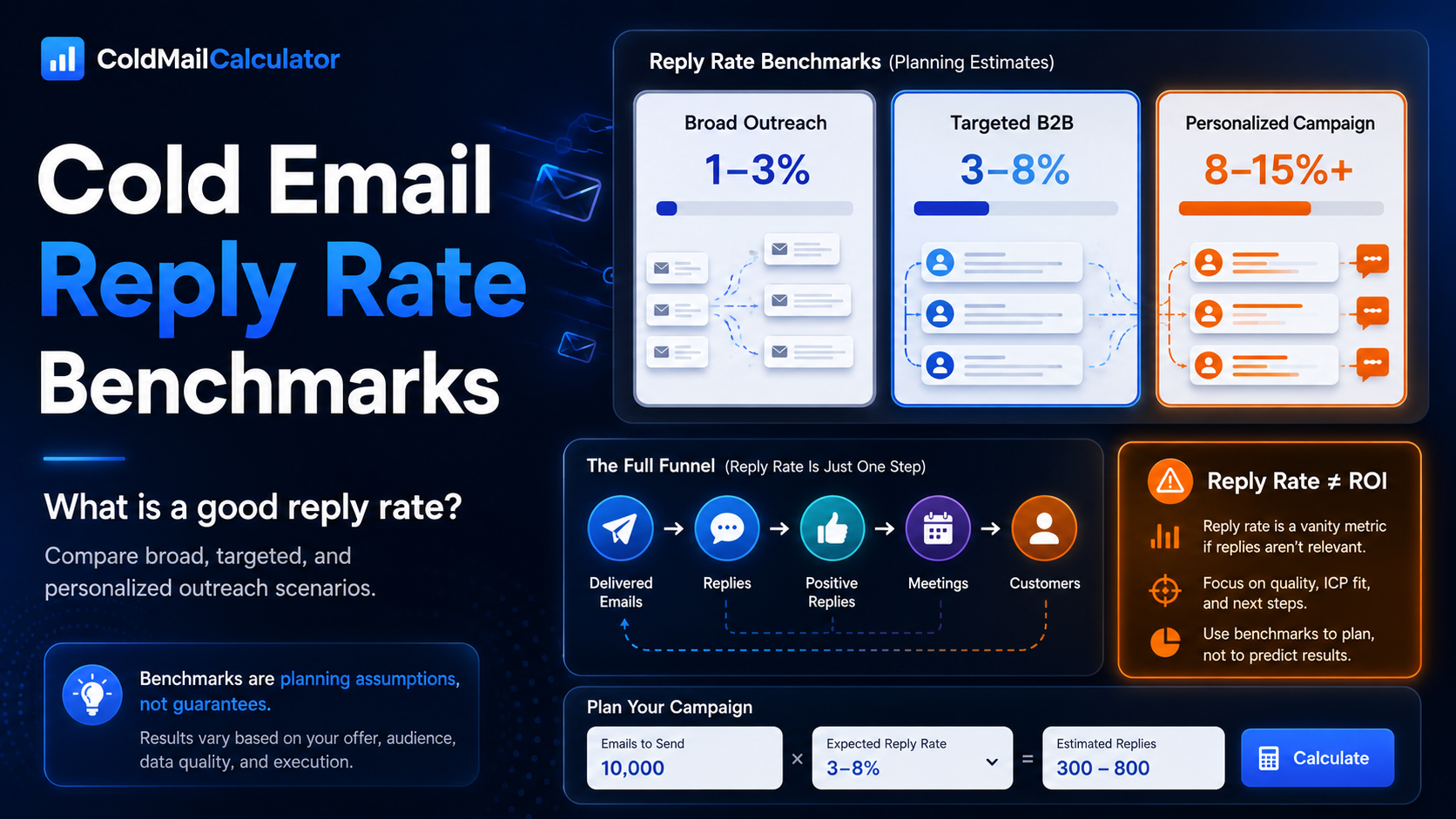
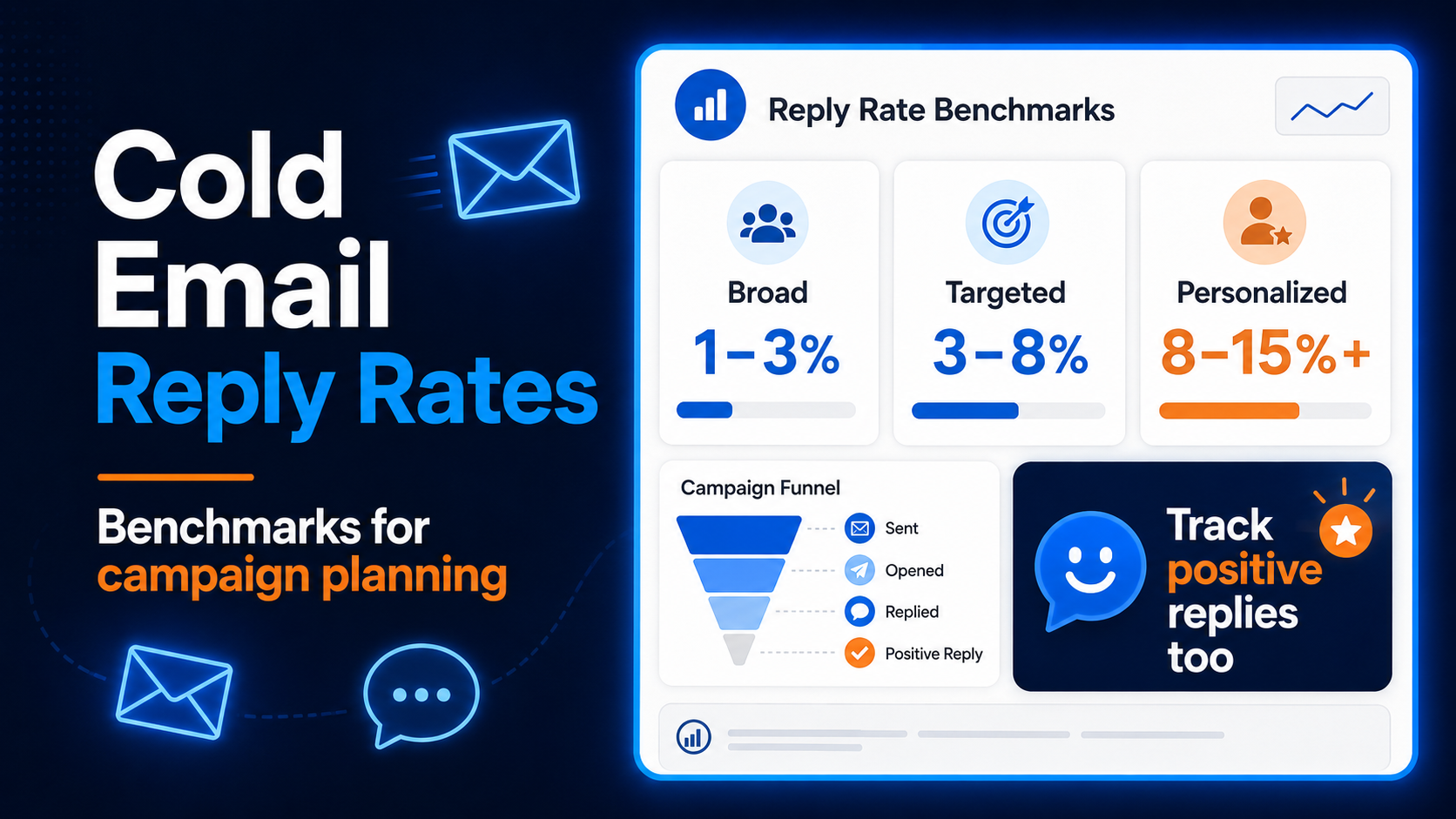
For planning, many cold email teams model reply rates around 1-3% for broad outreach, 3-8% for targeted B2B outreach, and 8-15%+ for highly relevant, personalized campaigns with a strong offer. Those are estimates, not promises. The real goal is not replies by themselves. The goal is qualified conversations, booked meetings, customers, and profitable ROI.
Short answer
For planning purposes, many cold email campaigns model reply rates somewhere around:
- 1-3% for broad or weakly personalized outreach
- 3-8% for targeted B2B outreach
- 8-15%+ for highly relevant, personalized campaigns with a strong offer
Reply rate is not the same as positive reply rate, booked meeting rate, or customer conversion rate. Your actual results may vary.
What Is a Cold Email Reply Rate?
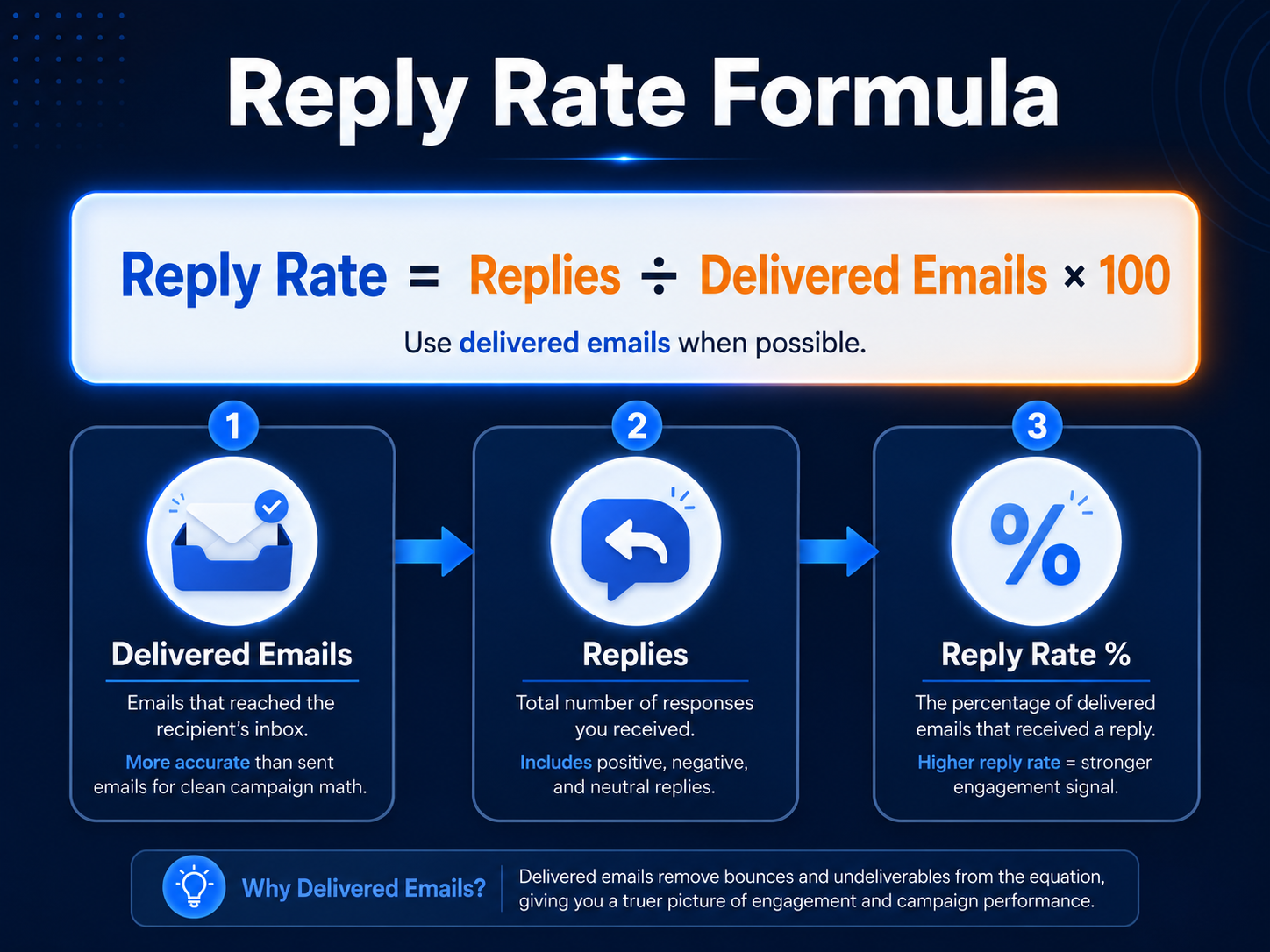
A cold email reply rate measures how many delivered emails produce a reply. Use delivered emails when possible, not only sent emails, because bounces and undelivered emails distort the campaign view.
Reply rate formula
Replies include positive, neutral, negative, and unsubscribe-style replies. That means reply rate alone does not prove campaign profitability. A campaign can get replies and still fail if those replies are not qualified, not interested, or not connected to your offer.
What Is a Good Cold Email Reply Rate?
A good cold email reply rate depends on audience fit, offer clarity, personalization, timing, list quality, deliverability, and follow-up. Use benchmark ranges as planning inputs, not fixed targets or guaranteed results.
The same number can mean very different things in different markets. A 4% reply rate from CFOs at mid-market SaaS companies may be valuable if the meetings are qualified and the deal size is high. A 12% reply rate from a broad list may be less useful if most replies are objections, job-seeker responses, vendor replies, or people outside the buying committee.
For planning, avoid copying someone else's benchmark directly into your model. Start with a conservative assumption, then update it once you have your own delivered email count, reply count, positive reply count, booked meeting count, and closed-won revenue.
| Campaign type | Planning reply rate range | What it usually means | Watch out for |
|---|---|---|---|
| Broad cold outreach | 1-3% | Large list, loose targeting, limited personalization | Can create low-quality replies and weak conversion |
| Targeted B2B campaign | 3-8% | Clear ICP, relevant pain point, decent list quality | Still need to measure positive replies and booked meetings |
| Highly personalized outreach | 8-15%+ | Strong relevance, narrow list, clear offer, good timing | Harder to scale without more labor cost |
| Existing audience / warm-ish list | Often higher than cold outreach | Some familiarity or prior relationship exists | Do not compare this directly with pure cold outreach |
| Poor-fit or weak offer campaign | Below 1-2% | Audience, offer, data, or deliverability may be off | Increasing volume usually makes the problem more expensive |

Reply Rate vs Positive Reply Rate
A campaign with a 10% reply rate can still perform poorly if most replies are negative or unqualified. A campaign with a 3% reply rate can be profitable if the replies are high intent and turn into meetings with strong-fit prospects.
Positive reply rate formula
Example: 1,000 delivered emails, 50 replies, and 15 positive replies equals a 5% reply rate, a 30% positive reply rate, and positive replies from delivered emails of 1.5%.
This is why agencies and founders should separate total reply rate from positive reply quality. Total replies help diagnose attention. Positive replies help diagnose offer-market fit.
Reply Rate vs Booked Meeting Rate
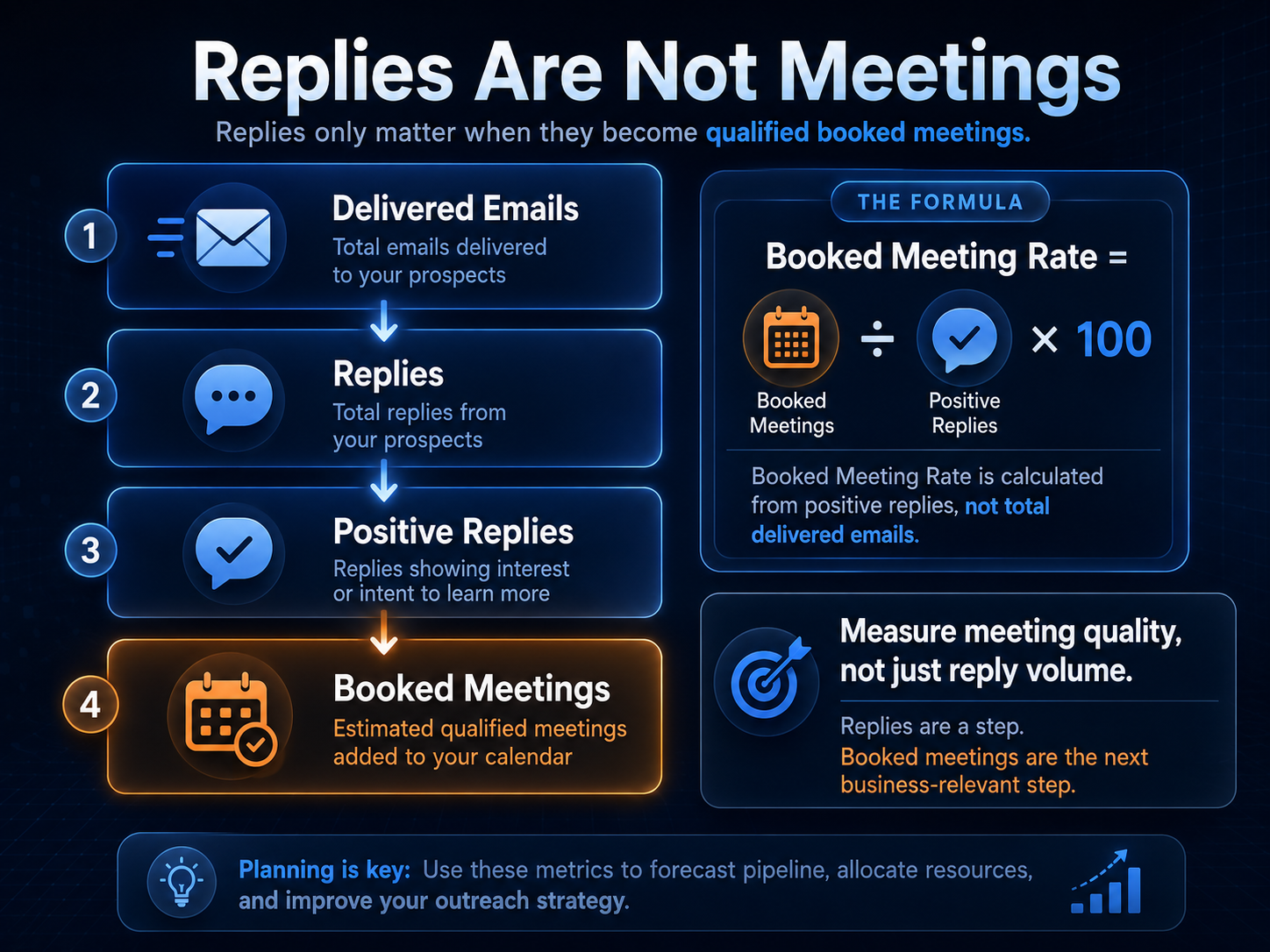
The real business question is: "How many replies become qualified booked meetings?" Replies are only useful if the team can convert enough of them into conversations that match the ICP and sales process. To estimate the email volume needed to produce a single booked meeting, read the guide on how many cold emails to book a meeting.
Booked meeting rate formula
If positive replies do not become booked meetings, the bottleneck may be the CTA, offer, qualification criteria, follow-up speed, or sales handoff. Use the Cold Email Cost Per Meeting Calculator to see how reply assumptions affect meeting economics.
This matters for founders comparing vendors and for agencies writing proposals. Two campaigns can have the same reply rate, but the better campaign is the one that creates more qualified booked meetings at a cost the business can afford.
Turn replies into meeting economics
See how your reply rate affects cost per booked meeting.
Calculate Cost Per Meeting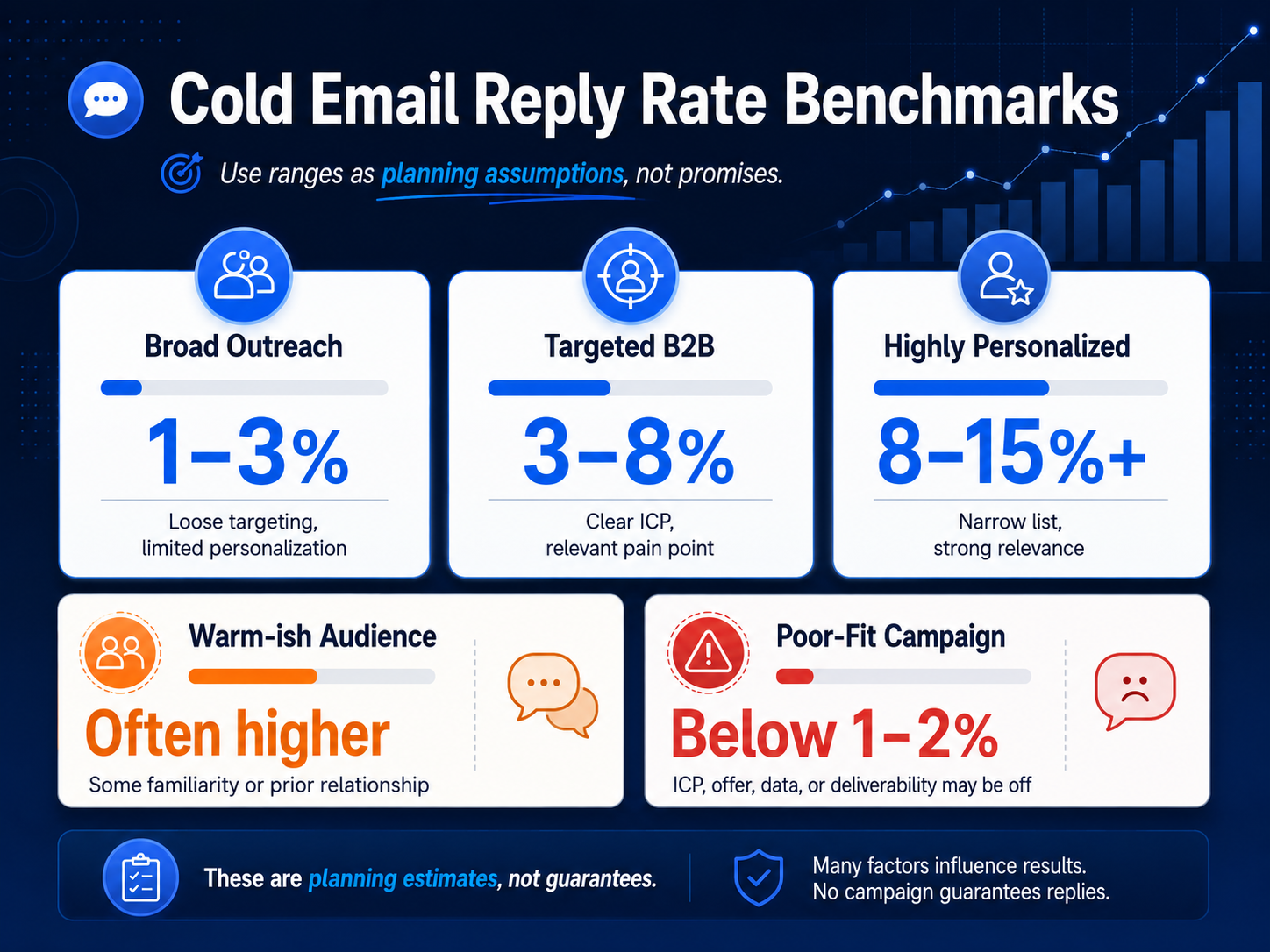
How Reply Rate Affects Cold Email ROI
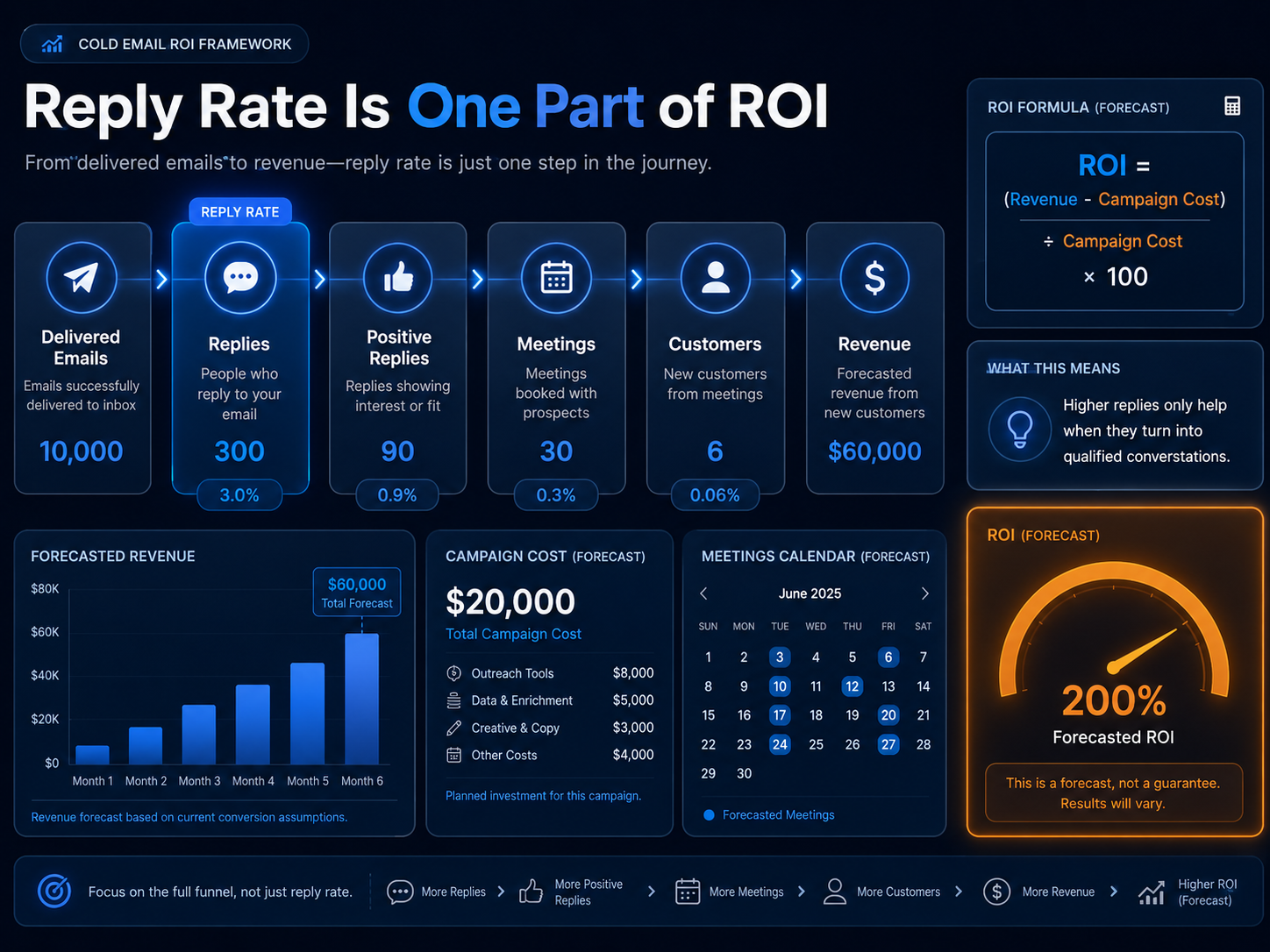
Reply rate is one part of the funnel: delivered emails → replies → positive replies → meetings → customers → revenue. Improving reply rate can help, but ROI also depends on positive reply quality, booking rate, close rate, average customer value, and total campaign cost.
ROI formula
A higher cold email reply rate improves ROI only when those replies become qualified conversations and revenue. A campaign with expensive infrastructure, weak qualification, and low close rate can still lose money with a decent reply rate.
Test your reply rate assumptions
Change reply rate, positive reply rate, booking rate, close rate, and customer value to see how campaign ROI changes.
Use the Agency ROI CalculatorBuilding a cold email tool or agency dashboard?
Use the ColdMail API to forecast replies, meetings, clients, revenue, and ROI from campaign assumptions.
Explore the ColdMail API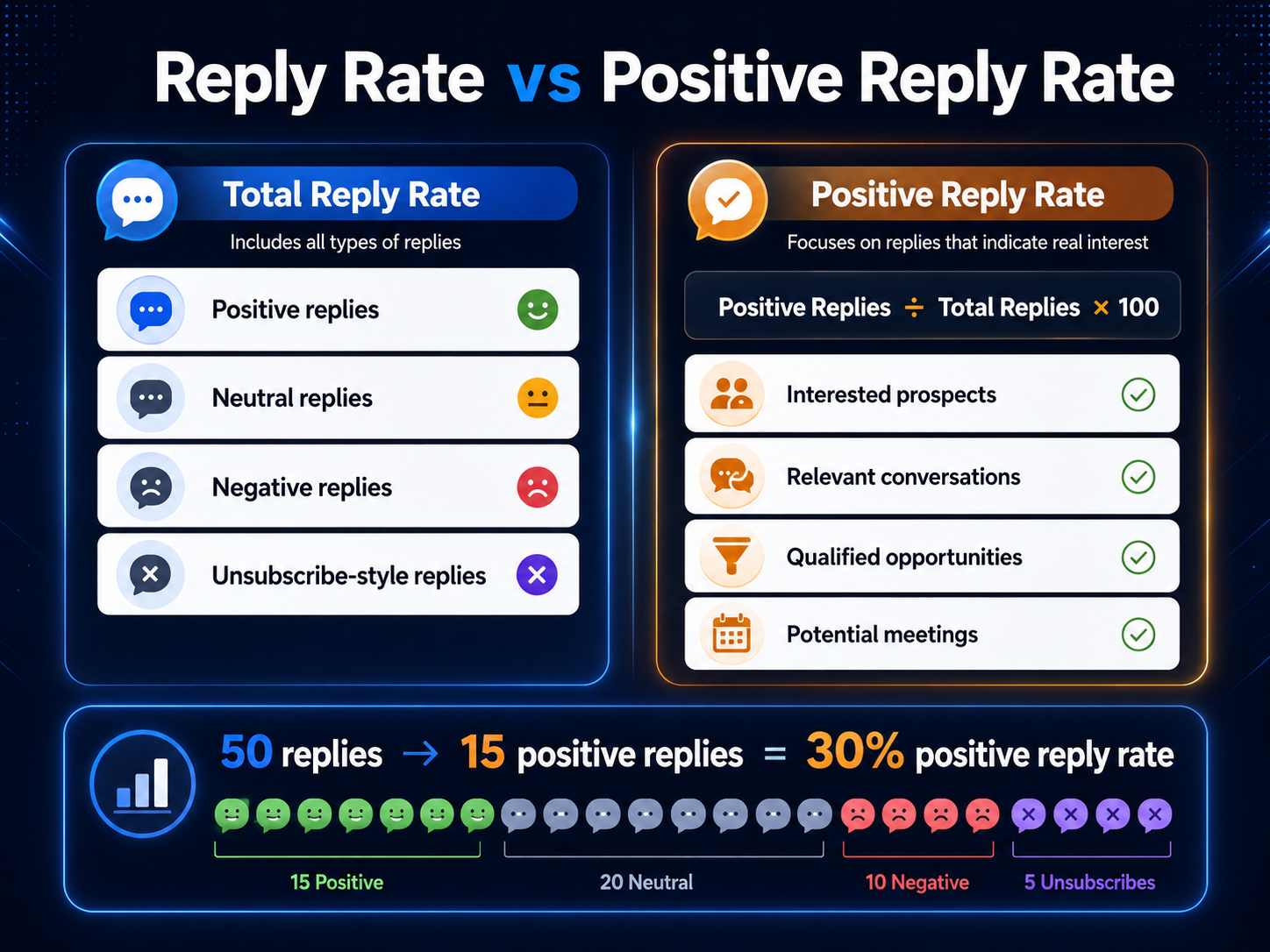
Cold Email Reply Rate Benchmarks by Scenario
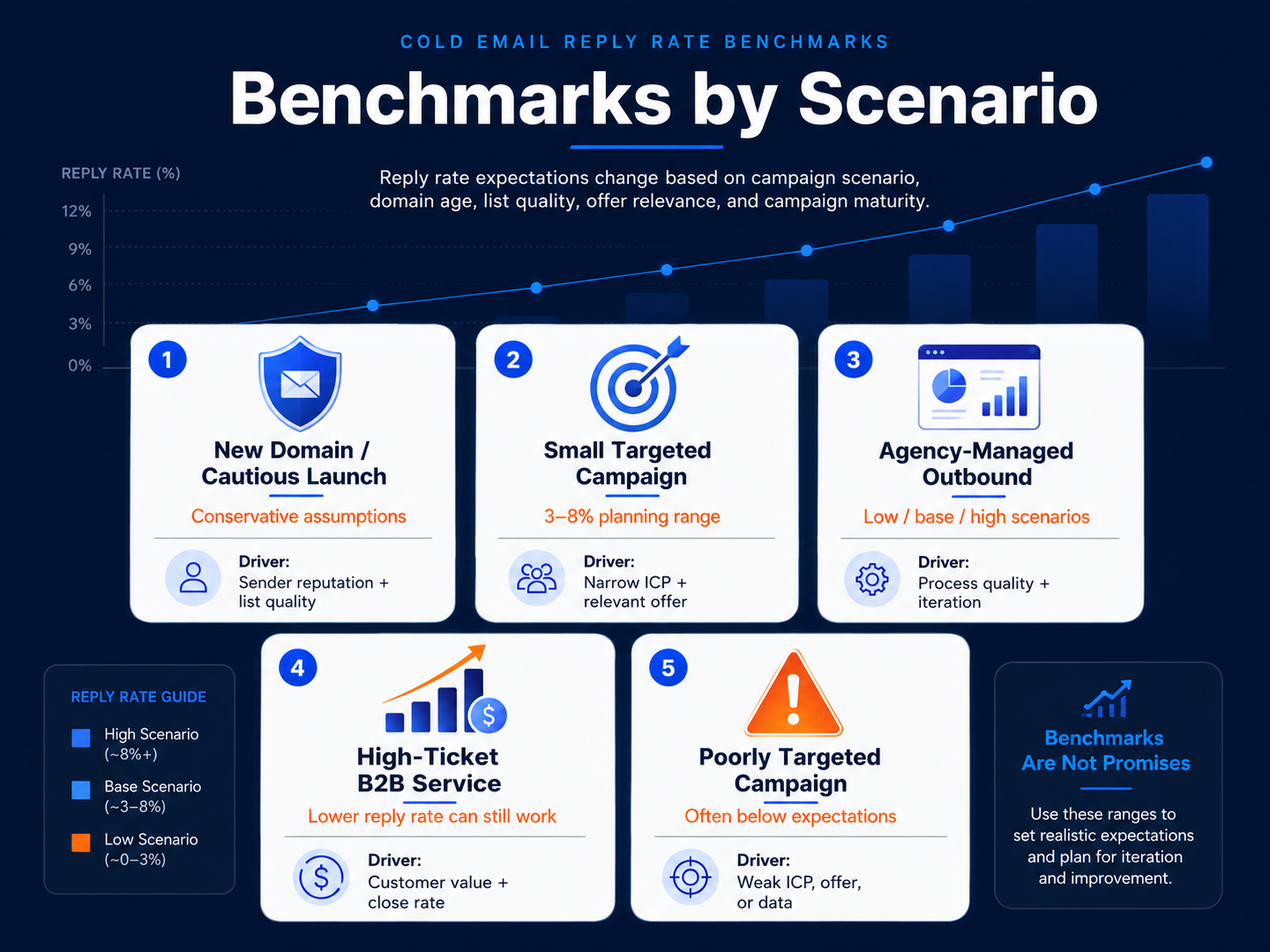
Benchmarks are most useful when they are tied to a specific scenario. A new sending setup should usually be modeled more carefully than a proven campaign with known list quality, stable inbox health, and a clear offer. A high-ticket B2B campaign may tolerate lower reply volume because one closed customer can cover more campaign cost.
| Scenario | Typical planning assumption | Main driver | What to optimize |
|---|---|---|---|
| New domain / cautious launch | Lower volume, conservative reply assumptions | Sender reputation and list quality | Deliverability, bounces, and reply quality |
| Small targeted campaign | 3-8% | Narrow ICP and relevant offer | First line relevance and CTA clarity |
| Agency-managed outbound | Use low/base/high scenarios | Process quality and campaign iteration | Cost per meeting and positive reply rate |
| High-ticket B2B service | Lower reply rate can still work | Customer value and close rate | Qualification and meeting quality |
| Poorly targeted campaign | Often below expectations | Weak ICP, offer, or data | List quality before volume |
Why Your Cold Email Reply Rate May Be Low
Low reply rate usually means one or more parts of the system is weak. Common causes include weak ICP, generic offer, poor subject line, long email copy, no personalization, bad lead data, poor deliverability, wrong timing, no follow-up, low trust, or an unclear CTA.
Technical setup also matters. If bounces are high or inbox health is weak, reply rate math becomes unreliable. Review your cold email infrastructure costs and setup before assuming the copy is the only issue.
How to Improve Cold Email Reply Rate
Improving reply rate is usually a sequence of small changes, not one magic subject line. Fix the biggest uncertainty first. If the list is weak, better copy will not save the campaign. If the offer is vague, more personalization may create replies but not buying conversations. If deliverability is unstable, the campaign may never get a fair test.
- Narrow the ICP so each email feels relevant.
- Improve list quality before increasing send volume.
- Use a clearer offer that connects to a specific pain point.
- Make the first line relevant to the recipient.
- Keep the email short and easy to scan.
- Ask for a simple next step instead of a big commitment.
- Test one variable at a time.
- Use follow-ups because many replies happen after the first email.
- Monitor bounces and inbox health.
- Track positive replies, not just total replies.
For cost control, connect reply improvements to qualified leads with the Cold Email Cost Per Lead Calculator. Cheap replies are not useful if they are not qualified.
What Reply Rate Should Agencies Use in Proposals?
Agencies should avoid promising exact reply rates. A better approach is to show conservative scenarios: low case, base case, and high case. This keeps expectations realistic and helps prospects understand cold email agency pricing through the lens of pipeline economics.
Scenario planning also makes reporting cleaner after launch. If actual replies land below the low case, the team knows to investigate targeting, data, deliverability, or offer-market fit. If replies are near the base case but meetings are low, the issue may be positive reply quality, qualification, or the meeting CTA. If meetings are strong but closes are weak, the sales process or offer may need work.
| Scenario | Reply rate assumption | Positive reply assumption | When to use it |
|---|---|---|---|
| Low case | 1-3% | Conservative | New market, new domain, unproven offer, or early testing |
| Base case | 3-8% | Moderate | Clear ICP, decent data, relevant offer, normal campaign risk |
| High case | 8-15%+ | Strong | Narrow list, high relevance, strong offer, high personalization |
Final Takeaway
A good cold email reply rate is only useful if it creates qualified conversations, booked meetings, and profitable customers.
Use the Cold Email ROI Calculator for Agencies to test different reply rate assumptions before launching a campaign. Model reply rate, positive reply rate, booking rate, close rate, customer value, and campaign cost together instead of judging a campaign on replies alone.
FAQ
What is a good cold email reply rate?
For planning, many targeted B2B campaigns model around 3-8%, while highly relevant personalized campaigns may model higher. Actual results vary.
What is the average cold email reply rate?
There is no universal average. Broad outreach may be modeled around 1-3%, targeted outreach around 3-8%, and highly relevant outreach around 8-15%+ for planning.
Is a 5% cold email reply rate good?
It can be good if replies are qualified and turn into booked meetings. It can be weak if most replies are negative or unqualified.
What is the difference between reply rate and response rate?
Many teams use the terms similarly. The important detail is the denominator: delivered emails, sent emails, or opened emails.
What is a good positive reply rate?
A good positive reply rate depends on ICP and offer quality. Track positive replies separately from total replies so negative responses do not inflate campaign quality.
Why are my cold emails not getting replies?
Common reasons include weak ICP, generic offer, poor subject line, long copy, bad data, poor deliverability, no follow-up, low trust, or unclear CTA.
Does a higher reply rate always mean better ROI?
No. Higher reply rate only helps ROI if replies become qualified meetings, customers, and revenue.
How do I calculate cold email reply rate?
Reply Rate = Replies / Delivered Emails × 100. Use delivered emails when possible.