Planning guide
How to Build a Cold Email Reporting Template
A good cold email report shows assumptions, funnel, economics, and risk side by side. Here is how to build a reporting template clients and teams trust.
Last updated July 9, 2026 · ColdMailCalculator, operated by Wade Digital
The short answer
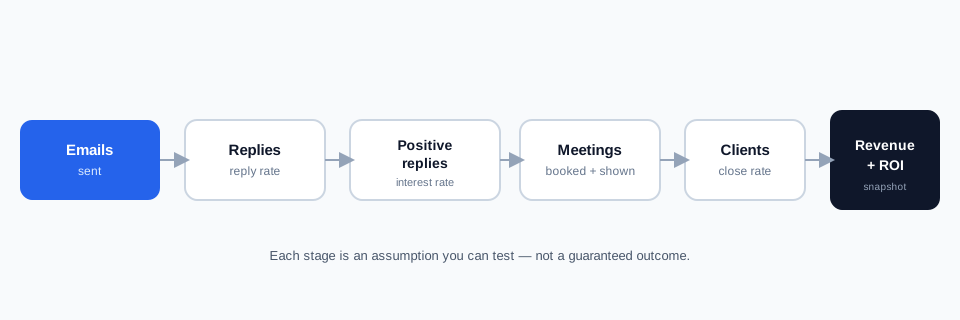
A cold email reporting template should show assumptions, funnel outputs, economics, risk, and a clear disclaimer — in that order. The key is making assumptions visible so a single headline number is never mistaken for a guarantee.
Build it once, then reuse it for every campaign and client so comparisons are apples to apples.
Sections to include
Assumptions: reply rate, positive reply rate, meeting rate, show-up rate, close rate, and deal value — with the source of each (your history vs a benchmark). Funnel outputs: estimated replies, positive replies, meetings, clients. Economics: revenue, total cost, net profit, ROI, CAC, cost per meeting. Risk: score and specific recommendations.
End with a disclaimer: figures are estimates based on stated assumptions, not guarantees. This protects you and keeps the report honest.
How to present results to a client
Lead with the funnel chart and the economics, not the send volume. Show conservative, working, and upside scenarios so the client sees the range and the assumptions behind it. Call out the weakest stage explicitly — that is where the next conversation should go.
Use plain language. 'We need about 1,250 delivered emails at a 2% positive reply rate to book 10 meetings' lands better than a wall of percentages.
Which charts to include
A funnel chart with counts and rates. A scenario comparison (conservative vs working vs upside). A cost chart of cost per meeting and CAC versus target. A trend line if you have multiple waves. Keep it to one screen where possible so the story is obvious.
Always pair rates with absolute counts so a small sample is not read as strong performance.
Keep the template honest
Never present a forecast as a promise. Mark every assumption with its source, show the downside scenario, and attach the disclaimer. A report that overclaims is a liability the first time reality diverges from it.
Cold email report checklist
- List every assumption with its source (history vs benchmark).
- Show funnel outputs as counts and rates.
- Include economics: profit, ROI, CAC, cost per meeting.
- Show conservative, working, and upside scenarios.
- Attach a clear 'estimates, not guarantees' disclaimer.
Common mistakes
- Presenting a single number as a guarantee.
- Hiding assumptions inside the headline figure.
- Omitting cost so the campaign looks free.
- Showing rates without the absolute counts.
Frequently asked questions
What goes in a cold email report?
Assumptions (with sources), funnel outputs, economics (profit, ROI, CAC, cost per meeting), risk score, and a disclaimer — plus conservative, working, and upside scenarios.
How do I present results to a client?
Lead with the funnel and economics, show three scenarios, call out the weakest stage, and use plain language with counts alongside rates.
Which charts should a cold email report include?
A funnel chart, a scenario comparison, a cost chart (cost per meeting and CAC versus target), and a trend line across waves if available.
Related pages
Related guides
Put this into your own numbers
This article is educational planning content, not guaranteed results, legal advice, or compliance advice. Use the calculator to model your own assumptions.
Estimates are based on user-provided assumptions and are not guaranteed. See the disclaimer for details.