Positive Reply Rate in Cold Email: What It Means and How to Improve It
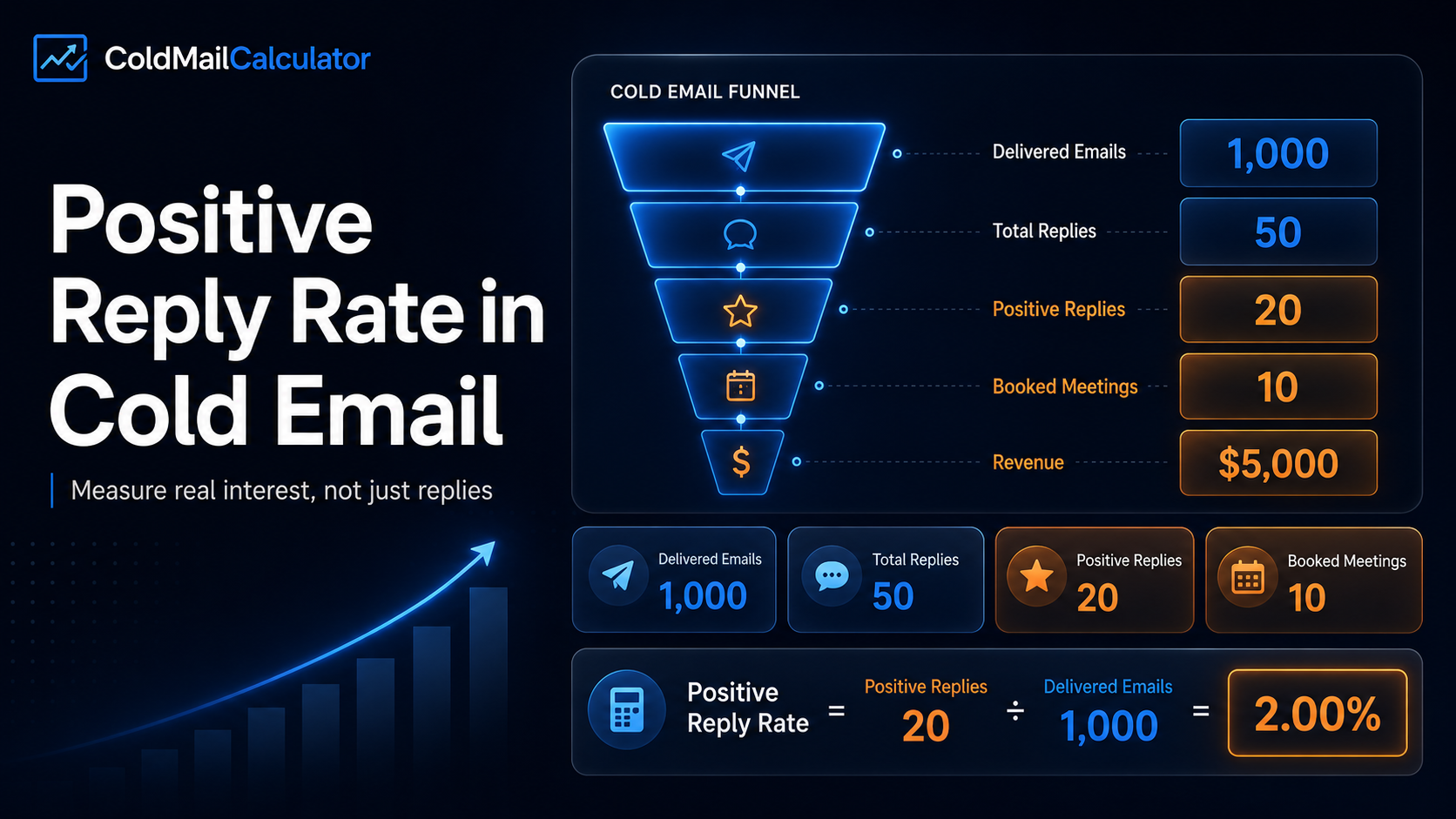
Positive reply rate is the percentage of delivered cold emails that receive a genuine, interested response. It excludes automated out-of-office replies, unsubscribe requests, and negative responses like "not interested." Unlike total reply rate, positive reply rate measures real buying interest and directly correlates with meetings booked and revenue generated.
Short answer
- Positive reply rate is the share of delivered emails that get a genuine interested reply
- Average range: 1-2% of delivered emails, or 20-40% of total replies
- Strong range: 3-4% of delivered emails, or 40-60% of total replies
- Why it matters: Only positive replies can become meetings and revenue
Why Positive Reply Rate Matters More Than Reply Rate
A high total reply rate can mask weak targeting. If 8% of your emails get a reply but most are "not interested" or "stop emailing me," your campaign is generating noise, not pipeline. Positive reply rate filters out that noise.
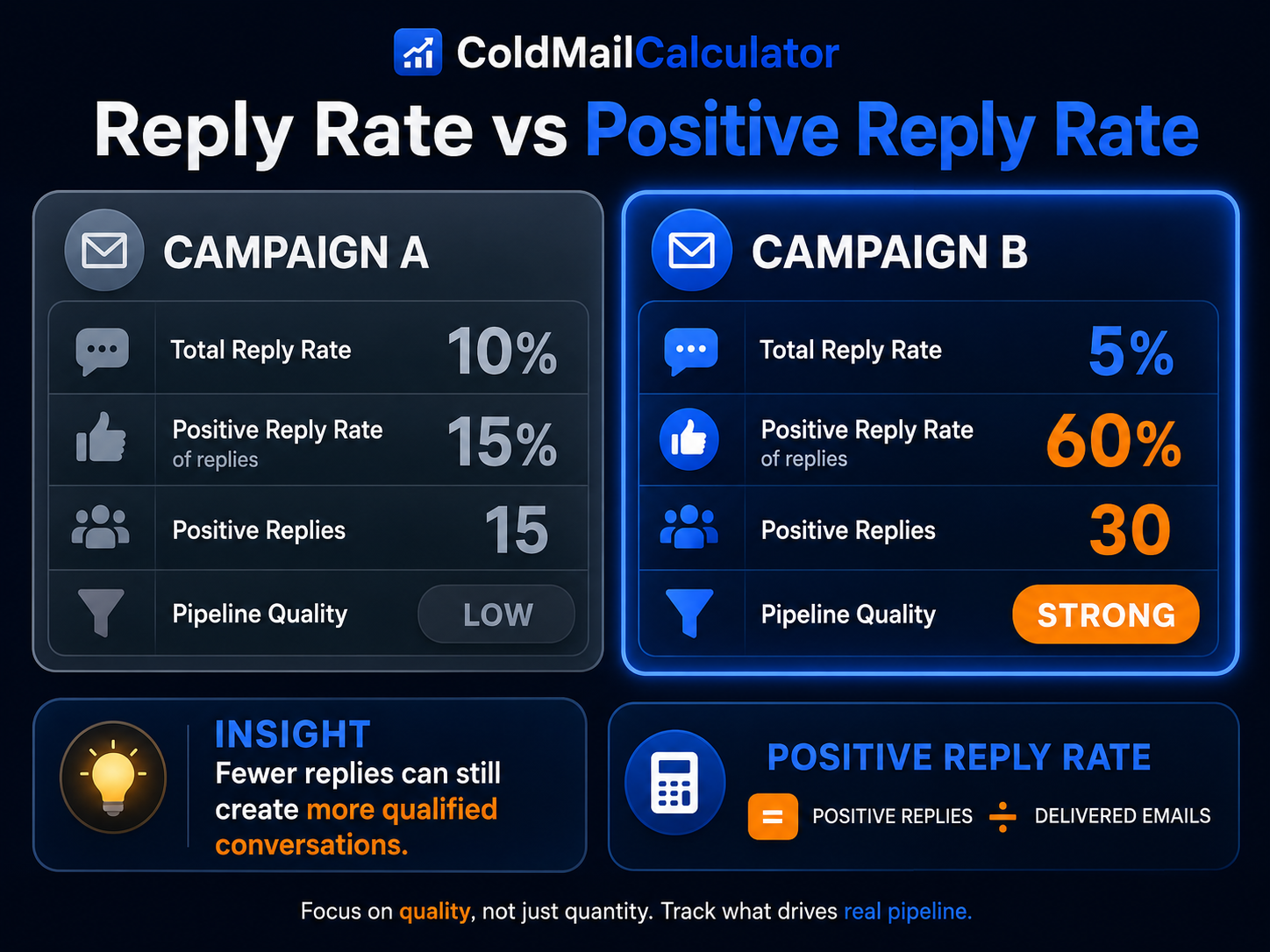
Consider two campaigns:
- Campaign A: 10% reply rate, 15% positive reply rate — 1.5% positive replies overall
- Campaign B: 5% reply rate, 60% positive reply rate — 3% positive replies overall
Campaign B generates twice as many interested prospects from half the replies. If you only tracked total reply rate, you would think Campaign A is outperforming. Positive reply rate reveals the truth.
Reply Rate vs Positive Reply Rate Comparison
| Scenario | Total reply rate | Positive reply rate (% of replies) | Positive replies per 1,000 delivered |
|---|---|---|---|
| Weak targeting, broad list | 8% | 15% | 12 |
| Average B2B campaign | 5% | 30% | 15 |
| Strong targeting, good offer | 5% | 50% | 25 |
| Narrow ICP, high relevance | 7% | 60% | 42 |
Positive Reply Rate Benchmarks by Campaign Type
The typical range for positive reply rate varies by campaign type and audience quality:
- Broad B2B outreach: 0.5-1.5% positive replies per delivered email
- Targeted ICP outreach: 1.5-3% positive replies per delivered email
- Signal-based outreach: 3-5% positive replies per delivered email
- Highly personalized, narrow list: 4-8% positive replies per delivered email
As a percentage of total replies, positive reply rate typically falls between 20% and 50%. If your positive reply rate is below 20% of total replies, your targeting or offer likely needs attention.
How to Improve Positive Reply Rate
Improving positive reply rate is usually more profitable than increasing total email volume. Here are the most effective tactics:
- Tighten your ICP. A narrower ideal customer profile means your email is relevant to more recipients. Relevance drives positive replies.
- Make your offer obvious. If the reader cannot quickly understand what you do and why it matters, they will not reply with interest.
- Personalize the first line. Reference something specific about the prospect or their company. Generic openers get generic responses.
- Ask a question instead of pitching. Questions that show research and curiosity often produce more positive replies than direct offers.
- Reduce CTA friction. Asking for a simple reply is lower friction than asking for a demo booking. Low-friction CTAs generate more positive replies.
- Qualify your list before sending. Remove addresses that are unlikely to fit your ICP. A smaller, cleaner list almost always produces a higher positive reply rate.
How the ColdMailCalculator Uses Positive Reply Rate
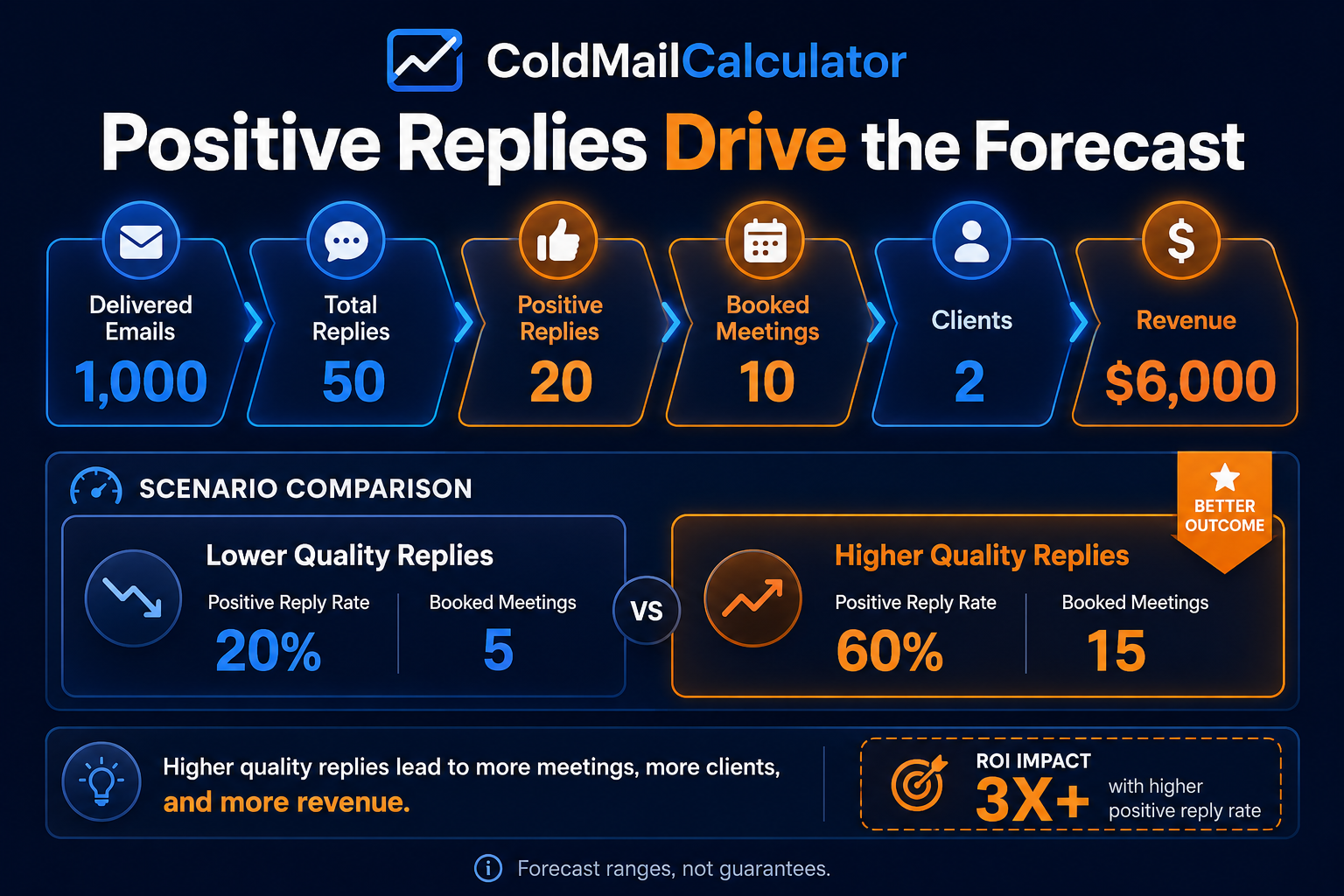
The ColdMailCalculator uses positive reply rate (not total reply rate) to forecast meetings, clients, and revenue. This matters because total reply rate includes responses that will never convert. By using positive reply rate, the calculator gives you a realistic view of your funnel.
For example, entering a 5% total reply rate with a 30% positive reply rate produces very different results than a 5% total reply rate with a 60% positive reply rate. The calculator accounts for this automatically.
Use the free calculator to model how changes in positive reply rate affect your meeting volume and campaign ROI.
Forecast your campaign with real positive reply rates
Use the ColdMailCalculator to model how positive reply rate changes affect your meetings, clients, and revenue.
Use the Cold Email ROI CalculatorPositive Reply Rate vs Meeting Booking Rate
Positive reply rate and meeting booking rate serve different purposes:
- Positive reply rate measures how many delivered emails generate genuine interest
- Meeting booking rate measures how many positive replies turn into a booked calendar event
Both are needed for accurate forecasting. A high positive reply rate with a low meeting booking rate may indicate friction in your booking process. A low positive reply rate with a high meeting booking rate may mean your targeting is too narrow but your sales process is strong.
Read more about how many cold emails it takes to book a meeting for a deeper look at the full funnel.
Final Takeaway
Positive reply rate is the most underrated metric in cold email. Most senders track total reply rate and draw the wrong conclusions. Shifting your focus to positive reply rate will give you a clearer picture of what is actually working and what needs to change.
Run your numbers through the ColdMailCalculator to see how small improvements in positive reply rate compound into significantly more meetings and revenue.
FAQ
What is positive reply rate in cold email?
Positive reply rate is the percentage of delivered cold emails that receive a genuine, interested response. It excludes automated out-of-office replies, unsubscribe requests, and negative responses. It is a more meaningful metric than total reply rate because it measures actual buying interest.
What is a good positive reply rate?
A positive reply rate of 1-2% of delivered emails is average for most B2B campaigns. Strong campaigns achieve 3-4%. As a percentage of total replies, 20-40% is average and 40-60% is strong. The rate depends on targeting quality, offer relevance, and personalization.
How is positive reply rate different from reply rate?
Total reply rate counts every response including out-of-office, unsubscribe, and negative replies. Positive reply rate only counts replies that express genuine interest in your offer. Total reply rate can look good while positive reply rate reveals weak targeting or a poor offer.
How do I improve positive reply rate?
Target a narrower ICP, use a clearer offer, personalize the first line, reduce CTA friction, ask a relevant question instead of pitching immediately, and qualify your list before sending. Small improvements in relevance compound into significantly higher positive reply rates.
Why do agencies track positive reply rate instead of total reply rate?
Agencies track positive reply rate because it is the only reply metric that correlates with booked meetings and revenue. Total reply rate includes noise like out-of-office and spam complaints. Positive reply rate feeds directly into meeting forecasting and ROI calculations.
Get a free cold email funnel audit
Not sure where your positive reply rate stands? Get a free cold email funnel audit and identify the fastest path to improvement.
Request API Access