Cold Email Personalization Examples That Actually Increase Reply Rate
Most "personalization" in cold email is noise. Adding a prospect's first name and company name does not move reply rates. Real personalization changes the message based on something specific and relevant to the person receiving it. Here are five types that actually work, with examples and reply-rate math.
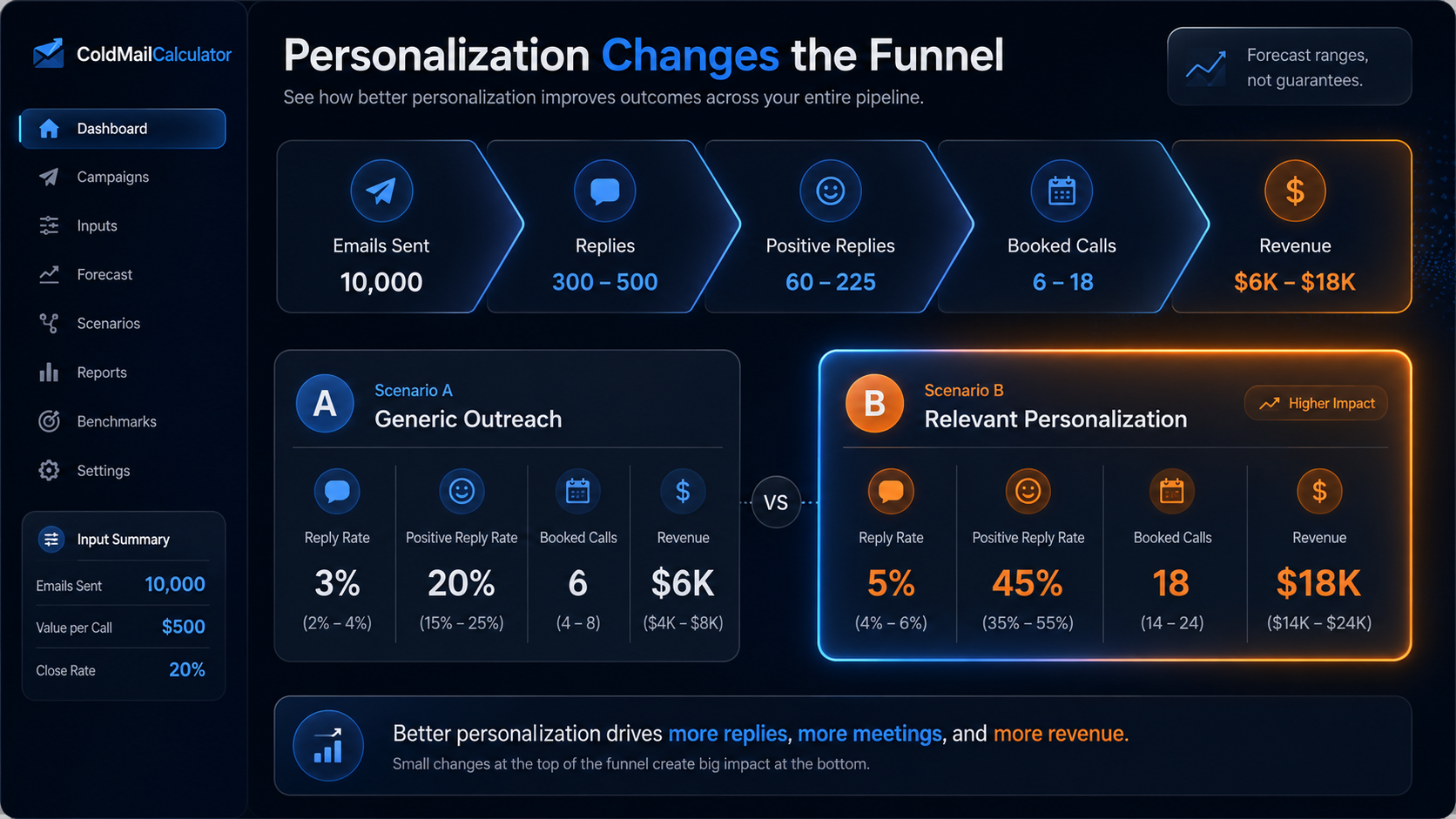
Use the Cold Email ROI Calculator to see how personalization-driven reply rate improvements change your campaign outcomes.
Short answer
Cold email personalization increases reply rate when it uses a real buying signal, not just a merge tag. The best examples reference something specific: a funding event, hiring plan, product launch, recent post, market shift, or mutual connection.
- Use one relevant detail in the first 1-2 sentences.
- Connect that detail directly to your offer or question.
- Model the lift in reply rate, positive replies, meetings, and ROI before scaling.
Personalization improves campaign economics only when the replies are qualified and become booked meetings.
Why Personalization Matters More Than Ever
The era of the identity merge tag is over. Adding {first_name} and {company} to a generic template no longer moves reply rates.
Inbox providers have gotten better at filtering mass outreach. Prospects have gotten better at ignoring it. The cold emails that get replies today are the ones that feel like they were written for one specific person, not for a list of 500.
That does not mean you need to spend 20 minutes researching every prospect. It means you need to find one real signal per prospect and build the email around it. One relevant detail is enough to double your reply rate. Zero is enough to guarantee it gets deleted.
Data from outbound teams running A/B tests on personalization consistently shows that replacing generic opening lines with signal-based personalization increases reply rates by 30 to 60 percent. The effect is largest in B2B campaigns where the prospect receives dozens of outreach emails per week.
What Actually Counts as Personalization
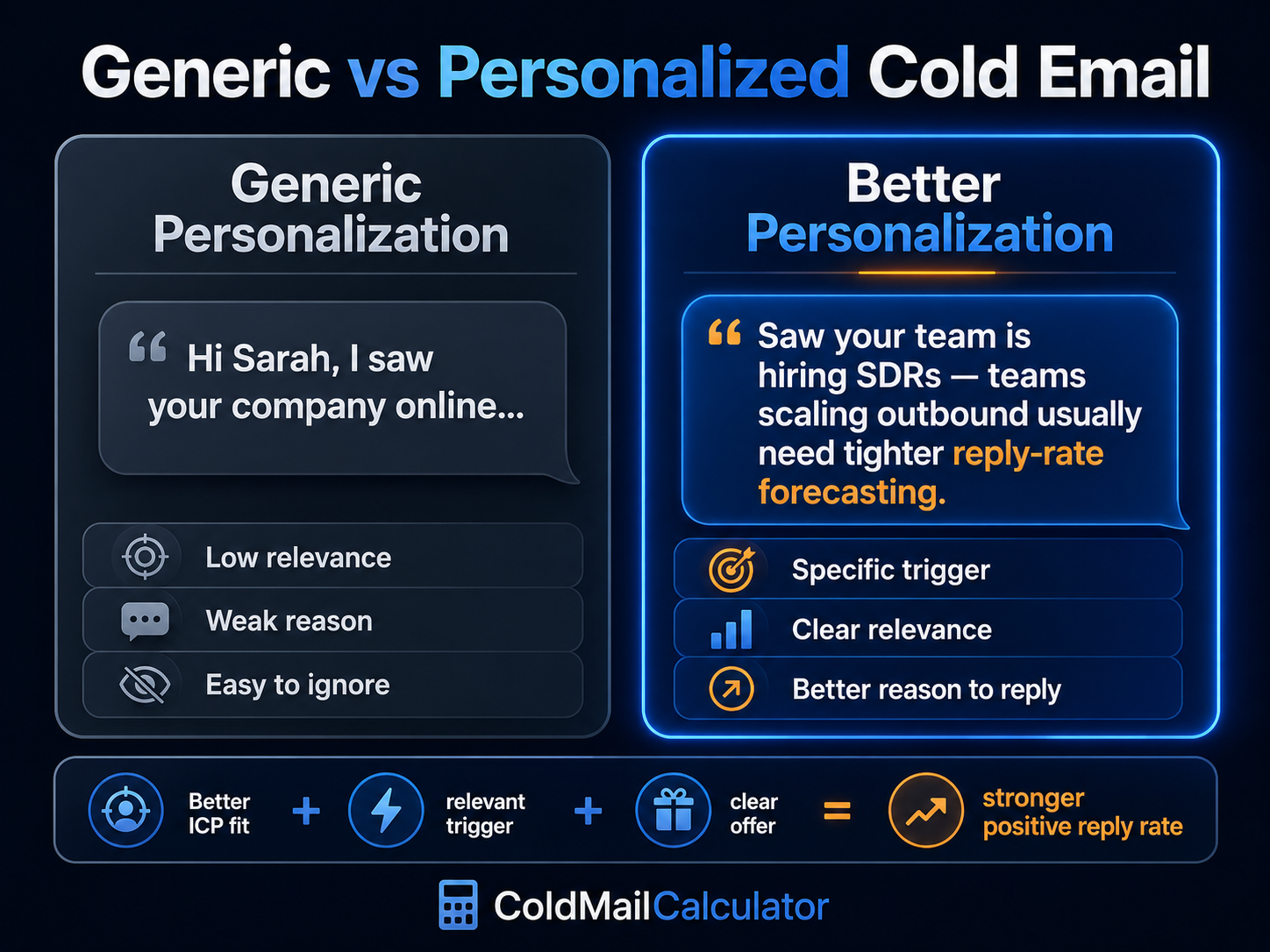
Before looking at examples, it helps to define the line between personalization and noise. Here is a simple test: if you could send the same sentence to every person on your list, it is not personalization.
- Not personalization: "I saw you are the Head of Marketing at Acme Corp." That is a fill-in-the-blank sentence.
- Not personalization: "I have been following your company for a while." This is the most common lie in cold email.
- Personalization: "I noticed Acme Corp just raised a Series A for your AI-powered logistics platform." That references a specific event.
- Personalization: "Your recent post about cold email deliverability made me think you might find this useful." That references specific content the prospect created.
The difference is specificity. If the detail you used could apply to 10 other people in the same industry, it is not specific enough. If it only applies to that one person, you have a signal.
Example 1: Signal-Based Personalization
Signal-based personalization uses a recent event or change as the hook. The prospect did something observable: they hired a new role, raised funding, launched a product, expanded to a new market, or published content. Your email references that signal and connects it to your offer.
This is the highest-impact form of personalization because the signal is timely and relevant. The prospect is already thinking about whatever triggered the signal, so your email arrives in a context that makes sense.
Signal: New Funding Round
Hi [Name],
Congrats on the $10M Series A. Expanding the sales team from 5 to 20 reps in six months is an aggressive move, and most companies at that stage see reply rates drop as new reps ramp up.
We built a forecasting tool that helps sales leaders model exactly how many emails, replies, and meetings it takes to hit revenue targets at each stage of team growth. Happy to share what we have seen work for other post-Series A teams.
Open to a quick look?
Signal: New Product Launch
Hi [Name],
Saw that you launched [Product Name] last week. The analytics dashboard looks polished — clean UX.
One question: how are you thinking about outbound for the new product line? Most teams we talk to underestimate the volume needed to book meetings for a new category. Happy to share the benchmarks we have tracked across similar launches.
Worth 5 minutes?
Signal: Hiring Spree
Hi [Name],
Noticed you are hiring for three new SDR roles. Scaling outbound headcount is one of the fastest ways to grow pipe, but only if the per-rep metrics hold up as you add headcount.
We built a calculator that forecasts exactly how many emails and meetings your expanded team needs to hit pipeline goals. Might save you a few spreadsheet headaches.
Want to see it?
The key with signal-based emails is to connect the signal to your value proposition. Do not just mention the event. Explain why it matters in the context of what you offer. The prospect should feel like you understand their situation, not just that you read a press release.
Example 2: The Account Research Angle
Not every prospect has a recent signal. If nothing notable has changed at the account level, the next best option is a researched insight about their business. The goal is to show you have looked at their company and have a specific observation that most senders would miss.
Research: Website or Product Change
Hi [Name],
I was looking at your pricing page and noticed you moved to usage-based pricing for the enterprise tier. That is a smart shift, but it also means your customers need to forecast usage more accurately to avoid bill shock.
We help companies in your space model customer usage patterns so they can set expectations upfront. Similar to what [Competitor or Similar Company] does, but without the integration overhead.
Worth a conversation?
Research: Competitor or Market Move
Hi [Name],
[Competitor] just announced a free tier of their product. I have seen that playbook before — they are trying to compress the sales cycle by removing the buying friction at the top of funnel.
If you are planning to respond, you might need to increase outbound volume to protect your pipeline coverage. We have data on how similar market moves affected reply rates and meeting bookings for companies in your space.
Want me to share the benchmarks?
Research-based personalization works because it flips the dynamic. Instead of asking the prospect to give you something (their time, attention, a meeting), you are giving them something first: a useful observation about their business. That builds credibility before you ask for anything.
Example 3: The Content-Based Trigger
When a prospect publishes content — a blog post, LinkedIn article, podcast appearance, or tweet — they are giving you permission to reach out. They have publicly stated an interest or opinion, and your email can engage with that directly.
Trigger: Blog Post
Hi [Name],
Your post on cold email deliverability in 2026 was excellent. The point about mailbox provider fatigue is something most outbound teams do not think about until they are already in spam.
One thing we have seen in our data is that reply rates for well-personalized campaigns actually increase as inbox providers get stricter, because the noise gets filtered out first. Might be worth a follow-up post.
Either way, keep writing.
Trigger: LinkedIn Post or Comment
Hi [Name],
Saw your LinkedIn post about outbound metrics. You mentioned that most teams do not track cost per meeting, and I completely agree.
We built a tool that connects all the funnel metrics into one forecast: emails sent, replies, positive replies, meetings booked, clients closed, and revenue. It might save you the spreadsheet-building time if you are working on outbound planning.
Happy to share early access if you are interested.
Trigger: Podcast or Interview
Hi [Name],
Listened to your interview on [Podcast Name] about scaling B2B outbound. Your point about hiring SDRs before you have predictable conversion metrics resonated — we see that mistake constantly.
One thing that helped the teams we work with is modeling the funnel backwards: start from the revenue target, then calculate the email volume needed at each conversion stage. It makes the hiring decision much clearer.
Would you be open to a 10-minute call to compare notes?
Content-triggered emails have the highest reply rates of any personalization type, often 2x to 3x higher than generic outreach. The reason is simple: the prospect has already told you what they care about. You just need to show up and engage with it honestly.
Example 4: The Industry-Specific Insight
Industry-specific personalization works when you have domain knowledge that most senders lack. If you sell to a niche vertical, demonstrating that you understand their specific challenges, regulations, or market dynamics sets you apart from generalist outreach.
Industry: SaaS / B2B Technology
Hi [Name],
Most SaaS companies we talk to have an ACV between $500 and $5,000 and need roughly 200 to 500 meetings per quarter to hit growth targets. The math works, but only if the reply-to-meeting conversion rate stays above 30 percent.
We built a planning tool that forecasts exactly how many emails your team needs to send per day to hit those meeting targets, based on your actual conversion rates.
Worth a look?
Industry: Agency / Services
Hi [Name],
Agencies have a different math problem than product companies. You need to book a meeting, sell a retainer, deliver the service, and collect payment — all before you can reinvest in more outbound. That means your cost per meeting needs to be lower than product companies because your margins are tighter.
We help agencies model their outbound ROI so they know exactly how much to spend on email campaigns to hit their client acquisition targets.
Want to run your numbers?
Industry: E-commerce
Hi [Name],
E-commerce cold outreach is different from B2B. You are selling to store owners who get pitched by 10+ suppliers a day. The ones who reply are the ones who see a specific way to improve their numbers.
I noticed you are running Facebook ads but do not have email retargeting set up. Most stores we work with see a 15 to 20 percent revenue lift when they add email to the mix.
Want to see how that math works for your store?
Industry personalization signals that you are not a generalist spraying every vertical. It tells the prospect you have worked with similar companies and understand their world. For niche verticals, this can be the difference between a 3 percent reply rate and a 12 percent reply rate.
Example 5: The Mutual Connection
A mutual connection or introduction is the strongest form of personalization because it comes with social proof baked in. The prospect is more likely to read and reply if they see a name they recognize.
Warm Introduction Referral
Hi [Name],
[Mutual Connection] suggested I reach out. They mentioned you are focused on improving outbound conversion rates at [Company], and they thought our forecasting tool might be useful for your planning process.
Quick context: we help outbound teams model their funnel so they can predict replies, meetings, and revenue before launching campaigns.
Do you have 10 minutes this week to see if there is a fit?
Shared Community or Group
Hi [Name],
I saw you are active in the [Group Name] community. I have been following your comments on outbound scaling — the thread about SDR ramp time was spot on.
We recently published some benchmarks on how reply rates change as teams scale from 1 to 10 SDRs. Thought you might find it useful given the discussion in the group.
Happy to send it over if you are interested.
Mutual connection emails work because they bypass the cold email trust problem. The prospect does not need to decide whether you are legitimate — the connection vouches for you. If you have a genuine connection, lead with it. If you do not, do not fake it. False mutual connections destroy trust instantly.
Building a sales tool or agency dashboard?
Use the ColdMail API to forecast campaign outcomes programmatically. Pass in your funnel assumptions and get back estimated replies, meetings, clients, revenue, and ROI.
Explore the ColdMail APIPersonalization Mistakes That Kill Reply Rates
Even well-intentioned personalization can backfire. Here are the most common mistakes that turn a personalized email into a deleted one.
- Fake personalization. "I have been following your company for a while" is the most obvious lie in cold email. If you have no signal, do not pretend. Use a different angle or skip the prospect.
- Too much personalization. Mentioning three different signals in one email feels overwhelming and stalkerish. One specific, relevant detail is enough. The rest of the email should focus on the value you offer.
- Personalization without connection to your offer. "I saw you hired a new VP of Sales" followed by "We sell email verification tools" does not connect. The signal and the offer need to relate to each other.
- Personalizing the wrong variable. Spending 10 minutes researching the prospect's college or hometown does not move reply rates. Focusing on business signals — funding, hiring, product changes, content — does.
- Template-based personalization. If every email in your sequence has one bracket to fill in, it is not personalized. Real personalization changes the structure of the email, not just a few words.
- Getting the detail wrong. Mentioning the wrong title, the wrong company, or an outdated signal destroys credibility before you have said anything about your product. Double-check every detail before sending.
Model Your Personalization Impact
The Cold Email ROI Calculator makes it easy to see the financial impact of personalization on your campaigns. Here is a realistic before-and-after comparison:
Before (generic outreach):
- 1,000 emails sent
- 4% reply rate
- 25% positive reply rate
- 40% booking rate from positive replies
- 20% close rate
- $2,000 average deal size
- Total replies: 40 | Meetings: 4 | Clients: 0.8 | Revenue: $1,600
After (signal-based personalization):
- 1,000 emails sent
- 8% reply rate
- 35% positive reply rate (better-qualified replies)
- 40% booking rate from positive replies
- 20% close rate
- $2,000 average deal size
- Total replies: 80 | Meetings: 11.2 | Clients: 2.24 | Revenue: $4,480
A 4-point reply rate improvement and a 10-point positive reply rate improvement produce a 180 percent increase in projected revenue. The only cost is the time it takes to find one signal per prospect. Enter your actual numbers into the calculator to see what personalization is worth for your specific campaign.
Calculate your cold email ROI with personalization
Enter your funnel metrics and see how reply rate improvements change your campaign outcomes.
Try The Free CalculatorFAQ
Does cold email personalization actually increase reply rates?
Yes. Data from B2B outbound campaigns consistently shows that signal-based personalization increases reply rates by 30 to 60 percent compared to generic templates. The effect is strongest when the personalization is tied to a recent event or piece of content the prospect created.
How much personalization is enough in a cold email?
One specific, relevant detail is enough. The first 1-2 sentences should show you have a reason for emailing this specific person. The rest of the email should focus on the value you offer and a clear call to action. More than one or two personalization details can feel overwhelming.
What is the best type of personalization for cold email?
Content-triggered personalization consistently produces the highest reply rates. When a prospect publishes a blog post, LinkedIn article, or appears on a podcast, they have publicly declared an interest. Emails that reference and engage with that content regularly achieve 2x to 3x the reply rate of generic outreach.
What personalization mistakes should I avoid in cold email?
The most common mistakes are faking personalization (saying you follow the company when you do not), using too many details (feels stalkerish), personalizing without connecting to your offer, and getting details wrong. One accurate, relevant signal is better than three generic ones.
Does adding a first name count as personalization?
No. Adding {first_name} to a generic template is a merge tag, not personalization. Real personalization changes the content of the email based on something specific to the prospect: a recent event, a piece of content, an observation about their business, or a mutual connection.
How much time should I spend personalizing each cold email?
Signal-based personalization should take 2 to 5 minutes per prospect: scan their LinkedIn for recent activity, check their company blog or news, review their recent content. For high-value enterprise prospects, you might spend 10 to 15 minutes. Anything beyond that has diminishing returns.
Can I automate cold email personalization?
You can automate the research step with tools that surface signals (funding alerts, hiring changes, content publication), but the email itself should be written by a human. Automated personalization at scale usually produces the same generic feel that neutralizes the benefit. Use tools to find signals, not to write emails.