Cold Email Reply Rate Formula: How to Calculate Replies Correctly
The cold email reply rate formula is replies divided by delivered emails, multiplied by 100. Use delivered emails instead of total emails sent, because bounced or blocked messages never had a chance to generate a response.
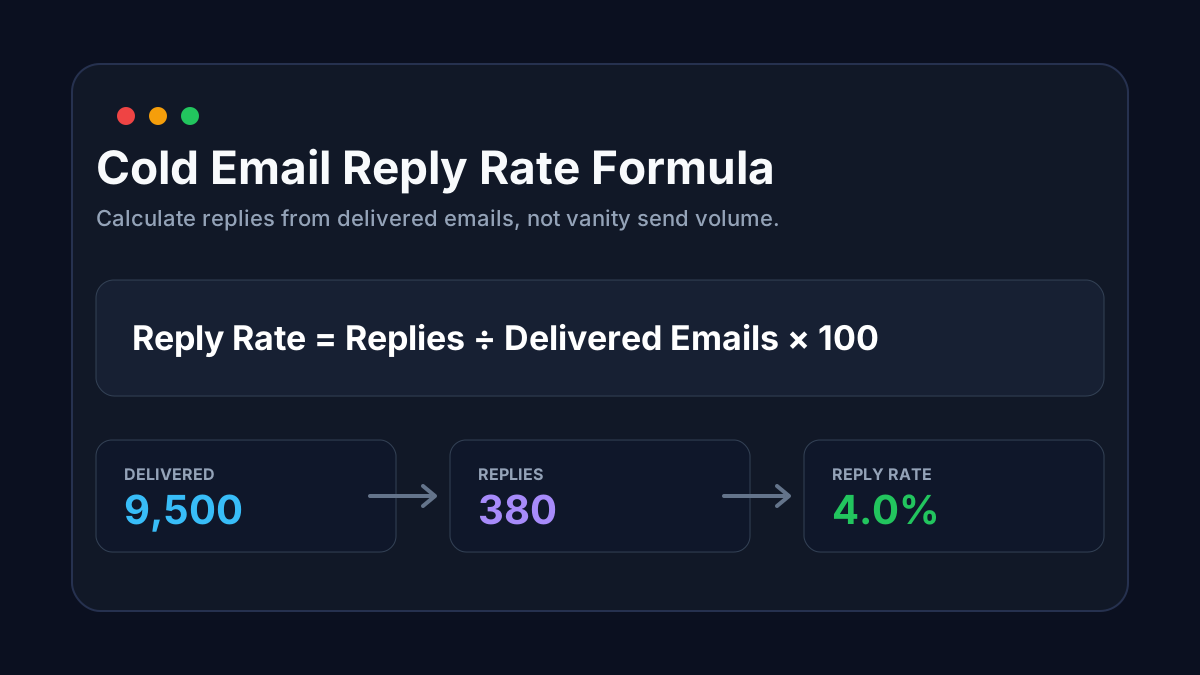
Short answer
Cold email reply rate is calculated as:
Reply rate formula
If you deliver 9,500 emails and receive 380 replies, your reply rate is 4%. If you sent 10,000 emails but 500 bounced, using sent volume would make the campaign look worse than it really was.
Track total reply rate, positive reply rate, and meeting booking rate separately. Reply rate tells you whether people respond. Positive reply rate tells you whether the response is useful. Meeting booking rate tells you whether interest turns into pipeline.
Cold email reply rate formula
The cleanest cold email reply rate formula uses delivered emails as the denominator:
Correct formula
Delivered emails are the messages that reached a mailbox after bounces, blocks, invalid addresses, and failed sends are removed. This matters because reply rate is supposed to measure engagement from people who actually received your message.
For example:
- You send 10,000 cold emails.
- 500 bounce or fail to deliver.
- 9,500 emails are delivered.
- 380 people reply.
The reply rate is 380 divided by 9,500, or 4%. If you divide replies by the full 10,000 sent emails, you get 3.8%. That number is not useless, but it mixes list quality and message performance into one metric.
Reply rate based on sent emails vs delivered emails
Teams often calculate reply rate two different ways. Both can be useful, but they answer different questions.
| Formula | Best for | Weakness |
|---|---|---|
| Replies / sent emails | Executive reporting and total campaign output | Penalizes campaigns for bounces and delivery failures |
| Replies / delivered emails | Measuring message, offer, targeting, and audience response | Requires accurate delivery or bounce tracking |
If you are diagnosing copy or targeting, use delivered emails. If you are calculating the overall business output of a campaign, also track replies per sent email so list quality is not hidden.
Example reply rate calculation
Here is a simple example that shows why the denominator matters.
| Metric | Campaign A | Campaign B |
|---|---|---|
| Emails sent | 5,000 | 5,000 |
| Delivery rate | 98% | 90% |
| Delivered emails | 4,900 | 4,500 |
| Replies | 196 | 180 |
| Reply rate from delivered | 4.0% | 4.0% |
| Replies per sent email | 3.9% | 3.6% |
Both campaigns have the same engagement rate from delivered emails. Campaign B produces fewer total replies because its delivery rate is weaker. That is a deliverability or list quality issue, not necessarily a copy issue.
Total reply rate vs positive reply rate
Total reply rate includes every response: interested replies, objections, referrals, unsubscribe requests, out-of-office replies, and negative replies. Positive reply rate only counts responses that show potential sales interest.
Positive reply rate formula
This distinction is important. A campaign with a 7% reply rate and a 10% positive reply share may be worse than a campaign with a 4% reply rate and a 35% positive reply share.
Example:
- Campaign A: 1,000 delivered emails, 70 replies, 7 positive replies. Total reply rate is 7%, positive reply rate is 0.7%.
- Campaign B: 1,000 delivered emails, 40 replies, 14 positive replies. Total reply rate is 4%, positive reply rate is 1.4%.
Campaign B creates more real opportunities even though the total reply rate is lower. For a deeper breakdown, read the guide to positive reply rate in cold email.
Reply rate is not the same as meeting rate
Reply rate is near the top of the funnel. It does not tell you how many sales conversations you will book. To forecast meetings, you need two more conversion rates:
- Positive reply rate: the share of delivered emails that become interested replies.
- Meeting booking rate: the share of positive replies that turn into booked meetings.
Booked meetings formula
If you deliver 10,000 emails, generate a 1.2% positive reply rate, and book meetings from 35% of positive replies, you should expect about 42 booked meetings.
What is a good cold email reply rate?
A good cold email reply rate depends on list quality, offer relevance, industry, seniority, and how personalized the campaign is. Broad campaigns may sit around 1% to 3%. More targeted campaigns often land around 3% to 6%. Strong signal-based campaigns can exceed that, but they usually require better data and lower volume.
Use reply rate as a diagnostic, not a trophy. If replies are low, the problem may be targeting, deliverability, offer clarity, subject line, list quality, or the first sentence. Compare your assumptions against the cold email reply rate benchmarks before deciding a campaign is good or bad.
Common reply rate calculation mistakes
1. Counting out-of-office replies as real replies
Out-of-office messages can inflate total reply rate. Track them separately so they do not make campaign engagement look stronger than it is.
2. Mixing positive replies with total replies
Total replies and positive replies answer different questions. Do not report total reply rate as if it were pipeline interest.
3. Ignoring bounces
If delivery rate drops, reply volume drops even when copy quality is unchanged. Always pair reply rate with delivery rate or bounce rate.
4. Judging too early
Cold email replies arrive over several days. Wait until the campaign has had enough time to collect replies before declaring the reply rate final.
5. Comparing different audiences directly
A reply rate from founders at small companies should not be compared one-to-one with a reply rate from enterprise finance leaders. Segment benchmarks by audience whenever possible.
How to forecast replies before sending
To forecast replies, start with delivered email volume and multiply by your expected reply rate:
Reply forecast formula
If you plan to send 8,000 emails, expect 96% delivery, and assume a 4% reply rate, your forecast is:
- 8,000 x 96% = 7,680 delivered emails
- 7,680 x 4% = 307 expected replies
From there, forecast positive replies, meetings, clients, revenue, and ROI. That full funnel matters more than reply rate alone.
Calculate replies, meetings, and ROI
Use ColdMailCalculator to forecast delivered emails, replies, positive replies, booked meetings, clients, revenue, and ROI before you send.
Use the ColdMailCalculator