Cold Email Meeting Booking Rate: How to Forecast Booked Calls
Cold email meeting booking rate shows how many interested replies turn into booked sales calls.
Short answer
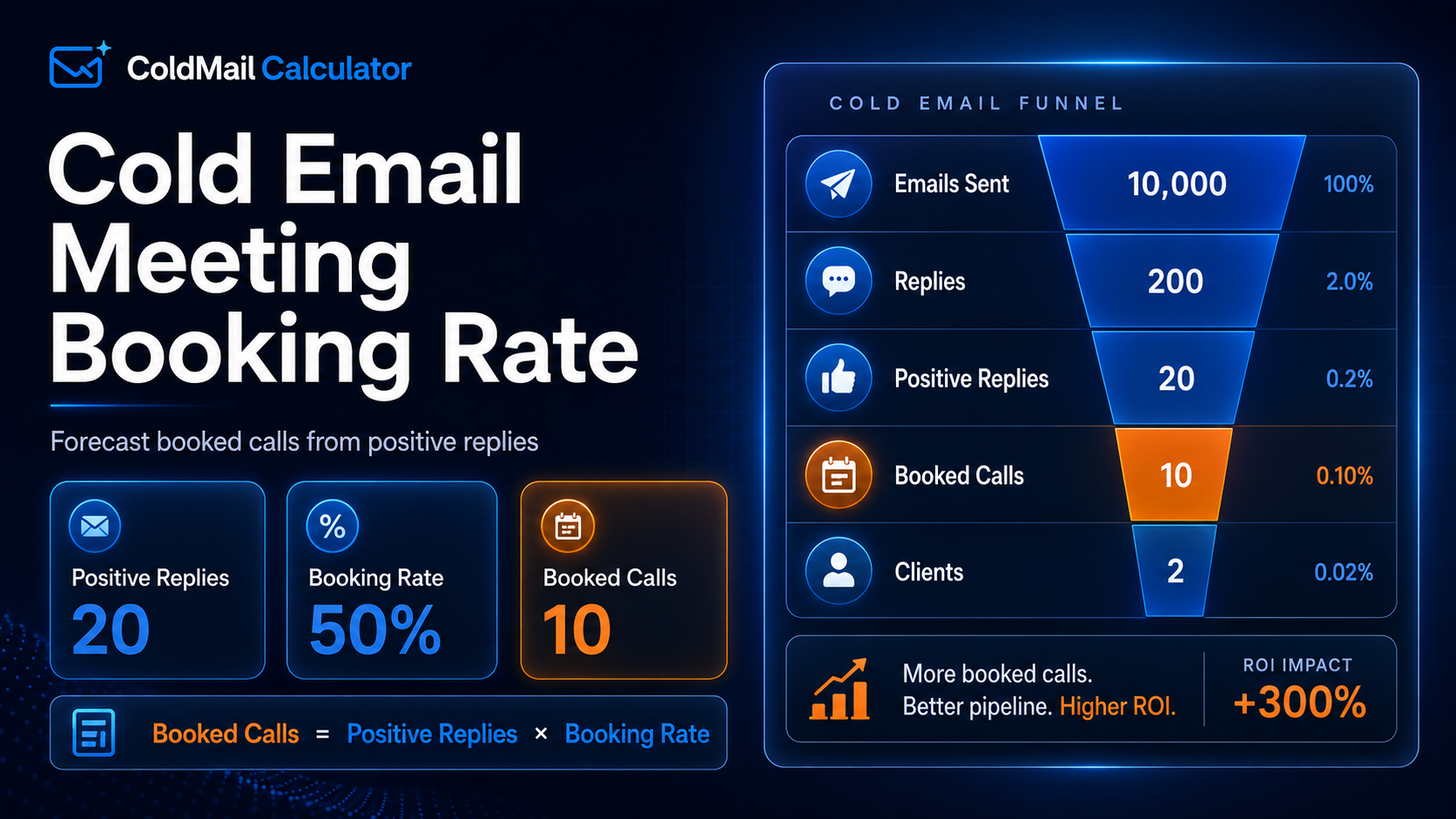
Cold email meeting booking rate is the percentage of positive replies that become booked calls.
Formula: Meeting booking rate = Booked meetings ÷ Positive replies × 100
For example, if a campaign generates 20 positive replies and 10 booked meetings, the meeting booking rate is 50%.
This metric helps you forecast how many sales conversations a cold email campaign may create before you spend money sending it.
It is one of the most important metrics in a cold email campaign because replies alone do not create pipeline. Booked meetings do.
A campaign can generate a strong reply rate but still underperform if prospects do not schedule calls. On the other hand, a campaign with fewer replies can still create better results if those replies are qualified and easy to convert into meetings.
What is cold email meeting booking rate?
Cold email meeting booking rate measures the step between positive replies and booked calls.
It answers a simple question:
When someone shows interest, how often do they actually book a meeting?
That makes it different from reply rate.
Reply rate measures how many people respond. Positive reply rate measures how many replies show interest. Meeting booking rate measures whether that interest turns into a scheduled conversation.
Cold email meeting booking rate formula
The formula is:
Meeting booking rate = Booked meetings ÷ Positive replies × 100
Here is a simple example:
| Campaign metric | Example value |
|---|---|
| Positive replies | 20 |
| Booked meetings | 10 |
| Meeting booking rate | 50% |
In this example, half of the positive replies became booked meetings.
That means the campaign is not just getting interest. It is creating actual sales conversations.
Why meeting booking rate matters
Meeting booking rate matters because it connects cold email engagement to sales activity.
Many teams focus heavily on open rate or reply rate. Those metrics are useful, but they do not tell you whether the campaign is creating pipeline.
A campaign needs to move through the full funnel:
Emails sent → Replies → Positive replies → Booked meetings → Clients → Revenue
If the booking step is weak, the campaign may look good on the surface but still fail economically.
| Metric | What it measures | Why it matters |
|---|---|---|
| Reply rate | Total responses | Shows message engagement |
| Positive reply rate | Interested or qualified responses | Shows offer relevance |
| Meeting booking rate | Positive replies that book calls | Shows conversion from interest to pipeline |
| Close rate | Meetings that become customers | Shows sales efficiency |
| ROI | Revenue compared with campaign cost | Shows whether the campaign economics work |
Meeting booking rate is the bridge between marketing response and sales opportunity.
Example: same replies, different booked calls
Two campaigns can have the same number of positive replies but very different outcomes.
| Scenario | Positive replies | Booking rate | Booked meetings |
|---|---|---|---|
| Campaign A | 20 | 25% | 5 |
| Campaign B | 20 | 50% | 10 |
| Campaign C | 20 | 75% | 15 |
All three campaigns generated 20 positive replies.
But Campaign C booked three times as many meetings as Campaign A.
That difference can completely change the campaign's cost per meeting, revenue forecast, and ROI.
How to forecast booked calls before sending
You can estimate booked calls before launching a campaign by modeling the funnel.
You need:
- Emails sent
- Expected reply rate
- Expected positive reply rate
- Expected meeting booking rate
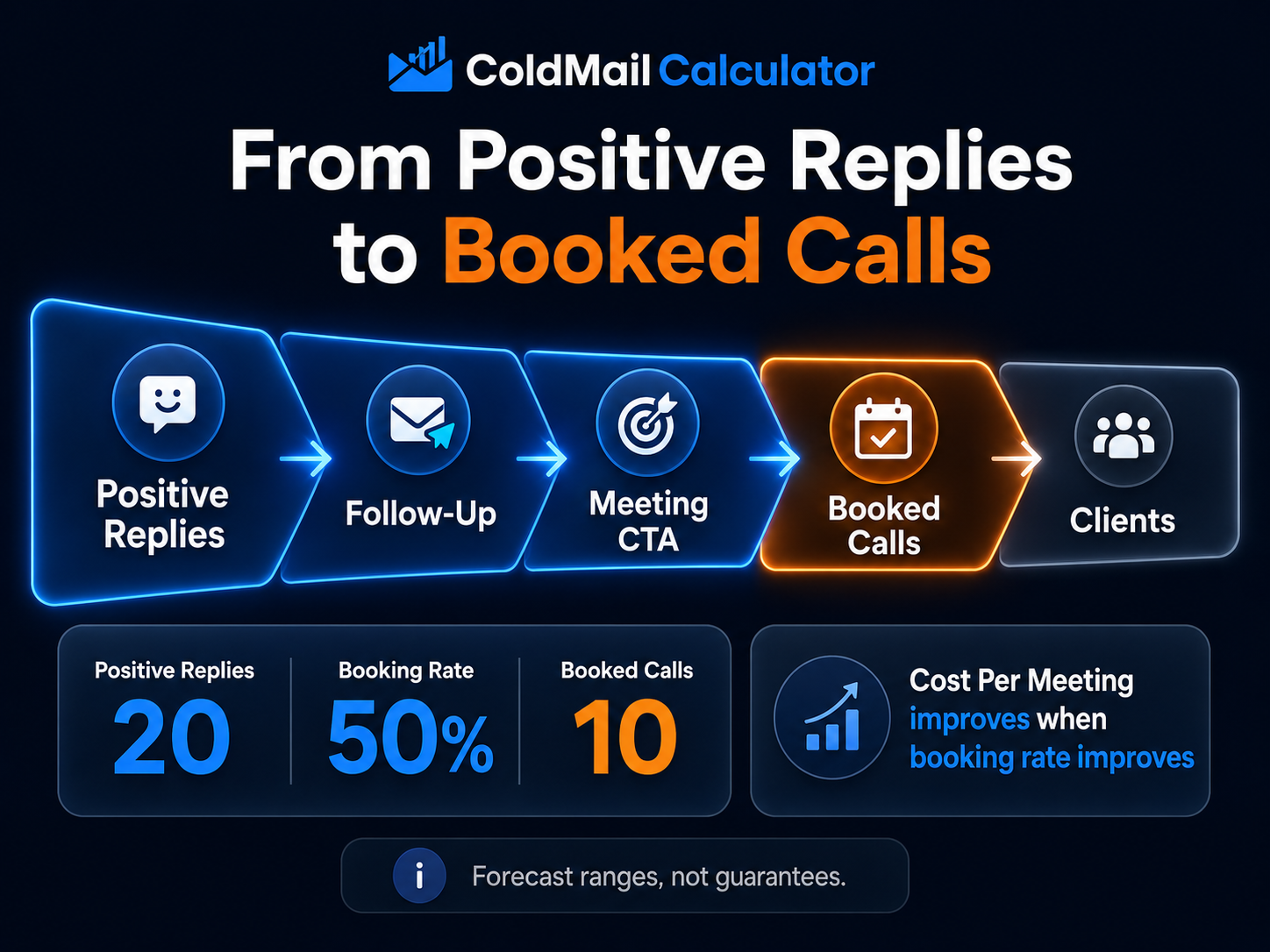
Example forecast:
| Forecast input | Example value |
|---|---|
| Emails sent | 1,000 |
| Reply rate | 5% |
| Total replies | 50 |
| Positive reply rate | 40% |
| Positive replies | 20 |
| Meeting booking rate | 50% |
| Estimated booked meetings | 10 |
This does not guarantee 10 meetings. It gives you a planning scenario.
The value is that you can model what needs to happen for the campaign to make sense.
How meeting booking rate affects cost per meeting
Meeting booking rate directly affects cost per meeting.
If campaign cost stays the same, more booked meetings means a lower cost per meeting.
| Scenario | Campaign cost | Booked meetings | Cost per meeting |
|---|---|---|---|
| Low booking rate | $1,000 | 5 | $200 |
| Base booking rate | $1,000 | 10 | $100 |
| Strong booking rate | $1,000 | 15 | $67 |
This is why meeting booking rate is so important.
It does not just affect your calendar. It affects your campaign economics.
Why positive replies do not always become meetings
A positive reply is not always a booked meeting.
Common reasons include:
- The call to action is too vague
- The prospect asks for more information but does not commit
- The reply gets handled too slowly
- The offer is interesting but not urgent
- The prospect is not the decision-maker
- The booking link creates friction
- The follow-up after the reply is weak
- The campaign attracts curious but low-intent replies
This is where many campaigns lose potential pipeline.
The email gets interest, but the sales process does not convert that interest into a next step.
How to improve cold email meeting booking rate
The easiest way to improve meeting booking rate is to reduce friction.
A prospect who replies positively should know exactly what happens next.
Ways to improve meeting booking rate:
- Ask a clear, low-friction question
- Offer one specific next step
- Reply quickly to positive responses
- Keep the booking process simple
- Use a clear meeting reason
- Confirm the business problem before pushing a call
- Make the call feel useful, not sales-heavy
- Avoid long back-and-forth scheduling threads
- Follow up with interested prospects who do not book
- Improve targeting so replies are more qualified
A good meeting CTA does not pressure the prospect. It makes the next step obvious.
Good and weak meeting CTAs
The CTA can strongly affect meeting booking rate.
Weak CTAs often create uncertainty. Strong CTAs make the next step simple.
| CTA type | Example | Why it matters |
|---|---|---|
| Weak | Let me know if you are interested. | Too vague and easy to ignore |
| Better | Worth a quick 10-minute call next week? | Clear and low friction |
| Better | Should I send over a quick forecast example? | Creates a smaller next step |
| Better | Open to seeing what this would look like for your team? | Connects the meeting to a useful outcome |
The best CTA depends on your offer, market, and buyer awareness.
For some campaigns, asking for a meeting directly works. For others, a softer next step can produce better booked-call conversion.
How meeting booking rate affects ROI
Meeting booking rate affects ROI because it changes the number of sales opportunities created.
| Metric | Low case | Base case | High case |
|---|---|---|---|
| Emails sent | 1,000 | 1,000 | 1,000 |
| Positive replies | 15 | 20 | 30 |
| Meeting booking rate | 30% | 50% | 60% |
| Booked meetings | 5 | 10 | 18 |
| Close rate | 20% | 20% | 20% |
| Estimated clients | 1 | 2 | 4 |
A stronger booking rate can turn the same campaign into more meetings and more potential customers.
That is why it should be part of your cold email forecast before you send.
What is a good cold email meeting booking rate?
There is no universal good meeting booking rate.
It depends on:
- How qualified your list is
- How strong your offer is
- How clear your CTA is
- How quickly replies are handled
- How much trust your email creates
- Whether the prospect has urgent need
- How easy it is to book
Instead of relying on one benchmark, model a range.
| Planning range | Meeting booking rate | When to use it |
|---|---|---|
| Low case | 20-30% | New campaign, unproven offer, broad list |
| Base case | 40-50% | Relevant offer and clear next step |
| High case | 60%+ | Strong intent, strong fit, fast reply handling |
These are planning ranges, not guarantees.
Your actual rate will depend on the campaign, market, offer, and follow-up process.
Use ColdMailCalculator to forecast booked calls
ColdMailCalculator helps you model the cold email funnel before you send.
You can estimate:
- Replies
- Positive replies
- Booked calls
- Clients
- Revenue
- Campaign cost
- Profit
- ROI
- Cost per meeting
By changing meeting booking rate, you can see how much the booked-call step affects the whole campaign.
Forecast Your Cold Email Booked Calls Before You Send
Use ColdMailCalculator to estimate replies, positive replies, booked calls, clients, revenue, profit, ROI, and cost per meeting.
Use Free Calculator