Cold Email Cost Per Meeting Calculator
Cold email cost per meeting shows how much you spend to generate one booked sales call from an outbound campaign. It is one of the clearest ways to judge whether a cold email campaign is economically viable because it connects campaign cost to actual pipeline activity — not just opens, replies, or vanity metrics.
A campaign with a high reply rate can still be expensive if few replies become meetings. A campaign with a lower reply rate can be profitable if the replies are qualified and the booked-call rate is strong.
Short answer
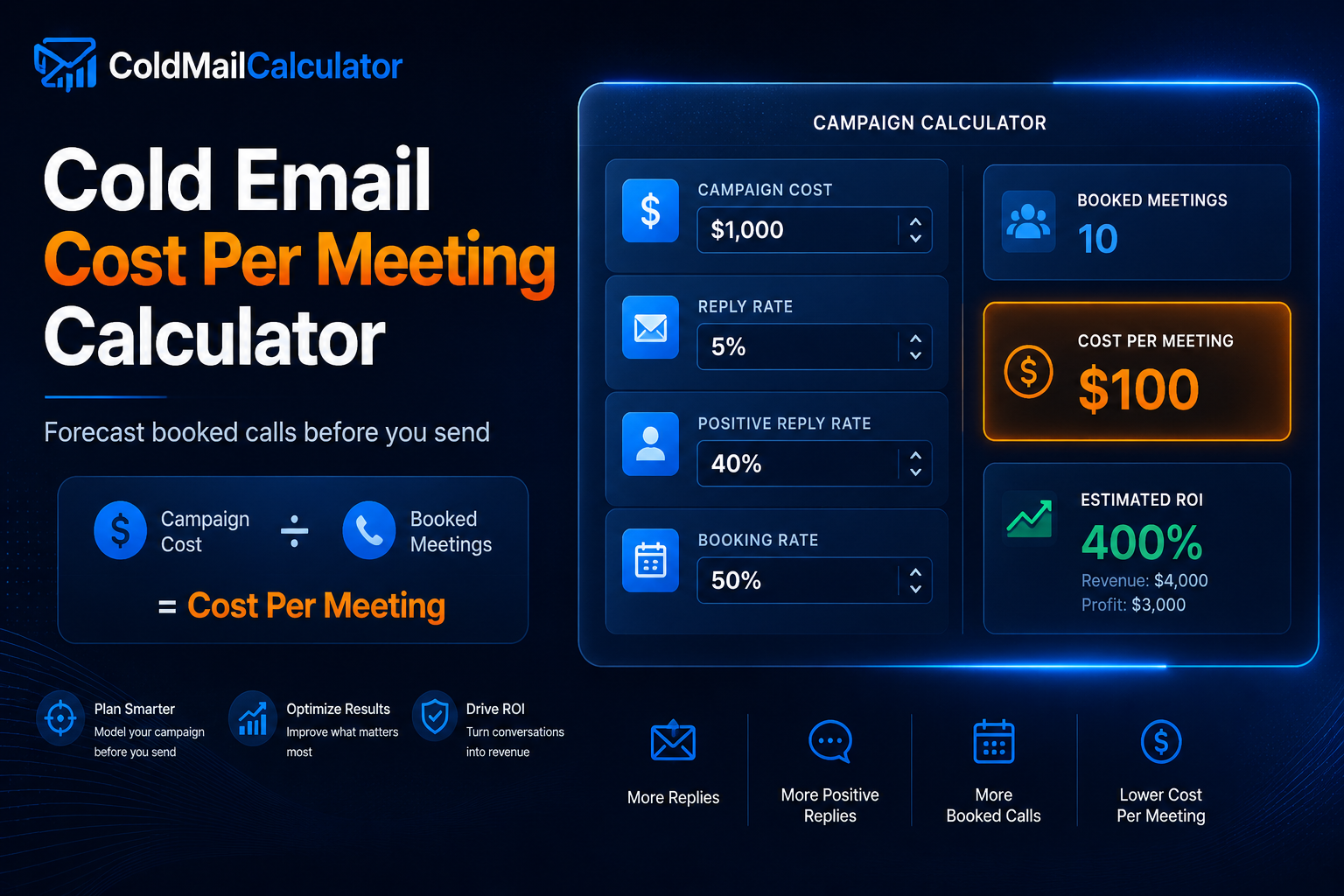
Cold email cost per meeting is calculated by dividing your total campaign cost by the number of booked meetings.
Formula: Cost per meeting = Total campaign cost ÷ Booked meetings
For example, if you spend $1,000 on a campaign and book 10 meetings, your cost per meeting is $100. The number only becomes useful when you compare it against your close rate, average deal value, and expected profit.
Cost per meeting is a forecast, not a guarantee. Your actual results will depend on campaign quality, audience fit, offer relevance, and execution.
What Is Cold Email Cost Per Meeting?
Cold email cost per meeting is the amount of money it takes to generate one booked call through cold email.
It includes the costs required to run the campaign, such as:
- List building
- Email infrastructure
- Sending tools
- Copywriting
- Personalization
- Agency or freelancer fees
- Internal team time
- Data enrichment
- Deliverability tools
Some teams only count direct software and service costs. Others include labor cost as well. Both approaches can work, but you should be consistent. If you include labor cost in one campaign, include it in future campaigns too.
Cold Email Cost Per Meeting Formula
The basic formula is simple:
Cost per meeting = Campaign cost ÷ Booked meetings
Here is a simple example:
| Campaign input | Example value |
|---|---|
| Total campaign cost | $1,500 |
| Booked meetings | 15 |
| Cost per meeting | $100 |
In this example, every booked meeting costs $100 to generate. That does not automatically mean the campaign is good or bad. It depends on what happens after the meeting.
If your average client is worth $5,000 and your close rate is healthy, a $100 meeting may be attractive. If your average deal value is low or your close rate is weak, the same $100 meeting may be too expensive.
Why Cost Per Meeting Matters More Than Reply Rate Alone
Reply rate is useful, but it does not tell the full story.
A reply can be:
- Interested
- Not interested
- Out of office
- A referral
- A pricing objection
- A complaint
- A wrong-fit response
That is why cost per meeting is usually more useful than total reply rate. It measures how efficiently a campaign creates the thing most sales teams actually want: qualified conversations.
| Metric | What it tells you | Why it can be misleading |
|---|---|---|
| Open rate | Whether emails appear to be opened | Open tracking can be inflated or incomplete |
| Reply rate | Whether people respond | Not every reply is qualified or positive |
| Positive reply rate | Whether replies show interest | Still does not guarantee a meeting |
| Booked meeting rate | Whether interest turns into calls | Depends on CTA, offer, timing, and follow-up |
| Cost per meeting | How much each booked call costs | Needs close rate and deal value to judge ROI |
A campaign should not be judged by reply rate alone. It should be judged by the full funnel.
Example: Two Campaigns with the Same Cost
Here is why cost per meeting can change how you evaluate performance. Both campaigns cost $1,000.
| Scenario | Total replies | Positive replies | Booked meetings | Cost per meeting |
|---|---|---|---|---|
| Campaign A | 80 | 12 | 4 | $250 |
| Campaign B | 50 | 25 | 10 | $100 |
Campaign A has more total replies, but Campaign B has a better cost per meeting. That can happen when Campaign B has:
- Better targeting
- Stronger offer relevance
- Better personalization
- A clearer call to action
- Better follow-up
- A more qualified prospect list
The lesson: more replies do not always mean better economics.
What Costs Should You Include?
Your cost per meeting calculation is only useful if the campaign cost is realistic.
| Cost category | Examples | Include it? |
|---|---|---|
| Data/list cost | Prospect lists, enrichment, verification | Yes |
| Email infrastructure | Domains, inboxes, warmup, sending tools | Yes |
| Software | Sequencing tools, CRM, enrichment tools | Yes, if campaign-specific |
| Copywriting | Offer writing, personalization, testing | Yes |
| Agency or freelancer | Setup fee, monthly retainer, campaign management | Yes |
| Internal labor | Team time, research, manual personalization | Optional, but recommended for full ROI |
For a quick estimate, you can start with direct campaign costs. For a more accurate forecast, include labor and management time.
How to Forecast Cost Per Meeting Before Sending
You do not need to wait until the campaign is finished to estimate cost per meeting. You can forecast it with a simple funnel:
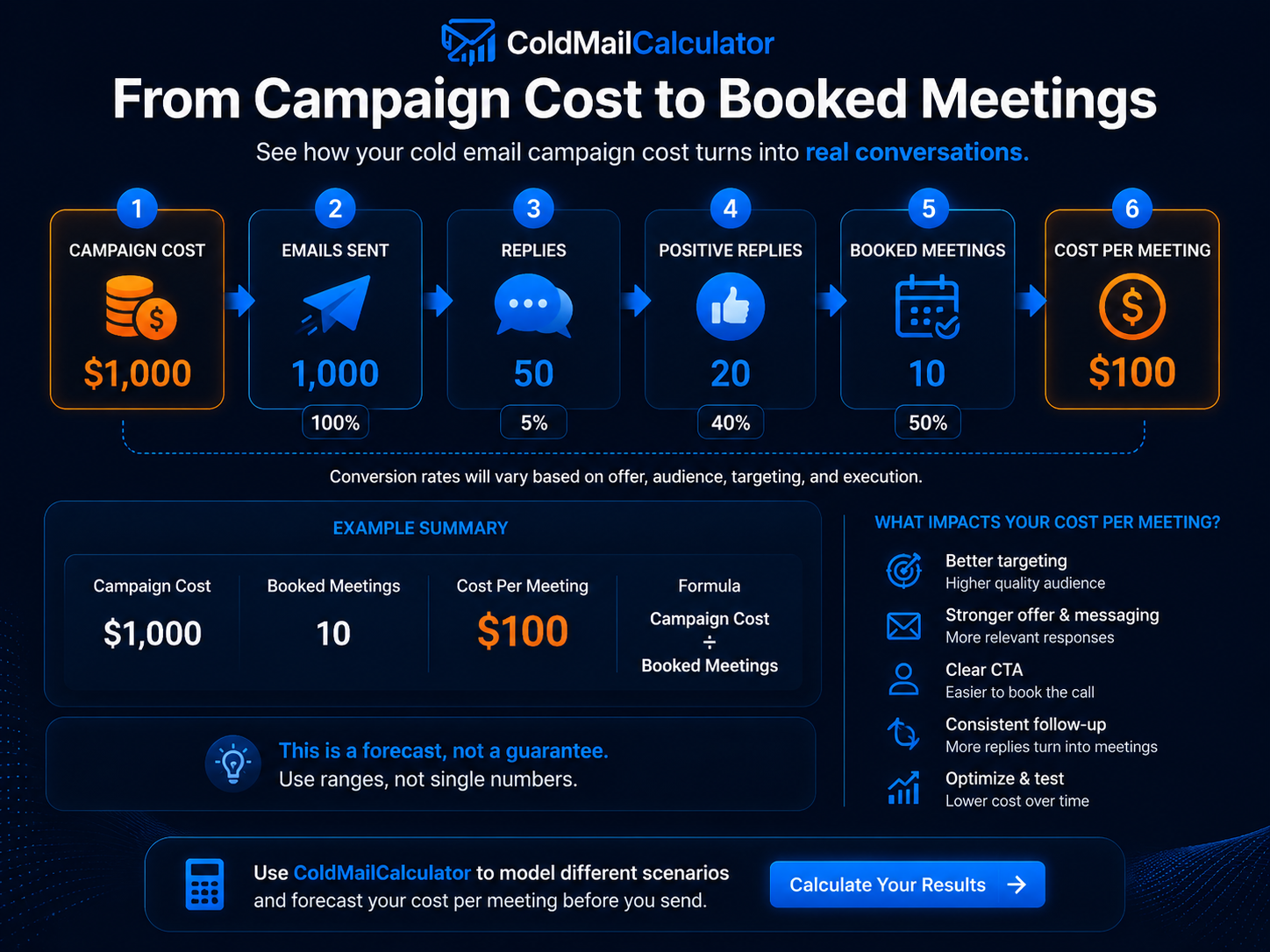
- Emails sent
- Delivery rate
- Reply rate
- Positive reply rate
- Booking rate
- Booked meetings
- Campaign cost
- Cost per meeting
Example:
| Forecast input | Example value |
|---|---|
| Emails sent | 1,000 |
| Reply rate | 5% |
| Positive reply rate | 40% |
| Booking rate | 50% |
| Total campaign cost | $1,000 |
| Estimated booked meetings | 10 |
| Estimated cost per meeting | $100 |
This is a forecast, not a promise. The value is that you can model low, base, and high scenarios before spending money on the campaign.
How Cost Per Meeting Connects to ROI
Cost per meeting is not the final metric. It is one step in the economics. To understand ROI, you also need close rate, average deal value, gross margin, campaign cost, and expected number of clients.
| Metric | Example |
|---|---|
| Booked meetings | 10 |
| Close rate | 20% |
| Estimated clients | 2 |
| Average deal value | $3,000 |
| Estimated revenue | $6,000 |
| Campaign cost | $1,000 |
| Estimated profit before delivery costs | $5,000 |
This is why a campaign with a higher cost per meeting can still work if the close rate and deal value are strong. A $300 meeting can be profitable for a high-ticket B2B offer. A $30 meeting can still be too expensive if the offer has low margin or poor close rates.
How to Lower Cold Email Cost Per Meeting
There are two ways to lower cost per meeting:
- Reduce campaign cost
- Increase the number of qualified booked meetings
The second option is usually more important.
Ways to improve cost per meeting:
- Narrow your ICP
- Use cleaner prospect data
- Improve your offer relevance
- Personalize the first line or business reason
- Use clearer subject lines
- Make the CTA easier to answer
- Follow up consistently
- Improve reply handling speed
- Test stronger landing pages or booking flows
- Remove poor-fit segments
Do not focus only on sending more emails. More volume can increase costs without improving meeting quality.
Common Mistakes When Calculating Cost Per Meeting
Mistake 1: Counting All Replies as Wins
A reply is not the same as a qualified opportunity. Track total replies, but pay closer attention to positive replies and booked meetings.
Mistake 2: Ignoring Labor Cost
If your team spends hours researching, writing, sending, and following up, that time has a cost. You can exclude labor for a simple calculation, but include it when comparing cold email against paid ads, agencies, or other acquisition channels.
Mistake 3: Judging Campaigns Too Early
Small sample sizes can be misleading. A campaign with only a few hundred sends may not give you enough signal. Use early results as directional, then update your forecast as more data comes in.
Mistake 4: Not Connecting Meetings to Revenue
A low cost per meeting is not enough. If the meetings do not become customers, the campaign still may not work.
When Is Cost Per Meeting Good?
There is no universal good cost per meeting. It depends on:
- Your average deal value
- Your close rate
- Your gross margin
- Your sales cycle
- Your fulfillment cost
- Your campaign goal
- Whether the meetings are qualified
A good cost per meeting is one that allows the campaign to create profitable customers. Instead of asking, "Is $100 per meeting good?" ask: "If we book meetings at this cost, and close a realistic percentage of them, does the campaign still make money?"
Forecast Your Cold Email Cost Per Meeting Before You Send
Use ColdMailCalculator to estimate replies, positive replies, booked calls, clients, revenue, profit, ROI, and cost per meeting.
Use Free CalculatorFAQ
How do you calculate cold email cost per meeting?
Divide total campaign cost by the number of booked meetings. For example, $1,000 campaign cost ÷ 10 booked meetings = $100 per meeting.
What is a good cold email cost per meeting?
It depends on your close rate, average deal value, and margin. A $100 meeting may be profitable for a $5,000 deal but too expensive for a $500 deal.
What costs should I include in cost per meeting?
Include list building, infrastructure, tools, copywriting, personalization, agency fees, and labor. Be consistent across campaigns.
How is cost per meeting different from cost per lead?
Cost per lead tracks how much you spend to get a qualified prospect. Cost per meeting tracks how much you spend to get a booked sales call.
Can I forecast cost per meeting before launching?
Yes. Use estimated reply rate, positive reply rate, booking rate, and campaign cost to model low, base, and high scenarios before you send.