Cold Email Spam Words to Avoid in 2026
Spam words do not automatically send every cold email to spam, but they can make a weak message look more promotional, deceptive, or complaint-worthy.
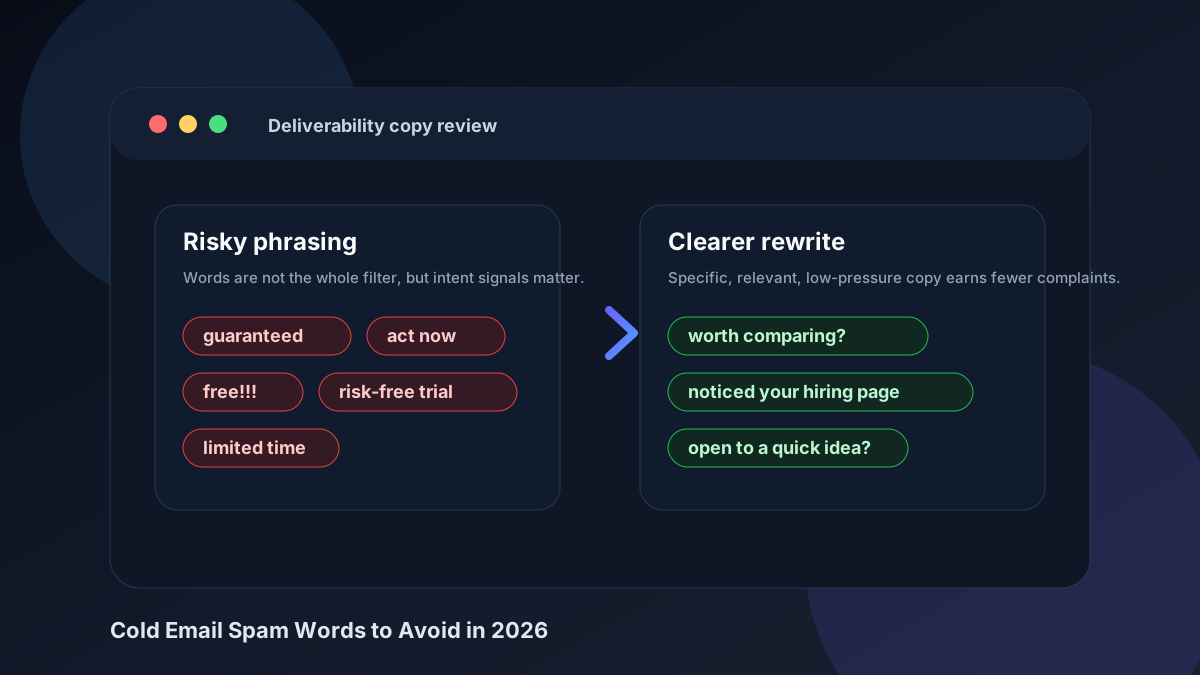
Short answer
The cold email spam words to avoid in 2026 are words that make your message feel exaggerated, urgent, misleading, or mass-promotional. The biggest risks are phrases like guaranteed, free, act now, no risk, limited time, make money, winner, urgent, and excessive punctuation.
The fix is not swapping one word at a time. Rewrite the email so it is specific, relevant, easy to ignore, and honest about why you are reaching out.
Modern inbox placement depends on sender reputation, authentication, engagement, complaints, content, links, and volume patterns. Spam words are one signal inside a bigger deliverability picture.
If a cold email sounds like a blast, people treat it like a blast. That creates lower replies, more deletes, and more spam complaints. In 2026, the safer approach is to write cold email copy that sounds like a specific business note from a real person.
Google's sender guidance tells senders to keep reported spam rates low, authenticate mail, and make unsubscribing easy for relevant traffic. Yahoo's anti-spam policy also emphasizes clear sender identity, honest subject lines, and valid contact information. In other words: the language problem is really a trust problem.
Why spam words still matter
Spam filters do not rely on one banned word list. They evaluate patterns. A single use of the word free may not be fatal, but a subject line with free, guaranteed, urgent, and three exclamation points can look risky when paired with a new domain, low engagement, or a broad list.
Spammy wording hurts cold email in three ways:
- It creates a promotional tone before the reader understands relevance.
- It can increase deletes, ignores, unsubscribes, and spam complaints.
- It makes your campaign assumptions weaker because fewer delivered emails turn into qualified replies.
That last point matters for forecasting. If spammy language drops reply rate from 3% to 1%, the same campaign may need three times more delivered emails to create the same number of replies.
Cold email spam words and phrases to avoid
Use this table as a copy review checklist. The goal is not to panic over every word. The goal is to spot phrases that make a legitimate outreach email feel generic or manipulative.
| Risky phrase type | Examples to avoid | Why it can hurt | Cleaner rewrite |
|---|---|---|---|
| Guarantees | Guaranteed, 100% success, risk-free, no fail | Sounds exaggerated and hard to believe | Use specific evidence or a modest claim |
| Pressure | Act now, urgent, limited time, final chance | Creates false urgency in a cold relationship | Ask a calm, low-pressure question |
| Money claims | Make money, double revenue, passive income, cash bonus | Looks like consumer promotion or financial spam | Describe the business outcome and context |
| Free hooks | Free!!!, free gift, free access, no cost | Can look like mass marketing when overused | Explain the concrete reason the resource is useful |
| Winner language | You won, selected, exclusive offer, congratulations | Often resembles sweepstakes or scam copy | State why the prospect is relevant |
| Over-formatting | ALL CAPS, multiple exclamation points, heavy symbols | Makes a normal business email feel automated | Use plain sentence case and one clear CTA |
Subject line spam words to watch
The subject line has less room to recover from a bad impression. Avoid subject lines that oversell, hide the purpose, or pretend to be part of an existing conversation.
| Risky subject line | Why it is risky | Better direction |
|---|---|---|
| Urgent: quick question!!! | False urgency plus excessive punctuation | Question about {{specific workflow}} |
| Guaranteed leads for {{company}} | Unsupported promise | Idea for {{company}} outbound |
| Free growth audit | Generic promotional hook | Noticed {{specific signal}} |
| Re: our meeting | Misleading if there was no meeting | Worth comparing notes? |
A good cold email subject line is clear enough to earn the open and honest enough to avoid disappointment when the prospect reads the body.
Rewrite spammy cold email copy
Here is a simple before-and-after pattern.
| Spammy version | Clearer version |
|---|---|
| We guarantee 10x more meetings with our risk-free system. Act now to claim a free audit. | I noticed {{company}} is hiring SDRs. We help teams forecast whether a new outbound motion can pay back before they add volume. Worth sending over a 2-minute benchmark? |
| Limited-time offer to double your pipeline with zero risk. | Saw {{specific trigger}} and thought this might be timely. We help {{ICP}} find the reply-rate and booking-rate assumptions needed for outbound to make sense. |
The better version is still direct. It just removes fake certainty, vague urgency, and salesy language. It gives the prospect a reason to understand the email before deciding whether to reply.
What matters more than individual spam words
Spam words are easy to audit, but they are not the whole deliverability system. Before sending volume, review the bigger signals:
- Authenticate the sending domain with SPF, DKIM, and DMARC.
- Use a clean, relevant list and avoid stale or scraped contacts.
- Send from a real identity with a clear reason for outreach.
- Keep volume conservative when a domain or campaign is new.
- Make opt-out language easy to understand where appropriate.
- Track replies, positive replies, bounces, unsubscribes, and spam complaints.
Google's public guidance says senders should keep spam rates reported in Postmaster Tools below 0.10% and avoid reaching 0.30% or higher. That is a useful planning reminder: one irritated audience can damage a campaign faster than one imperfect word.
How spammy wording affects ROI
Cold email language affects the whole funnel. If the copy creates complaints or suppresses replies, the economics get worse even when the offer is strong.
| Scenario | Delivered emails | Reply rate | Positive reply rate | Positive replies |
|---|---|---|---|---|
| Clear, relevant copy | 2,000 | 4% | 35% | 28 |
| Spammy, generic copy | 2,000 | 1.5% | 20% | 6 |
In this example, the campaign with clearer copy creates more than four times as many positive replies from the same delivered volume. That difference flows into booked meetings, clients, revenue, and cost per meeting.
Pre-send spam word checklist
Before launching a cold email campaign, read the message out loud and check for these patterns:
- Does the email make a promise you cannot prove?
- Does the subject line create false urgency?
- Would the email still make sense without the prospect's name merge field?
- Is the CTA low pressure and easy to answer?
- Is there a clear business reason for contacting this person?
- Does the copy sound like something a real person would send one-to-one?
If the answer is no, rewrite for clarity before you send more volume.
Forecast the cost of weak replies
Use ColdMailCalculator to see how reply rate, positive reply rate, and meeting booking rate change campaign ROI before you launch.
Use the ColdMailCalculatorSources and further reading
For current sender requirements and anti-spam guidance, review Google's email sender guidelines, Google's sender guidelines FAQ, and Yahoo's anti-spam policy terms.