Cold Email Reply Rate Benchmarks 2026: What Counts as Good?
Quick answer
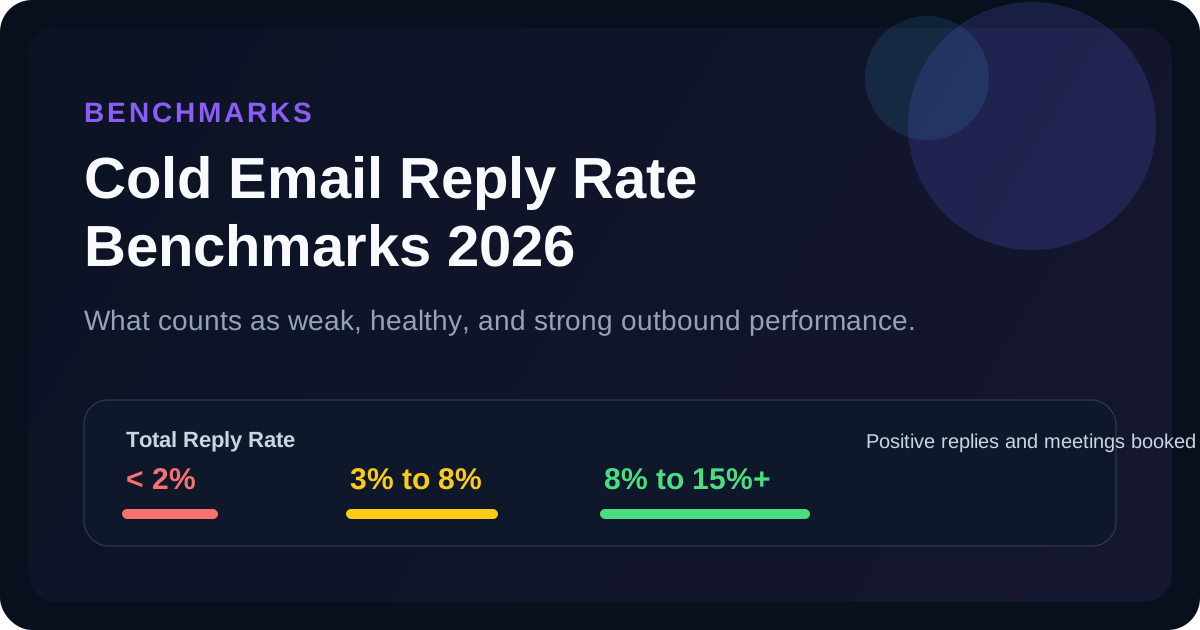
- Below 2% total reply rate usually means something is broken.
- A healthy range for many outbound campaigns is 3% to 8%.
- Strong campaigns with sharp targeting and personalization can reach 8% to 15%+.
- Open rate alone is not enough. Track total reply rate, positive reply rate, and meetings booked.
The keyword cold email reply rate benchmarks keeps showing up because founders and SDR teams want a simple answer: is this campaign working or not? In practice, the answer depends on list quality, offer strength, sender reputation, and how personalized the email really is.
Still, benchmark ranges are useful because they tell you where to investigate first. If your reply rate is weak, the fix is usually not “send more volume.” It is usually one of three things: bad targeting, generic messaging, or deliverability damage. If deliverability is the likely problem, start with the cold email deliverability checklist before rewriting everything.
2026 cold email reply rate benchmarks
| Metric | Needs work | Healthy | Strong |
|---|---|---|---|
| Total reply rate | < 2% | 3% to 8% | 8% to 15%+ |
| Positive reply rate | < 1% | 1% to 3% | 3% to 6%+ |
| Meeting booked rate | < 0.5% | 0.5% to 2% | 2% to 4%+ |
Those numbers line up with the 2026 SERP landscape around outbound benchmarks: most current ranking pages cluster around 2% to 5% as normal, with higher results only when the list is tight and the copy is highly relevant. That means a campaign at 1% is rarely “just average.” It is usually underperforming.
Why reply rate matters more than open rate
Open rate has become noisy. Apple Mail Privacy Protection, bot activity, and mailbox-provider image prefetching distort it. Reply rate is still imperfect, but it is much closer to real buyer interest. That is also why articles like sales outreach subject lines should support, not replace, funnel-level measurement.
If 1,000 emails show a 55% open rate but only a 1% reply rate, you do not have a subject line win. You have a message problem. The top of the funnel is fine; the body copy or CTA is failing.
Rule of thumb: use open rate to detect deliverability problems, and use reply rate to judge whether the campaign is commercially working.
What changes your benchmark range
1. Targeting quality
A list of 150 accounts with a real pain point will usually beat a purchased list of 10,000. The tighter the ICP, the less “benchmark” matters and the more relevance takes over.
2. Personalization depth
First-name merge tags do not count as personalization anymore. The campaigns that outperform usually reference a real trigger such as new hiring, product launches, funding, tech-stack gaps, or a public initiative.
3. Deliverability
Even great copy cannot recover a weak domain. If your spam complaint rate rises or your authentication is off, your benchmark collapses fast. That is why deliverability and reply rate should always be reviewed together. If you are also unsure about scale, pair this with daily cold email send-volume guidance.
4. CTA friction
Asking for a 30-minute meeting in the first email usually depresses replies. Low-friction CTAs such as “worth exploring?” or “open to a quick teardown?” tend to outperform harder asks.
How to improve a low reply rate
- Cut list size before you increase send volume.
- Rewrite the first line around a specific observation, not generic praise.
- Reduce the CTA to a yes/no or lightweight question.
- Check bounce rate, spam complaints, and authentication before rewriting the whole sequence.
- Measure positive replies separately from total replies.
Use your own numbers, not generic averages
Benchmarks are a starting point. Your real goal is to understand your own funnel math. A founder selling a high-ticket service can win with fewer total replies than a lead-gen agency running broad outbound. What matters is how many replies become opportunities.
If you want to see the real impact of moving from a 2% reply rate to a 6% reply rate, run the numbers through the ColdMailCalculator. That gives you the actual conversation gap, not just a vanity percentage.
Check your benchmark against your funnel
Plug in your send volume, open rate, and reply rate to see whether your current campaign is leaving pipeline on the table.
Use the CalculatorBuilding a cold email tool or agency dashboard?
Use the ColdMail API to forecast replies, meetings, clients, revenue, and ROI from campaign assumptions.
Explore the ColdMail APIFAQ
What is a good cold email reply rate in 2026?
For many campaigns, 3% to 8% is a solid working range. Strong, highly relevant campaigns can do better.
What is the difference between reply rate and positive reply rate?
Reply rate includes all responses, including objections and opt-outs. Positive reply rate counts only useful buying responses.
Can a high open rate still mean the campaign is bad?
Yes. If people open but do not reply, your body copy, offer, CTA, or targeting is weak.