Cold Email Cost Per Lead: How to Calculate CPL from Outreach Campaigns
Cold email cost per lead helps you understand whether your outreach is producing leads at a sustainable cost. Reply rate alone is not enough — a campaign can get replies but still have poor economics if those replies do not turn into qualified opportunities. Cost per lead connects how much you spend to how many relevant prospects you create.
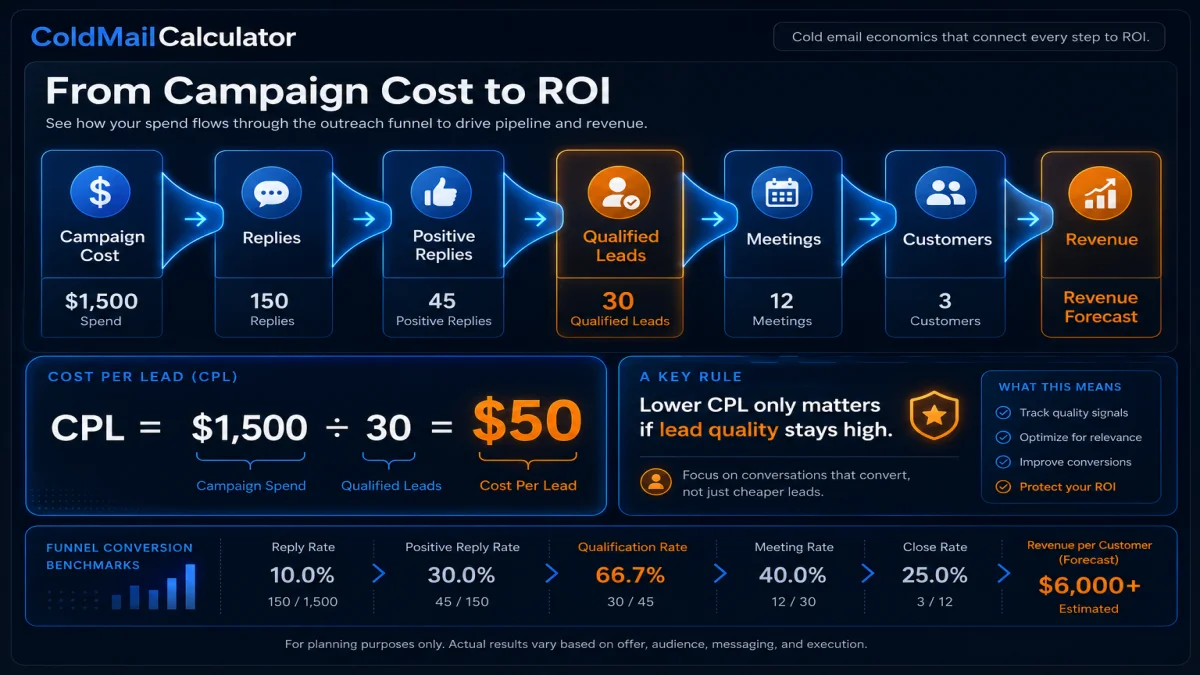
Best Answer: How Do You Calculate Cold Email Cost Per Lead?
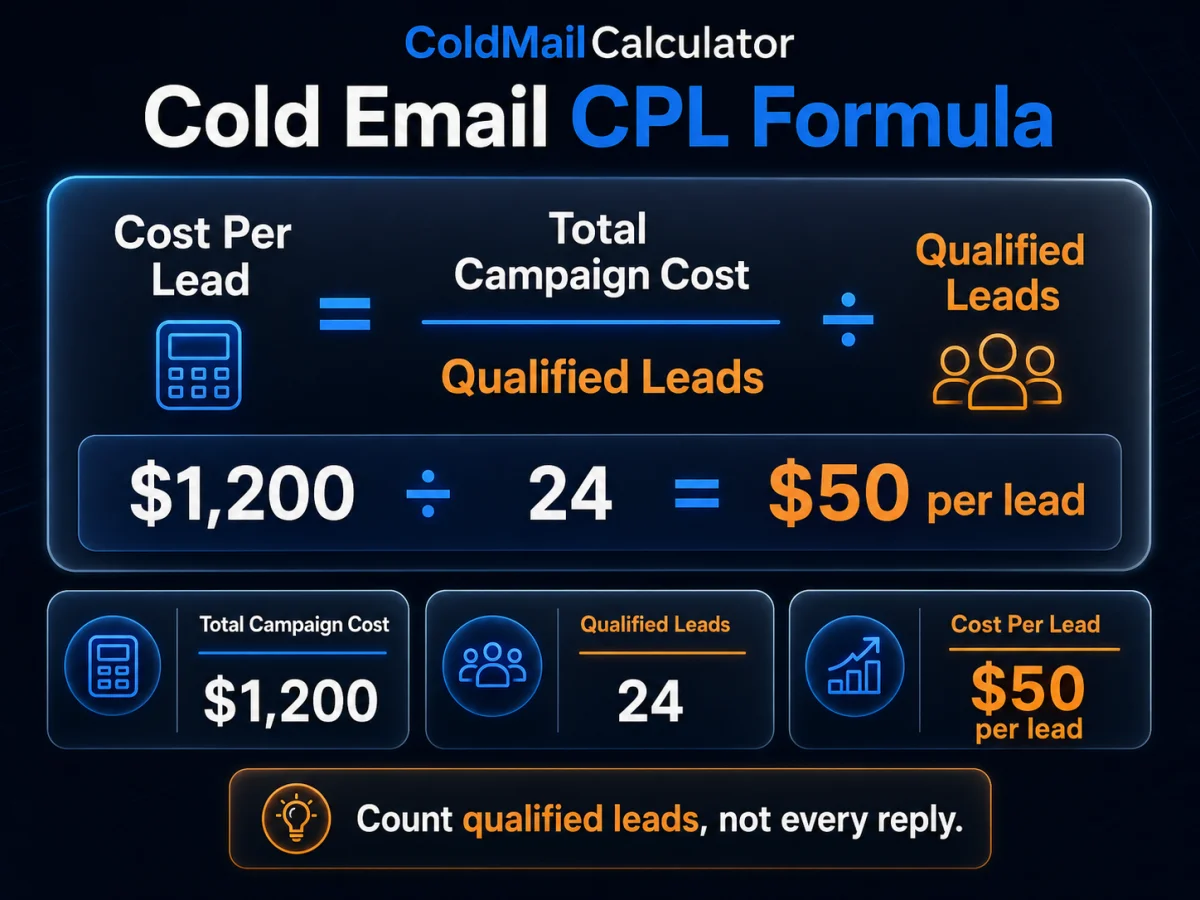
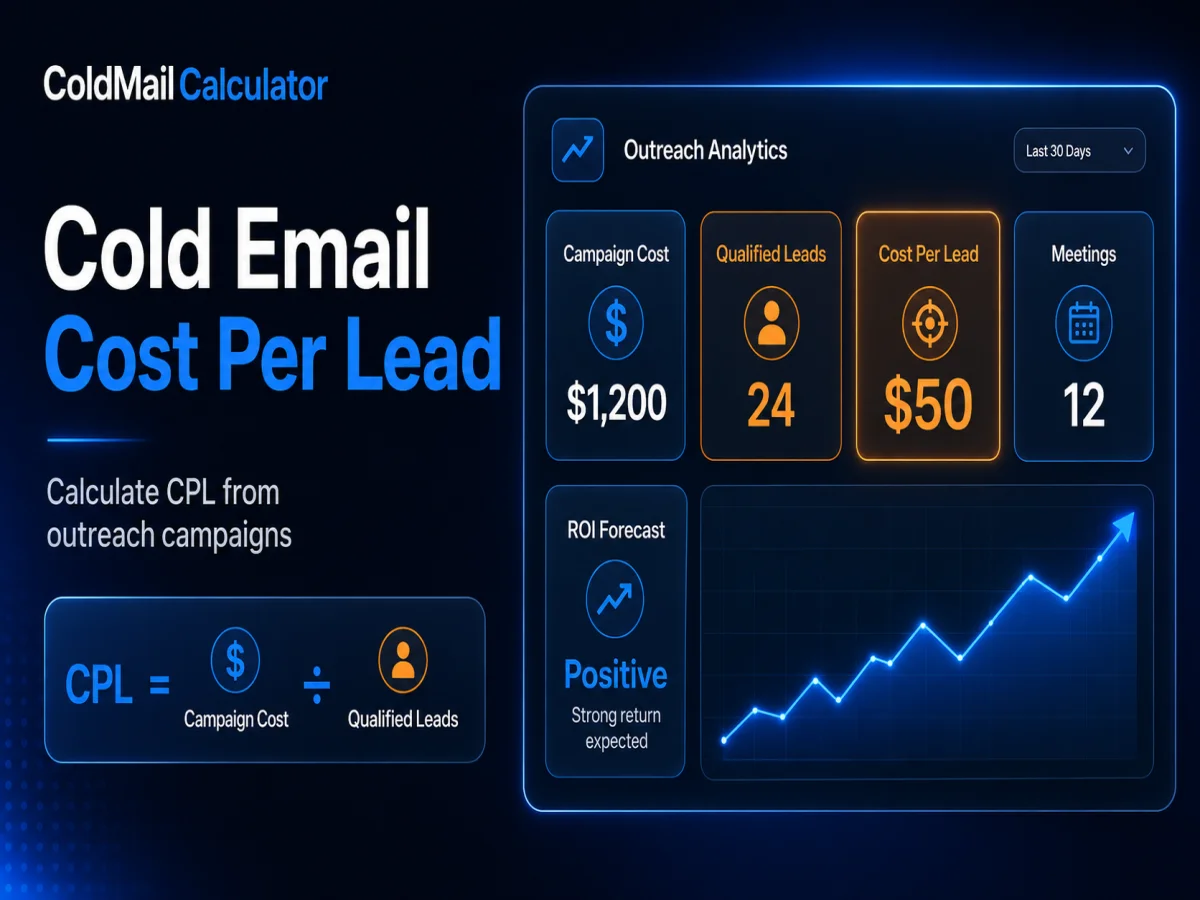
Cold Email Cost Per Lead = Total Campaign Cost ÷ Qualified Leads
A qualified lead is not just any reply. It should be a person who matches your target market and shows relevant interest. If a campaign costs $1,200 and creates 24 qualified leads, your cost per lead is $50.
- Include all campaign costs: data, infrastructure, tools, copywriting, and labor
- Count only qualified leads, not all replies
- Compare CPL to deal value and close rate to judge campaign health
Cost per lead is a planning estimate, not a guarantee. Actual results depend on campaign quality, audience fit, offer relevance, and execution.
What Is Cold Email Cost Per Lead?
Cold email cost per lead (CPL) is the amount of money required to generate one qualified prospect through a cold email campaign. It answers the question: how much do we spend to find someone who might buy?
CPL is different from cost per reply. A reply is any response to your email. A qualified lead is a response from someone who fits your ideal customer profile and has expressed relevant interest. The distinction matters because not all replies are worth the same.
Understanding CPL helps you decide whether your campaign is producing leads at a cost that makes sense for your business. If each lead costs $100 and your average deal is $2,000 with a 20% close rate, your cost of acquisition through cold email is $500 per customer. That may be sustainable. If your CPL is $100 but your close rate is 5% and your deal value is $500, the math does not work.
Cold email CPL is one input in a broader economic picture. The other inputs include reply rate, positive reply rate, meeting booking rate, close rate, average deal value, and campaign cost.
Why Reply Rate Alone Is Not Enough
Many campaign reports focus on reply rate as the primary success metric. Reply rate is useful for measuring message relevance, but it does not tell you whether a campaign is economically viable.
A campaign with a 10% reply rate can still be expensive if most replies are unqualified. A campaign with a 3% reply rate can be efficient if the replies are highly relevant and convert at a strong rate.
Consider two campaigns with identical costs:
- Campaign A: 8% reply rate, 20% positive reply rate — generates many replies but few qualified leads
- Campaign B: 4% reply rate, 60% positive reply rate — generates fewer total replies but more qualified leads
Campaign B likely has a lower cost per qualified lead even though its total reply rate is half of Campaign A. If you only looked at reply rate, you would misjudge which campaign is more efficient.
That is why metrics like positive reply rate and cost per lead give you a clearer picture than total reply rate alone.
Cold Email Cost Per Lead Formula
The formula is straightforward:
Cost Per Lead = Total Campaign Cost ÷ Qualified Leads
What goes into total campaign cost? A complete calculation includes:
- Lead list or data cost — purchasing or building prospect lists
- Email verification — verifying addresses before sending
- Sending domains and inboxes — domain registration, inbox setup, warmup tools
- Sending platform — sequencing software, CRM, or outreach tool
- Copywriting and strategy — writing offers, subject lines, personalization
- Agency fees or labor — agency retainers, freelancer costs, or internal team time
- Enrichment tools — data enrichment, research, firmographic data
- Deliverability monitoring — tools that track inbox placement and spam complaints
You can start with direct costs and add labor later. The important thing is to be consistent across campaigns so you can compare CPL over time.
Example Cold Email CPL Calculation
Here is a worked example using realistic campaign assumptions:
| Campaign input | Value |
|---|---|
| Campaign cost | $1,500 |
| Emails sent | 5,000 |
| Reply rate | 3% |
| Total replies | 150 |
| Positive reply rate (of replies) | 30% |
| Qualified leads (positive replies) | 45 |
| Cost per lead | $33.33 |
In this example, each qualified lead costs $33.33 to generate. Now consider what happens if only 20 of those 45 positive replies are sales-qualified after further review. Your cost per lead jumps to $75. That is why defining a qualified lead clearly matters.
You can model this calculation before sending using the ColdMailCalculator. Enter your expected campaign cost, email volume, reply rate, and positive reply rate to see estimated leads, meetings, clients, and ROI before you spend money.
Cost Per Lead vs Cost Per Reply vs Cost Per Meeting
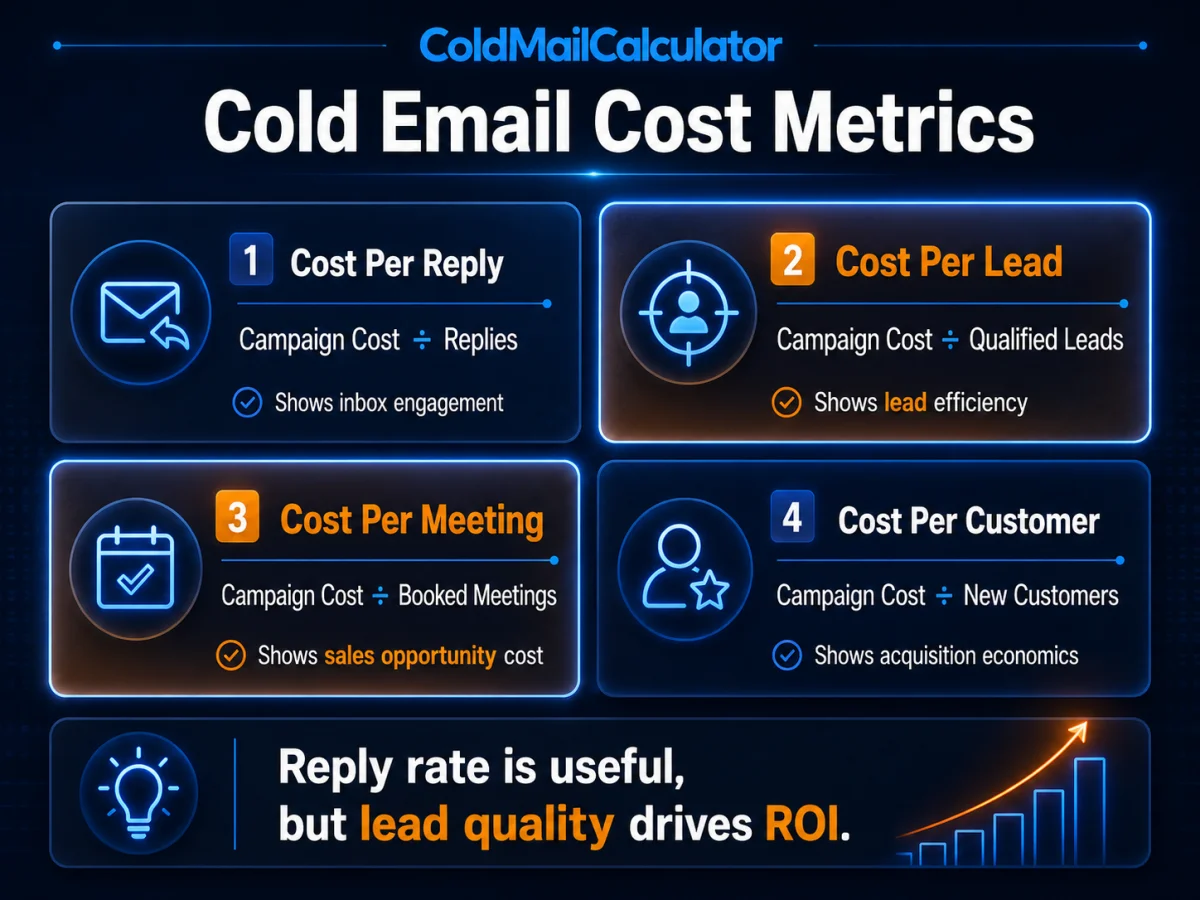
These three metrics serve different purposes. Here is how they compare:
| Metric | Formula | What it tells you | Limitation |
|---|---|---|---|
| Cost per reply | Campaign cost ÷ Replies | How much each response costs | Includes unqualified, OOO, and negative replies |
| Cost per positive reply | Campaign cost ÷ Positive replies | Cost per interested response | Interest does not guarantee a meeting |
| Cost per qualified lead | Campaign cost ÷ Qualified leads | Cost per ICP-matched, interested prospect | Depends on consistent qualification criteria |
| Cost per booked meeting | Campaign cost ÷ Booked meetings | Cost per scheduled sales conversation | Needs close rate to evaluate ROI |
| Cost per customer | Campaign cost ÷ Customers | True customer acquisition cost | Long sales cycles can delay this metric |
Cost per lead sits between cost per reply and cost per meeting. It is more useful than cost per reply because it filters out noise. It is less complete than cost per meeting because it does not account for the full sales process. Most teams should track both CPL and cost per meeting.
Use the Cost Per Meeting Calculator to see how your lead costs translate into booked meetings.
What Is a Good Cold Email Cost Per Lead?
There is no universal number. A good CPL depends on several factors:
- Average customer value — higher deal values can support higher CPL
- Gross margin — thin margins need lower CPL
- Close rate — low close rates mean you need more leads per customer, raising acceptable CPL pressure
- Sales cycle — longer cycles may require more investment per lead
- Lead quality — higher quality leads are worth more
- Market difficulty — niche audiences cost more to reach
- Campaign costs — your specific cost structure
As a planning range, here is how CPL typically relates to deal value:
- Low-ticket offers (under $500 deal value) need very low CPL — often under $10
- Mid-market B2B ($1,000–$5,000 deal value) CPL of $30–$80 can work depending on close rate
- High-ticket B2B ($10,000+ deal value) can tolerate CPL of $100–$300+
- Agencies should judge CPL alongside cost per meeting and cost per client
Instead of asking whether your CPL is good in isolation, ask: if we generate leads at this cost, and close a realistic percentage of them, does the campaign still produce profitable customers?
How to Lower Cold Email Cost Per Lead
Lowering CPL usually means improving the quality of your leads, reducing campaign costs, or both.
- Improve targeting — a narrower ICP produces higher reply quality
- Clean and verify your list — remove invalid addresses and poor-fit contacts before sending
- Write clearer offers — if prospects do not understand what you do and why it matters, they will not engage
- Personalize where it matters — research-driven personalization increases relevance more than token-level personalization
- Track positive replies separately from all replies — this helps you focus on what works
- Improve your landing page or booking path — if interested prospects cannot easily book a meeting, you lose leads
- Test subject lines without chasing opens only — subject lines that increase reply quality matter more than open rate
- Reduce wasted sending volume — sending to poorly matched contacts increases cost without producing leads
- Improve your follow-up sequence — a well-timed follow-up can convert a cold reply into a qualified lead
- Segment by industry or persona — tailored messaging outperforms generic outreach
How Agencies Should Report Cold Email CPL
If you run a cold email agency, the way you report cost per lead matters for client trust and campaign improvement. Avoid reporting only volume metrics like emails sent or total replies.
Instead, share a clear view of campaign economics:
- Campaign spend (all-in cost)
- Total replies
- Positive replies
- Qualified leads
- Booked meetings
- Cost per lead
- Cost per meeting
- Estimated pipeline or revenue (if available)
Reporting CPL alongside cost per meeting gives clients a realistic view of campaign health. It also helps agencies identify which parts of the funnel need attention. If CPL is reasonable but cost per meeting is high, the issue may be in the booking process rather than the email copy or targeting.
For agency-specific forecasting, use the Cold Email ROI Calculator for Agencies to estimate replies, booked meetings, cost per meeting, cost per client, and ROI before presenting a campaign plan.
Use a Calculator Before Scaling
Before increasing send volume or launching a new campaign, model your expected economics. Forecasting ahead of time helps you avoid spending money on campaigns that cannot produce leads at a sustainable cost.
The ColdMailCalculator estimates replies, positive replies, booked meetings, clients, revenue, and ROI from your campaign assumptions. Enter your expected email volume, reply rate, positive reply rate, booking rate, close rate, deal value, and campaign cost to see whether your numbers work before you send.
If you are building a sales tool, agency dashboard, or CRM integration, the ColdMail API provides programmatic access to the same forecasting engine. Request API Access to start integrating.
Final Checklist
Before running your next cold email campaign, review this checklist to make sure you are measuring cost per lead correctly:
- Define what counts as a qualified lead for your business
- Include all campaign costs in your CPL calculation
- Separate total replies from positive replies
- Track booked meetings separately from leads
- Compare CPL to average deal value and close rate
- Review CPL by segment (industry, persona, campaign)
- Use forecasts before scaling send volume
FAQ
How do you calculate cold email cost per lead?
Divide total campaign cost by the number of qualified leads. For example, $1,500 campaign cost ÷ 45 qualified leads = $33.33 per lead.
What counts as a lead in cold email?
A qualified lead matches your target market and has shown relevant interest. Exclude out-of-office replies, wrong-fit responses, and negative replies.
Is cost per lead better than reply rate?
For campaign economics, yes. Reply rate shows engagement. CPL shows whether that engagement is worth the cost. Both are useful, but CPL connects more directly to ROI.
What is a good cost per lead for cold email?
It depends on deal value, close rate, margin, and sales cycle. A $50 CPL may be excellent for a $5,000 deal but too high for a $500 deal. Judge CPL relative to customer value.
Should agency fees be included in cold email CPL?
Yes. Include all costs: data, infrastructure, tools, copywriting, agency fees, and labor. A complete cost picture makes CPL more useful for decision-making.
How do you reduce cold email CPL?
Improve targeting, clean your list, write clearer offers, track positive replies, reduce wasted volume, improve follow-up, and segment by industry or persona.
Should I track cost per meeting too?
Yes. Cost per meeting measures booked calls rather than just interest. Tracking both CPL and cost per meeting gives you a fuller picture of campaign health.
Can I use ColdMailCalculator to estimate CPL?
Yes. The ColdMailCalculator estimates replies, positive replies, meetings, clients, revenue, and ROI. Use the Cost Per Lead Calculator to model CPL from your campaign assumptions.
Estimate Cold Email Leads Before You Send
Use the Cold Email Calculator to estimate replies, positive replies, meetings, clients, revenue, and ROI before scaling your next campaign.
Use the Cold Email CalculatorRequest API Access
Integrate cold email lead forecasting into your sales tool, agency dashboard, or CRM using the ColdMail API.
Request API Access